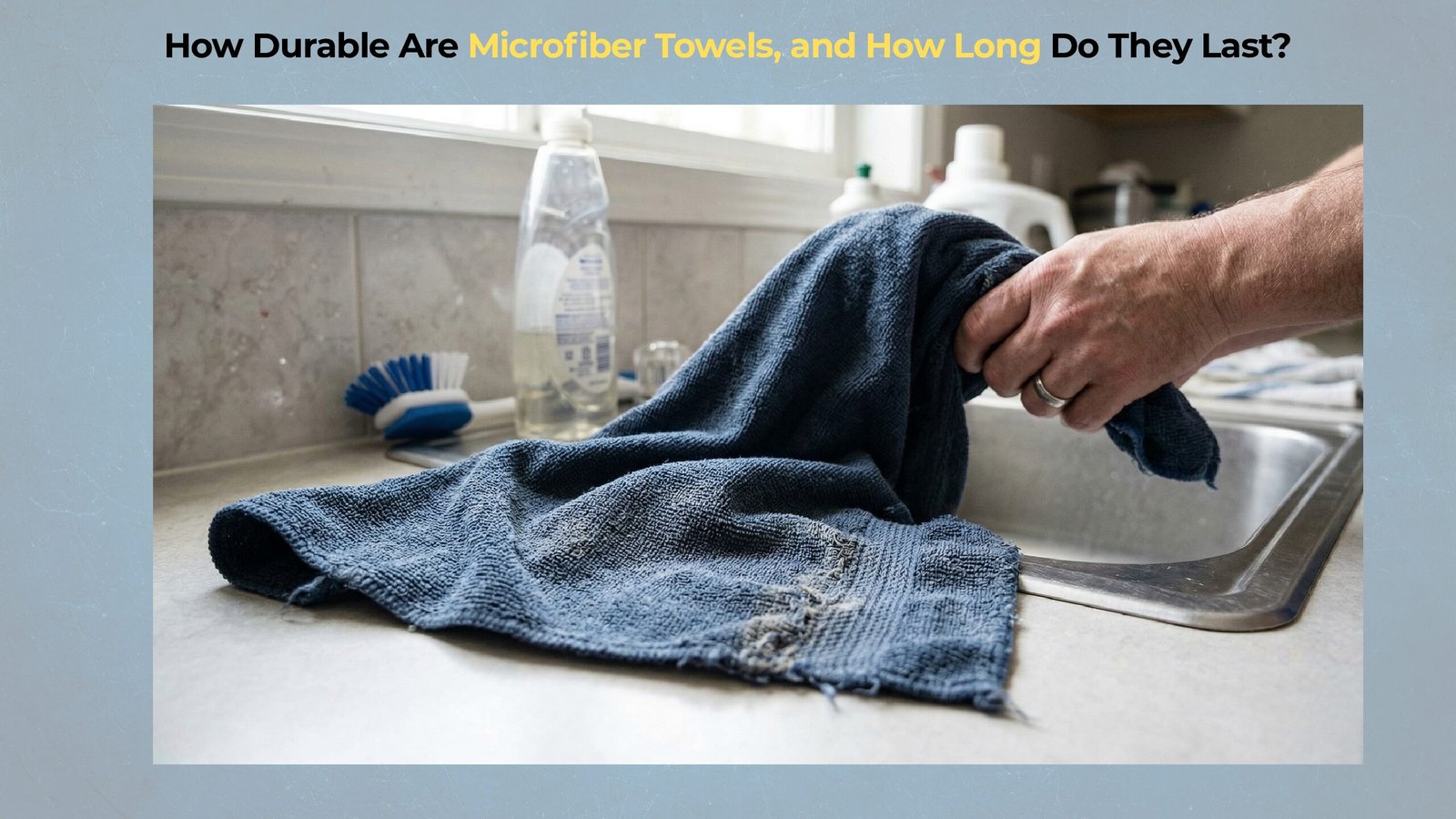
How Durable Are Microfiber Towels, and How Long Do They Last?
An architectural blueprint for synthetic textile longevity and lifecycle optimization.
High-performance microfiber towel durability typically allows synthetic textiles to sustain between 400 and 600 successful laundry cycles—often several times longer than carded cotton—because the continuous thermoplastic filaments resist the mechanical thinning and edge fraying common in natural fibers. In plain English, a high-quality microfiber towel is essentially an unbreakable plastic weave that lasts years instead of months. Evidence from textile science research published in industrial materials journals confirms that high-tenacity synthetic filaments provide a mechanical life significantly longer than carded cotton under controlled laundering conditions.
Why Is Microfiber More Durable Than Traditional Cotton?
Superior microfiber towel durability results from the use of continuous filaments that eliminate the “splice points” and short-staple ends that trigger the structural unraveling of traditional linens. While a cotton towel sheds mass with every wash (visible as dryer lint), a microfiber towel maintains its weight because the fibers don’t break off.
Because this article centers on wash-cycle lifespan and structural longevity, the most direct supporting next read is how to wash and dry microfiber towels correctly, since maintenance protocol is the main factor that determines whether durability benchmarks are actually achieved.
What Is the Industrial ROI of Microfiber Towel Durability?
Calculating the long-term value of microfiber towel durability requires a shift from unit price to a cost-per-wash metric, where high-cycle synthetics typically lower annual procurement overhead. High-quality microfiber often sustains 400+ launderings, resulting in a Cost-Per-Use (CPU) often 60% lower than utility-grade cotton that typically fails after 50 cycles.
How Does Mass Retention Preserve Textile Performance?
Sustained mass retention characterizes microfiber towel durability because the mechanical bond of the polymer filaments prevents the fiber breakage known as linting. Data documented by textile quality standards like ISO 6330 confirm that synthetic textiles exhibit significantly lower mass loss per cycle compared to cellulose fibers. Lint is the physical marker of a towel dying; the lack of lint in a microfiber dry-cycle signals that the textile’s absorbency and thickness remain structurally intact.
What Engineering Factors Drive Microfiber Towel Structural Integrity?
Specific engineering factors, primarily the molecular stability of polyester and the flexibility of polyamide, dictate the baseline of microfiber towel durability. To understand this, we look at Tensile Resilience—the ability of a fiber to withstand pulling forces and return to its original state without permanent deformation.
Why Does High Tensile Strength Support Synthetic Longevity?
Microfiber towel durability relies on high tensile strength where long-chain Polyethylene Terephthalate (PET) filaments withstand breaking loads that often exceed 50 lbs-force per industrial grab testing. Referencing ASTM D5034 grab testing protocols, we confirm that [Long-chain PET polymers] → [provide high breaking resistance] → [secure the structural integrity of microfiber towel durability]. High tensile strength allows the towel to survive the high-G extraction forces of commercial washing machines without tearing.
How Does Polyamide Prevent Fiber Brittleness?
The inclusion of Polyamide (Nylon) materially improves microfiber towel durability by adding mechanical flexibility to the rigid polyester core, preventing the fiber fatigue that leads to “crunchy” textures. An 80/20 or 70/30 blend represents the engineering “sweet spot,” providing enough Nylon to ensure the fibers bend rather than snap under high-RPM extraction. In simple terms: Polyester is the “armor” for strength, while Polyamide is the “joints” for flexibility.
What Are the Primary Failure Mechanisms for Microfiber Towels?
Identifying the primary failure mechanisms of microfiber towel durability allows users to avoid the specific thermal and chemical stressors that trigger terminal fiber collapse. “Baking” these towels in a hot dryer is the one thing that will kill them instantly.
Why Is Heat Fusion a Terminal Threat to Synthetic Fibers?
The most severe threat to microfiber towel durability is heat fusion, where temperatures exceeding the polymer’s glass transition threshold cause filaments to melt and bond together. Definition: Glass Transition Temperature ($T_g$) – The critical threshold (typically 60-70°C for PET) where the polymer shifts from a rigid to a rubbery, vulnerable state. Fused fibers create a “plasticized” surface that repels water; once fusion occurs, the towel is functionally decommissioned and cannot be restored.
How Does Detergent Clogging Cause Mechanical Strain?
Microfiber towel durability declines when surfactant residues act as a physical wedge within the split-fiber channels, creating internal pressure that eventually snaps the fine filaments. Textile engineering studies on “Surfactant Loading” confirm that residual soap salts materially increase fiber brittleness. [Detergent residue buildup] → [strains split-fiber channels] → [compromises the mechanical life of microfiber towel durability].
Once the guide explains that heat fusion and residue buildup shorten service life, a natural follow-up is how fast microfiber towels dry, because drying behavior directly affects how often users expose the fabric to damaging heat during routine care.
How to Compare the Service Life of Microfiber vs. Cotton?
Selecting the ideal inventory requires comparing the microfiber towel durability benchmarks against the natural lifecycle of cotton to identify the best fit for specific usage frequency.
| Metric | High-Quality Microfiber | Standard Polyester | Traditional Cotton |
|---|---|---|---|
| Wash Cycle Limit | 400–600 Cycles | 150–250 Cycles | 50–100 Cycles |
| Tensile Strength | Highest (> 50 lbf) | High | Moderate (< 35 lbf) |
| Shrinkage Risk | Near Zero | Zero | High (Up to 10%) |
| Thinning Rate | Extremely Low | Low | High (Mass loss) |
How to Convert Wash Cycles Into a Real-World Lifespan?
Translating technical wash data into a time-horizon helps users operationalize microfiber towel durability as a long-term household investment strategy. These projections are based on industrial wash-test data and home-use durability benchmarks.
| User Profile | Laundering Frequency | Est. Years of Peak Use |
|---|---|---|
| Active Athlete | Daily (365/yr) | 1.5 – 2 Years |
| Standard Home | Weekly (52/yr) | 8 – 10 Years |
| Guest / Travel | Monthly (12/yr) | 15+ Years |
Since long-term durability matters most when a towel is used for travel, gym, and repeated packing, readers would logically benefit from how compact and lightweight microfiber towels are, which shows why extended lifespan increases the value of these portable textiles.
Which Maintenance Steps Extend the Life of Your Microfiber Towels?
Extending microfiber towel durability requires a shift to technical laundering protocols that preserve the open wicking channels and protect the polymer’s molecular mass. If you stop using fabric softener and stop “cooking” your towels in the dryer, they will last twice as long.
Why Should You Avoid Fabric Softeners for Synthetic Longevity?
Fabric softeners directly neutralize microfiber towel durability by depositing a waxy silicone film that clogs the split-fiber wedges and fosters anaerobic bacterial growth. Softeners fill the “pockets” that make microfiber effective; this buildup increases internal friction during the spin cycle, accelerating fiber-shear. Mandatory: Exclude all liquid softeners and dryer sheets.
Because degraded fibers often lose hygiene performance before they fully fail mechanically, a strong lateral link is how microfiber towels retain odors, which helps readers understand one of the first practical signs that structural and care-related breakdown is already underway.
How Does Low-Heat Drying Preserve the Synthetic Weave?
Adhering to “Low Heat” or “Air Fluff” settings secures microfiber towel durability by keeping the mechanical drying temperature safely below the polymer’s fusion point. Reference ISO 3758 care symbols to ensure the mechanical life of the asset is maximized.
How Can You Fix Degraded Fibers to Restore Original Durability?
Restoring microfiber towel durability in aged inventory involves executing a chemical reset to dissolve the mineral buildup and detergent salts that cause fiber stiffening.
The Vinegar Reset Protocol:
- Load towels into a warm-water cycle.
- Add exactly one cup of white distilled vinegar to the drum.
- Run the cycle with NO detergent to exfoliate the synthetic weave.
- Dry on Low-Heat to realign the split-fiber loops.
Does Stripping Mineral Buildup Restore Fiber Flexibility?
Stiff or non-absorbent textiles recover their original microfiber towel durability baseline when a warm vinegar rinse dissolves the alkaline mineral films that “lock” the fibers. This exfoliation process returns the mechanical flexibility to the Polyamide core.
How to Verify the Logistical Integrity of Your Synthetic Linens?
Systematic technical audits of weave type and mechanical resilience verify the microfiber towel durability of current inventory to ensure it meets high-frequency requirements.
Checklist: Microfiber Towel Durability Audit
Material Audit: Does the label confirm an 80/20 or 70/30 blend for balanced flexibility?
Edge Reinforcement: Are the hems double-overlock stitched or heat-sealed to prevent fraying?
The “Sting Test”: Does the fiber surface resist “shedding” when a small section is pinched and pulled?
Thermal Check: Is the surface free of “shining” or plastic-like patches that indicate heat damage?
Wicking Check: Does a water droplet absorb instantly without “beading” on the surface?
Frequently Asked Questions
Typically, high-performance microfiber sustains 400 to 600 laundry cycles. This is approximately 10 times the lifespan of a standard utility-grade cotton towel, which often thins and frays after just 50 washes.
Yes. Fabric softeners deposit a waxy silicone coating that clogs the split-fiber wedges. This reduces absorbency and increases internal friction, causing fibers to snap during the high-speed extraction (spin) cycle.
Stiffness is usually caused by mineral buildup (from hard water) or detergent surfactant loading. You can restore fiber flexibility by running a “Vinegar Reset” cycle to dissolve these alkaline deposits.
Never. High heat leads to “Heat Fusion,” where the polyester filaments reach their glass transition temperature ($T_g$) and melt together. This creates a hard, plastic surface that can no longer absorb water.
An 80/20 or 70/30 Polyester/Polyamide blend is the engineering sweet spot. The polyester provides the high-tenacity core strength, while the polyamide provides the elastic recovery needed to prevent fiber fatigue.
Disclaimer: The information provided in this guide is for educational and technical informational purposes only. While every effort has been made to ensure scientific accuracy regarding textile engineering and polymer stability, actual microfiber towel durability may vary significantly based on specific material quality, industrial or residential laundry equipment, detergent chemistry, and local water hardness levels. Toweldaily.com assumes no liability for damage to textiles resulting from the application of reset protocols or maintenance suggestions. Always refer to the manufacturer’s specific care labels before proceeding with thermal or chemical restoration cycles.
When this article frames durability in terms of lifecycle ROI and repeated use, the next practical question is whether microfiber towels absorb well enough for full-body drying, because real-world performance determines whether a long-lasting towel is also worth keeping in daily rotation.
Final Summary: Does Microfiber Towel Durability Meet Your Longevity Goals?
Operationalizing a microfiber towel durability strategy requires a shift from comfort-centric expectations to an engineering model that prioritizes wash-cycle frequency and lifecycle ROI. Ultimately, the right microfiber towel provides years of reliable performance with fewer replacements and less wasted money.
Value Proposition Summary:
- Asset Endurance: 400-600 wash cycle benchmark.
- Structural Stability: Polymer-driven resistance to thinning.
- Economic Efficiency: 60% lower cost-per-use than cotton.