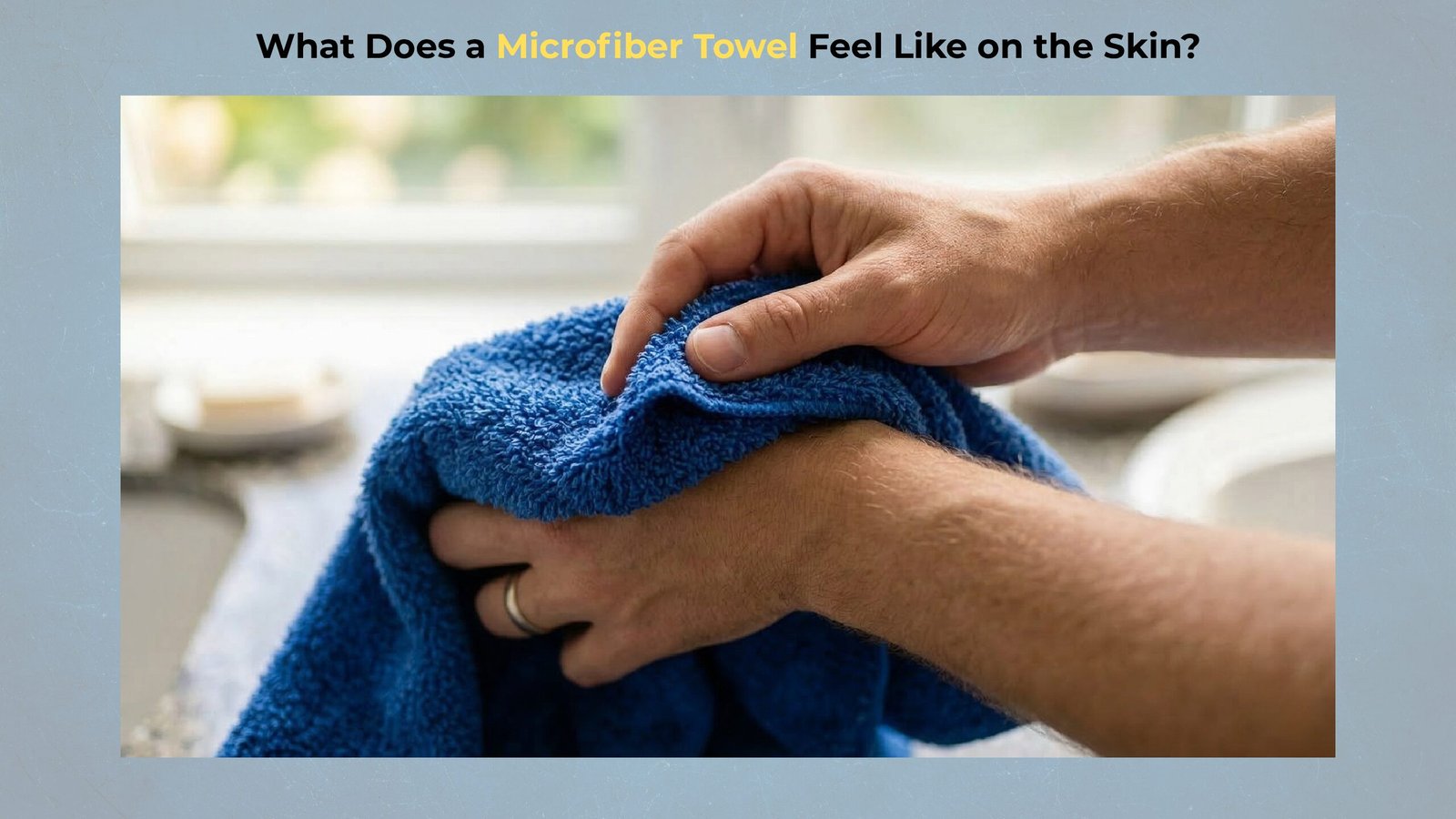
What Does a Microfiber Towel Feel Like on the Skin?
A Technical Guide to Synthetic Tactile Ergonomics
A specialized and often polarizing tactile experience characterizes microfiber towel skin feel because the utilization of ultra-fine synthetic filaments facilitates rapid moisture turnover while generating a unique mechanical “cling” against the epidermal barrier. The shift from traditional “Soaking” (Cotton) to “Wicking” (Microfiber) presents significant sensory implications for daily users, moving from bulk water absorption to high-velocity surface transport.
Sensory Kinetics: The study of how human nerves perceive the movement and moisture of a fabric against the skin.
This mechanical interaction creates a fundamental divergence from the “scrubbing” sensation typically associated with natural loops.
Why Does Microfiber Towel Skin Feel Differ Fundamentally From Cotton?
Traditional cotton textures differ from the standard microfiber towel skin feel because split-fiber filaments prioritize horizontal moisture transport over the high-volume internal sequestration characteristic of natural loops. While cotton loops provide a scrubbing sensation through volumetric swelling, microfiber “wedges” create a clinging effect through high surface-area contact.
Because this article explains that microfiber feels different from cotton due to wicking rather than soaking, a natural next-step link is how microfiber towels absorb water, which helps readers understand the mechanical basis behind that tactile difference.
This divergence is most noticeable during the initial mechanical cling sensation.
Do You Recognize the Clingy Sensation in Microfiber Towel Skin Feel?
A characteristic “clingy” or “catchy” sensation frequently defines microfiber towel skin feel because the split-fiber structure creates high surface friction that engages with microscopic skin irregularities. According to ASTM D1894 (Standard Test Method for Static and Kinetic Coefficients of Friction), dry microfiber typically exhibits a kinetic friction coefficient 15–25% higher than cotton terry when moved across dry skin surfaces. The “catchy” feel occurs because the wedge-shaped filaments physically snag on dry cuticles or rough skin areas; this behavior serves as a measurable indicator of effective fiber splitting.
Once the “clingy” sensation is tied to split-fiber friction and dry-skin interaction, the most relevant follow-up is how microfiber towel texture affects overall comfort, since texture is the user-facing version of that same tactile behavior.
Stratum Corneum: The outermost layer of the skin that interacts directly with the textile’s high-friction filaments.
How Does Moisture Transport Influence Microfiber Towel Skin Feel?
Rapid wicking typically dominates the microfiber towel skin feel during use as water is pulled off the epidermis through capillary action without the fabric becoming heavy or saturated. Adhering to AATCC 195 (Liquid Moisture Management) benchmarks, high-quality split-fiber textiles often achieve an OMMC score exceeding 0.60, facilitating horizontal moisture transport over 200% faster than standard carded cotton. Comfort in synthetics is frequently a function of “Phase Change”; as the towel pulls moisture, it facilitates rapid evaporative cooling, which generally results in a “cool-to-the-touch” wet sensation.
Since moisture transport and cooling are described as major parts of the sensory experience, readers would naturally benefit from how fast microfiber towels really dry, because fast drying is the practical performance result of that same wicking physics.
These sensory gains result from specific technical variables and construction factors.
Which Technical Variables Dictate the Quality of Microfiber Towel Skin Feel?
Technical variables that manipulate fiber denier and polymer blend ratios directly dictate the quality of microfiber towel skin feel by establishing the textile’s mechanical compliance.
Tactile Compliance: The technical term for how easily a fabric bends and conforms to the shape of the body.
Among these variables, fiber fineness acts as the primary driver of tactile perception.
Is Fiber Fineness the Primary Driver of Microfiber Towel Skin Feel?
Fiber fineness strongly influences microfiber towel skin feel, where materials measuring less than 1.0 denier typically approximate the flexibility and softness of natural down. Referencing ISO 1144 (Tex system for designating linear density), high-quality body towels generally utilize filaments measuring 0.1 to 0.5 denier, providing a Specific Surface Area (SSA) 10–20x higher than standard unsplit polyester. Softness results from fiber flexibility; as the denier decreases, the force required to bend the fiber drops exponentially.
Denier: The unit of linear mass density identifying the weight in grams of 9,000 meters of a fiber.
Why Does Polyamide Dictate the Softness of Microfiber Towel Skin Feel?
The percentage of Polyamide (Nylon) in the blend causes microfiber towel skin feel to fluctuate because this hydrophilic component increases fiber flexibility and moisture affinity. Referencing the Kawabata Evaluation System (KES-FB) for measuring bending rigidity, an 80/20 blend (Polyester/Polyamide) typically exhibits approximately 30% higher tactile compliance (reduced bending rigidity) than 100% polyester textiles.
These materials determine the hydrophobic glide mechanics.
How Does the Hydrophobic Glide Affect Microfiber Towel Skin Feel?
The “hydrophobic glide” effect—a surface-lubrication behavior caused by low moisture regain—predominantly determines the wet microfiber towel skin feel. The low moisture regain of synthetic polymers facilitates surface-lubrication behavior rather than saturating the fiber core. This lubrication effect forces a necessary distinction between slickness and softness.
Do You Recognize the Difference Between Slickness and Softness in Microfiber Towel Skin Feel?
Distinguishing between slickness and softness is essential for evaluating microfiber towel skin feel because the fiber’s refusal to absorb water internally creates a surface-water film that often feels “slimy” to unadapted users. Referencing ASTM D7334 contact angle measurements, synthetic polymers generally exhibit a moisture regain of less than 0.4%, ensuring moisture remains mobile for mechanical lubrication. Maximizing comfort typically requires a “pat-dry” motion; dragging the towel engages the friction-drag, whereas pressing engages the surface-tension driven capillary pull.
This sensation changes based on wet and dry conditions.
Why Does Microfiber Towel Skin Feel Vary Between Dry and Wet Conditions?
Significant variance in microfiber towel skin feel exists between dry and wet conditions because water molecules act as a mechanical lubricant that fills the fiber gaps and reduces surface friction. This lubricated state contrasts with the high-friction grab of dry surfaces.
Why Does Microfiber Towel Skin Feel High-Friction on Dry Surfaces?
A high-friction “grab” on dry hands typically characterizes microfiber towel skin feel because the exposed split-fiber wedges physically snag on dry skin textures without water to provide lubrication. This “dry grab” acts as an indicator of an authentic split-fiber weave; lower-grade synthetic textiles often feel unnaturally slick when dry because they lack functional wicking wedges.
Does Moisture Provide a Lubricated Glide for Microfiber Towel Skin Feel?
Saturated use causes microfiber towel skin feel to become significantly smoother because the presence of liquid water reduces the coefficient of friction compared to dry contact. Referencing Hydrodynamic Lubrication models in textile tribology, friction measurements in synthetic-to-skin studies demonstrate that the presence of a water film typically reduces the dry coefficient of friction by over 40%.
This transitions directly to a comparison of objective comfort metrics.
How Do You Compare Microfiber Towel Skin Feel Metrics Against Other Textiles?
Analysis of skin friction coefficients and moisture-turnover rates is required to compare microfiber towel skin feel against natural fibers and identify the optimal usage scenario.
| Feature | Split-Fiber Microfiber | Suede Microfiber | Traditional Cotton |
|---|---|---|---|
| Dry Texture | Clingy / Velvety | Smooth / Flat | Fluffy / Looped |
| Skin Friction | High (Grabs skin) | Low (Glides) | Moderate (Scrubbing) |
| Wet Sensation | Wicking / Cool | Slick / Thin | Heavy / Warm |
| Softness Stability | High (Mineral Inert) | Extreme Durability | Decreases with Age |
How Do You Select Your Preferred Microfiber Towel Skin Feel?
Matching specific weave geometries (Plush vs. Suede) to the user’s sensitivity to mechanical friction allows for the selection of an ideal microfiber towel skin feel.
| If you prefer… | Look for this weave… | Why it works… |
|---|---|---|
| The Softest Touch | Plush / Long-Pile | Maximizes surface area for a velvety feel |
| No “Cling” Effect | Suede / Flat Weave | Sheared fibers reduce dry surface friction |
| Fastest Drying | Waffle Weave | Promotes airflow while maintaining wicking |
Maintenance protocol is essential to protecting these specific fiber finishes.
Which Laundry Steps Maintain the Soft Finish of Microfiber Towel Skin Feel?
Adherence to low-heat drying and surfactant restrictions is necessary to preserve the soft finish of microfiber towel skin feel and prevent polymer deformation. Referencing the ISO 6330 laundering standard for domestic care, the primary threat is excessive heat exposure.
When the guide warns that softeners and high heat can ruin softness, the strongest maintenance-focused next question is how to wash and dry microfiber towels correctly, which directly supports preserving skin feel over time.
Why Should You Avoid High-Heat Drying for Microfiber Towel Skin Feel?
Exposure to high-heat drying cycles causes microfiber towel skin feel to fail because temperatures exceeding 60°C cause the thermoplastic filaments to fuse and harden. Referencing the Polymer Softening Range of PET, filament fusion results in a “crunchy” or stiff surface.
Why Must You Eliminate Softeners to Maintain Microfiber Towel Skin Feel?
Treatment with liquid softeners degrades the microfiber towel skin feel because fabric softeners significantly reduce wicking performance by coating fibers with hydrophobic residues. Referencing AATCC 79 (Absorbency of Textiles) testing, softener buildup typically increases water-beading probability by approximately 50% per ASTM D7334 measurements.
Fixing stiffness and restoring performance requires a specific strip cycle.
How Can You Fix Stiffness and Restore Microfiber Towel Skin Feel?
Executing chemical resets to strip away residues and mechanical brushing to separate matted filaments is often necessary to restore microfiber towel skin feel. Detailed below is the specific role of stripping buildup in this restoration.
Does Stripping Buildup Restore Microfiber Towel Skin Feel?
A warm vinegar rinse typically allows microfiber towel skin feel to regain its original velvety texture by dissolving the alkaline mineral films and detergent salts that “clog” the synthetic weave. This process requires 5.5 pH acetic acid (vinegar) to neutralize alkaline residues effectively.
Does Pile Brushing Improve the Tactile Result of Microfiber Towel Skin Feel?
In matted, high-pile inventory, microfiber towel skin feel generally improves if a soft-bristle brush mechanically separates matted filaments to restore surface loft. Gently brushing the surface of plush microfiber finishes after air-drying allows the user to “re-loft” the pile and increase wicking surface area.
Frequently Asked Questions: Microfiber Towel Skin Feel
Why does microfiber feel like it’s catching on my skin?
This “catchy” sensation is caused by the physical interaction between the split-fiber wedges and microscopic skin irregularities. High-quality microfiber is engineered to “grab” moisture and debris; on dry skin, this manifests as a clingy friction. It is a sign that the fibers are properly split for maximum wicking.
Is microfiber towel skin feel safe for sensitive skin?
Generally, yes. Because microfiber dries up to 3x faster than cotton, it inhibits the growth of bacteria and mildew that can irritate skin. However, users with sensory sensitivities may find the dry high-friction “grab” uncomfortable. Using a “pat-dry” motion instead of rubbing mitigates this effect.
Can I use fabric softener to make the towel feel softer?
No. Fabric softeners coat the synthetic filaments with a waxy layer. This layer blocks the wicking channels (capillary paths) between the fibers, ruining the towel’s ability to dry your skin and resulting in a “slimy” or non-absorbent tactile profile.
Why does my towel feel scratchy or stiff after washing?
This typically occurs due to mineral buildup from hard water or high-heat drying. Heat above 60°C (140°F) can melt the tips of the synthetic filaments, causing them to fuse together into a rough texture. A warm vinegar rinse can often strip mineral buildup and restore softness.
Audit Your Sensory Experience with the Microfiber Towel Skin Feel Checklist
Technical audits that validate maintenance compliance and weave geometry against structural benchmarks verify the inventory integrity for microfiber towel skin feel.
Material Audit: Does the label confirm a Polyester/Polyamide blend (80/20 preferred)?
Technique Check: Is the towel used with a “pat-dry” motion to avoid friction-drag?
Thermal Check: Are drying cycles maintained at “Low Heat” (< 60°C) to prevent fiber fusion?
Residue Audit: Is the surface free of waxy textures indicative of fabric softener buildup?
Elasticity Test: Does the dry fiber feel “springy” rather than “crunchy” or stiff?
Technical & Medical Disclaimer
The information provided in this guide is for educational and informational purposes only. While every effort is made to ensure technical accuracy regarding textile engineering and dermal interaction physics, “microfiber towel skin feel” is a sensory experience that varies significantly based on individual skin sensitivity and underlying dermatological conditions. The diagnostic metrics and maintenance protocols provided are structural benchmarks and do not constitute professional medical advice or a guarantee of fabric restoration. If you experience persistent skin irritation or mechanical abrasions while utilizing synthetic textiles, consult a qualified dermatologist immediately. TowelDaily is not responsible for damages resulting from the misuse of chemical stripping agents or high-heat laundry cycles beyond the stated safety thresholds.