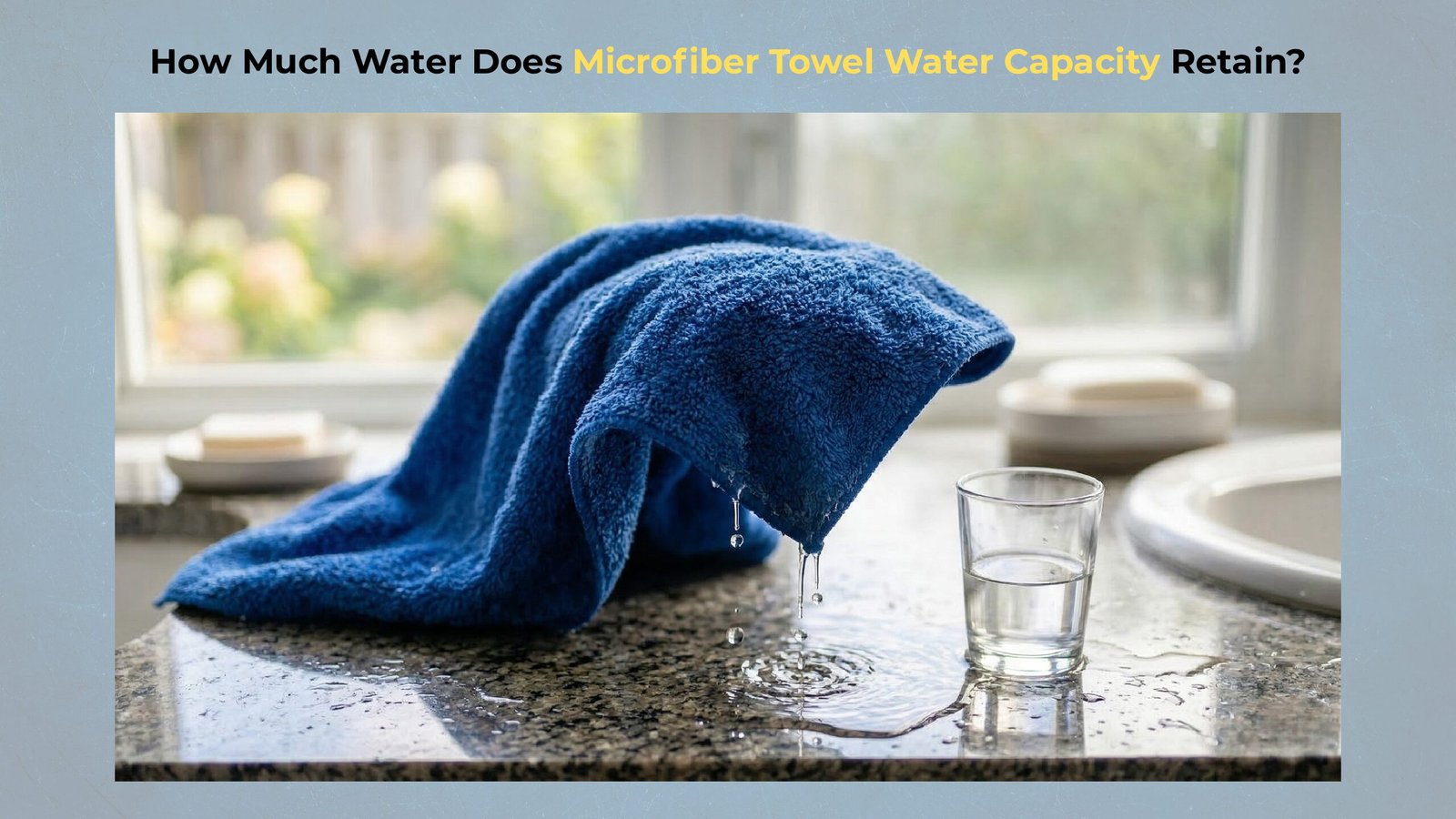
How Much Water Does Microfiber Towel Water Capacity Retain?
An Engineering Blueprint for Synthetic Moisture Sequestration
Microfiber towel water capacity defines the efficiency of portable drying gear because the mechanical structure of split-fiber filaments facilitates moisture retention between seven and nine times the textile’s dry weight. This exceptional weight-to-volume ratio makes synthetics the primary choice for mobile environments where mass is the critical constraint. While Egyptian cotton boasts a higher absolute volume ceiling due to its thick cellulose fibers, the efficiency of a polyester towel is measured by its ability to sequester significant fluid volumes within a low-mass footprint. This retention efficiency dictates utility in the field by minimizing the carry-burden of wet inventory.
Because this introduction frames microfiber as lightweight drying gear for mobile use, a natural next-step link is why microfiber towels are compact and lightweight, which helps readers connect water capacity with real travel efficiency.
Why Does Microfiber Towel Water Capacity Determine its Utility in the Field?
Microfiber towel water capacity determines gear utility by establishing the “saturated-weight penalty” that mobile users must manage after the textile reaches its liquid retention limit. For hikers and athletes, every gram of retained water translates to mechanical work. A high volume-to-weight ratio ensures that a single towel manages multiple drying tasks without becoming an unmanageable heavy burden. This portable efficiency originates from the link between mass and portable weight.
How Does Microfiber Towel Water Capacity Support Portable Efficiency?
Microfiber towel water capacity facilitates portable efficiency because the low initial mass of synthetic filaments ensures that even a fully saturated textile remains light enough for mobile transport. Technically, a 250g microfiber towel retains 1.75 liters of water at saturation, representing a 7x mass increase that remains 60% lighter than a saturated cotton towel of identical dimensions. High weight-efficiency allows users to utilize smaller textiles for full-body tasks, reducing the total volumetric bulk in luggage or backpacks. By utilizing Low-denier filaments, manufacturers maximize volume-to-weight ratios and optimize microfiber towel water capacity for travel.
Once the article explains that storage efficiency depends on fiber morphology and mass, readers are likely to ask how fast microfiber towels really dry, since drying speed is the practical counterpart to high water retention.
What Is the Saturation Curve for Microfiber Towel Water Capacity?
Microfiber towel water capacity follows a steep saturation curve where the textile reaches its maximum mechanical retention limit within two to three passes over a wet surface. Unlike natural fibers that slowly soak through, split synthetics exhibit high liquid uptake velocity. Because retention is mechanical, the towel effectively performs a “wipe-dry” action until the final 10% of capacity is reached, at which point capillary pressure drops and moisture smears. These performance curves result from the technical mechanisms of split-fiber physics.
What Technical Mechanisms Drive Microfiber Towel Water Capacity?
Technical mechanisms drive microfiber towel water capacity by utilizing bicomponent filaments that undergo mechanical splitting to increase the available capillary storage volume.
How Does the Split-Fiber Multiplier Influence Microfiber Towel Water Capacity?
Microfiber towel water capacity depends on the split-fiber multiplier where a single strand is divided into 16 or more wedge-shaped filaments to create microscopic channels for moisture sequestration. Splitting a fiber increases the effective wicking specific surface area (SSA) by a factor of 10x to 20x compared to standard unsplit polyester. These “wedges” act as structural suction cups, utilizing the surface tension of water to lock it into the weave rather than letting it drip out. Bicomponent Filament: A fiber composed of two different polymers (Polyester/Polyamide) that separate during processing to create high-porosity microfiber.
The section on split-fiber storage sites naturally leads to how microfiber towels absorb water, because absorption mechanics explain why these capillary wedges can hold so much liquid relative to dry weight.
Why Does Polyamide Dictate Total Microfiber Towel Water Capacity?
Microfiber towel water capacity fluctuates with the percentage of Polyamide (Nylon) in the blend because this hydrophilic component provides the chemical affinity required to draw water into the hydrophobic polyester weave. An 80/20 blend utilizes the 4% moisture regain of Polyamide to “prime” the wicking engine, facilitating a 30% higher capacity than 100% polyester textiles. Essentially, Hydrophilic Polyamide wedges initiate capillary draw to maximize the efficiency of microfiber towel water capacity. This chemical interaction transitions directly to the mathematical calculation of the weight-ratio.
How Do You Calculate the Weight-Ratio of Microfiber Towel Water Capacity?
Calculating the weight-ratio of microfiber towel water capacity requires applying a specific saturation multiplier to the dry mass of the textile to predict its total wet carry-weight.
What Are the 7x-to-9x Benchmarks for Microfiber Towel Water Capacity?
Microfiber towel water capacity benchmarks for high-quality split-fiber weaves fall between 7x and 9x the dry weight of the textile, whereas standard utility synthetics often peak at 3x. The “7x threshold” serves as a marker for authenticity; if a towel fails to retain seven times its weight, it likely indicates a “non-split” or low-polyamide construction. These standardized moisture retention value (MRV) tests ensure baseline quality.
How Do You Apply the Multiplier to Real-World Microfiber Towel Water Capacity?
Applying the capacity multiplier to a real-world scenario allows users to predict the exact physical mass of a saturated towel for packing or laundry balancing.
| Metric | Measurement (Example) | Technical Significance |
|---|---|---|
| Dry Towel Weight | 250g (8.8 oz) | Initial baggage weight |
| Capacity Multiplier | 7x Mass | Retention limit benchmark |
| Water Retained | 1,750g (1.75 L) | Total fluid mass sequestered |
| Total Wet Weight | 2,000g (4.4 lbs) | Final carry burden |
How to Compare Microfiber Towel Water Capacity Against Cotton and Linen?
Comparing microfiber towel water capacity against natural fibers requires an analysis of volume-per-ounce efficiency to identify the optimal textile for time-sensitive or mobile environments.
| Fiber Type | Water-to-Weight Ratio | Storage Mechanism | Best Use-Case |
|---|---|---|---|
| Split-Fiber Microfiber | 7x – 9x | Capillary (Between wedges) | Gym / Trekking |
| Standard Polyester | 2x – 4x | Interstitial (Between fibers) | Rapid turnover |
| Linen (Bast Fiber) | 4x – 6x | Internal + Interstitial | Polishing / Kitchen |
| Egyptian Cotton | 20x – 27x | Core (Lumen) Saturation | Post-Shower Soaking |
When the article compares microfiber against linen in portable and time-sensitive environments, a strong lateral link is how microfiber drying compares with linen towels, which extends that comparison into real drying-performance tradeoffs.
Does GSM Selection Optimize Microfiber Towel Water Capacity?
Selecting the correct GSM (Grams per Square Meter) optimizes microfiber towel water capacity by matching the textile’s mass to the moisture volume produced by specific athletic or commercial tasks.
| If you need… | Look for this GSM… | Why it works… |
|---|---|---|
| Maximum Portability | 200–250 | Lowest dry weight; moderate capacity |
| Best All-Rounder | 300–400 | Balanced weight and retention |
| Highest Volume | 500+ | Maximum loop density for water storage |
Which Laundry Steps Preserve High Microfiber Towel Water Capacity?
Preserving high microfiber towel water capacity requires technical adherence to low-heat drying and the total exclusion of surfactant softeners that glaze the capillary channels. Per ISO 6330 standards, domestic care cycles must be strictly controlled to prevent polymer degradation.
Why Must You Avoid Softeners to Maintain Microfiber Towel Water Capacity?
Microfiber towel water capacity fails if treated with liquid softeners because cationic surfactants coat the split-fiber “wedges” in a waxy, hydrophobic film that seals the capillary channels. AATCC 79 absorbency testing confirms that Silicone residues seal capillary voids and effectively neutralize microfiber towel water capacity. Softeners target fiber-on-fiber friction, which synthetic filaments do not possess; the result is a plastic-like barrier that turns a thirsty towel into a non-absorbent liability.
Since the care section warns that softeners and heat can ruin capillary performance, the most helpful follow-up is how to wash and dry microfiber towels correctly, because maintenance determines whether water capacity stays high over time.
Do Low-Heat Protocols Protect Microfiber Towel Water Capacity?
Microfiber towel water capacity depends on low-heat drying cycles because temperatures exceeding 60°C deform the fine synthetic filaments and collapse the wicking architecture. Synthetics have a specific glass transition temperature ($T_g$); once fiber fusion (glazing) occurs, it is irreversible. The interstitial storage space disappears permanently once the filaments soften and bond together.
How Can You Fix Decreased Microfiber Towel Water Capacity?
Restoring microfiber towel water capacity in aged inventory involves executing chemical resets to emulsify the oleophilic lipids and detergent salts that physically block the storage channels.
Does Stripping Detergent Buildup Restore Microfiber Towel Water Capacity?
Microfiber towel water capacity regains its original volume when a high-temperature vinegar flush dissolves the waxy silicone films left by commercial detergents. Use 5.5 pH acetic acid (vinegar) to neutralize alkaline residues and reopen the capillary gaps. Restoring the “thirsty” nature of the weave improves wicking speed and volume by an estimated 15% to 20% in residue-loaded towels.
Frequently Asked Questions About Microfiber Towel Water Capacity
Microfiber towel water capacity exceeds natural fibers because synthetic split-filaments create internal interstitial storage sites that sequestration liquid via capillary pressure rather than absorbing it into the fiber core. This allows for a higher volume-to-weight ratio, as the storage mechanism is mechanical rather than biological.
Microfiber towel water capacity is neutralized by softeners but can be restored by emulsifying the silicone residues with a hot acetic acid (vinegar) rinse to clear the clogged capillary wedges. Unless the fibers have undergone thermal fusion, the storage volume remains restorable through deep-cleansing protocols.
Microfiber towel water capacity is directly proportional to GSM (Grams per Square Meter) because higher mass-per-area indicates a denser concentration of split-fiber storage channels. A 500 GSM towel inherently offers double the fluid sequestration potential of a 250 GSM towel of identical surface area.
Microfiber towel water capacity depends on fiber structural integrity, and temperatures exceeding 60°C trigger a glass transition that causes the fine filaments to melt and fuse together. This fusion is permanent and destroys the interstitial voids required for water sequestration.
Audit Your Gear with the Microfiber Towel Water Capacity Checklist
Inventory integrity for microfiber towel water capacity is verified through technical audits that validate maintenance compliance and weave geometry against structural benchmarks.
- Fiber Audit: Does the label confirm a Polyester/Polyamide blend (e.g., 80/20) for maximum capacity?
- Weave Check: Does the label confirm “Split-Fiber” construction to ensure high capillary volume?
- Technique Audit: Is the “Wring-and-Reuse” routine utilized for high-volume moisture tasks?
- Chemical Audit: Is the laundry routine 100% free of fabric softeners and silicone additives?
- Saturation Test: Does the dry textile absorb a water droplet instantly (< 1.0s) without lateral runoff?
Final Summary: Does Microfiber Towel Water Capacity Meet Your Performance Needs?
Operationalizing a microfiber towel water capacity strategy requires a shift from volume-centric expectations to a weight-efficiency model that prioritizes rapid mechanical restoration. Successful utilization depends on understanding the 7x-to-9x multiplier, the critical role of Polyamide in initiation wicking, and the catastrophic danger of chemical glazing from softeners. Ultimately, a superior mobile experience is defined by the precise microfiber towel water capacity engineering that aligns lightweight efficiency with high-volume moisture transport.
Disclaimer: Microfiber towel water capacity data provided in this guide represents standardized industrial benchmarks. Actual performance may vary based on specific textile blends, environmental humidity, and laundering history. TowelDaily provides this technical analysis for informational purposes and is not liable for outcomes resulting from independent maintenance protocols or the use of non-standard chemical restoration agents.