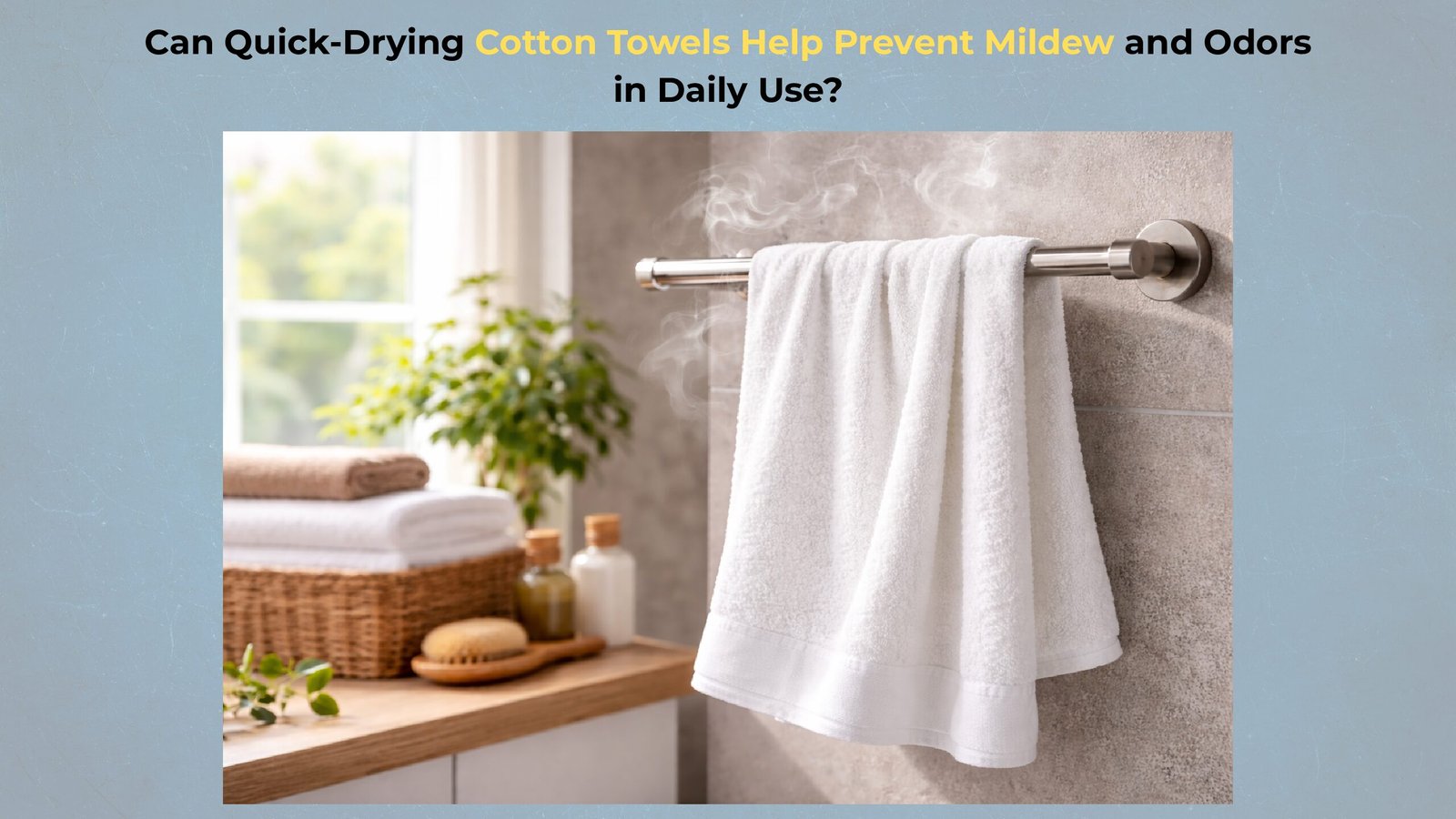
Can Quick-Drying Cotton Towels Help Prevent Mildew and Odors in Daily Use?
Structural airflow and construction establish the primary defense against bacterial growth in home textiles.
Yes, Quick-Drying Cotton Towels help prevent mildew and odors in daily use because they are structurally engineered to maximize airflow, rapidly evaporating the moisture that sustains bacterial growth. These towels are defined by minimal fiber mass and maximum surface area, creating a structural solution that interrupts the 4-hour bacterial growth window by denying microbes the stagnant moisture they require for colonization.
Why Is the Construction of Quick-Drying Cotton Towels Essential for Mildew Prevention?
The construction of Quick-Drying Cotton Towels is essential for mildew prevention because structural design is the primary mechanism for fighting moisture retention. While additives can fade, a weave built for airflow provides a permanent physical barrier to bacterial growth, effectively mastering cotton towel mildew prevention by ensuring moisture cannot be trapped deep within the textile core.
Analyzing the Surface Area Advantage in Quick-Drying Cotton Towels
Analyzing the surface area advantage in Quick-Drying Cotton Towels shows how construction methods dramatically increase the fiber’s exposed area, accelerating evaporation. Understanding the various cotton towel absorbency and drying factors shows how increased surface area speeds the evaporation rate and interrupts the 4-Hour Bacterial Growth Window before musty odors can form.
Identifying the Density Trade-Off in Quick-Drying Cotton Towels
Identifying the density trade-off is critical because low GSM (300-450) in Quick-Drying Cotton Towels is directly correlated with faster drying performance. Lower GSM ensures there is less trapped water within the towel, allowing the surrounding air to move through the fibers with minimal resistance.
Evaluating the Odor Prevention Mechanism of Quick-Drying Cotton Towels
Evaluating the odor prevention mechanism of Quick-Drying Cotton Towels confirms that speed is the only way to eliminate the water source sustaining anaerobic bacteria. Without a persistent water supply, the chemical processes that lead to musty scents cannot initiate and the bacterial load remains manageable.
How Do You Compare Quick-Drying Cotton Towel Types and Weaves?
You compare Quick-Drying Cotton Towels types and weaves by evaluating how structural ingenuity achieves rapid evaporation in natural fibers. According to our updated towel materials guide, different weaves prioritize different physics to achieve the same hygienic goal.
Distinguishing Waffle Weave and Muslin as Quick-Drying Cotton Towel Construction
Distinguishing Waffle Weave and Muslin is necessary because these two weaves rely on fundamentally different structural principles to achieve fast drying. Waffle weave utilizes dimensional texture to trap air and increase surface area, while Muslin relies on extremely low fiber mass and an open plain weave to allow air to pass directly through the textile.
Comparison Matrix: Quick-Drying Cotton Towel Weave
This matrix maps the common quick-drying Cotton Towel weaves to their primary mechanism and functional result.
| Quick-Drying Cotton Towel Type | Primary Mechanism | Drying Speed Profile | Softness Profile |
|---|---|---|---|
| Waffle Weave | Air Pockets / Increased Surface Area | Very Fast | High (Plush Pockets) |
| Thin Flat Weave (Muslin/Linen) | Low Fiber Mass / Minimal Density | Extremely Fast | Low (Crisp/Technical) |
| Low-GSM Terry | Reduced Loop Density | Fast | Medium (Slight Plushness) |
Analyzing the Role of Zero-Twist in Quick-Drying Cotton Towels
Analyzing the role of Zero-Twist in Quick-Drying Cotton Towels reveals that while it maximizes plushness, it is not an airflow solution and must be paired with low GSM for speed. Zero-twist yarns are bulkier by nature, meaning they require a lower density construction to ensure cotton towels balance plush comfort with quick drying even in higher humidity.
When Are Quick-Drying Cotton Towels the Optimal Choice for Your Home?
Quick-Drying Cotton Towels are the optimal choice for your home when user needs or environmental factors prioritize natural fibers and speed.
Prioritizing Quick-Drying Cotton Towels for Humid, Unventilated Bathrooms
Prioritizing Quick-Drying Cotton Towels is essential for humid, unventilated bathrooms where leveraging structural airflow is the only way to combat persistent dampness. These towels overcome ambient humidity by using active ventilation within the weave, ensuring the fabric returns to a hygienic state between users.
Maximizing Laundry Efficiency with Quick-Drying Cotton Towels
Maximizing laundry efficiency is achieved with Quick-Drying Cotton Towels because their low-mass structure releases water faster in the spin cycle, reducing drying energy consumption. This makes them a superior choice for high-frequency laundry environments where faster turnover is prioritized.
Selecting Quick-Drying Cotton Towels for Family and Guest Use
Selecting Quick-Drying Cotton Towels for family and guest use ensures the linen is fully dry and hygienic before the next person uses it, preventing the sharing of damp, bacteria-prone textiles. This provides a consistent level of cotton towels comfort and absorbency without compromising personal hygiene.
How Can You Preserve the Fast-Drying and Anti-Mildew Properties of Cotton Towels?
You can preserve the fast-drying and anti-mildew properties of Quick-Drying Cotton Towels by rigorously protecting the crucial airflow structure from chemical coatings and waxy buildup.
Restoring Airflow by Stripping Residue from Quick-Drying Cotton Towels
Restoring airflow is necessary because waxy softeners clog the crucial air pockets in Quick-Drying Cotton Towels, destroying their rapid evaporation ability. Learning how to keep cotton towels soft over time requires avoiding chemical shortcuts; a periodic strip wash using vinegar and baking soda will dissolve these hydrophobic barriers.
Data Table: Habits That Slow Down Quick-Drying Cotton Towels
This data table identifies common post-wash habits that impede towel performance. If you are experiencing persistent issues, the Towel Care Diagnosis Engine can identify specific laundry failures.
| Habit | Performance Impact | Mechanism of Damage |
|---|---|---|
| Fabric Softener Use | Wicking Speed Halved | Coats fibers, flattening the weave |
| Folding When Damp | Mildew Growth Guaranteed | Traps water inside crushed air pockets |
| Overloading Rack | Drying Time Double | Prevents airflow across surface |
Best Practices for Mechanical Drying of Quick-Drying Cotton Towels
Best practices for mechanical drying of Quick-Drying Cotton Towels focus on maximizing the exposed surface area immediately after the wash cycle. Rapidly hanging Quick-Drying Cotton Towels exposes the maximum surface area to air, which achieves the fastest possible evaporation rate and ensures the 4-hour bacterial window is never breached.
How Do You Validate Quick-Drying Cotton Towels Claims Before Buying?
You validate Quick-Drying Cotton Towels claims before buying by executing a physical audit focused on detecting structural airflow and low density.
Executing a 4-Step Quick-Drying Cotton Towels Audit
Verify the physical structure before purchase. For personalized help, the Towel Material Selector can narrow down your specific needs.
The Airflow Test (Waffle/Muslin): Can you clearly see the gaps/pockets in the weave?
The GSM Check: Is the weight stated as low or medium GSM (450 or less)?
The Density Check: Does the towel feel light and pliable, or dense and heavy?
The Water Test (Adsorption): Does the towel quickly soak it in and spread it out?
Conclusion: How Can Quick-Drying Cotton Towels Improve Your Home Hygiene?
Quick-Drying Cotton Towels improve your home hygiene by solving the environmental problem of moisture retention in damp spaces. By utilizing structural physics over chemical additives, they provide a sustainable, long-term solution to the growth of odor-causing bacteria.
Recap: Summarizing the Dual Benefit of Quick-Drying Cotton Towels
Summarizing the dual benefit confirms that these towels solve the core problem of needing natural fiber while achieving synthetic-like speed. Users enjoy the comfort of 100% cotton without the hygiene compromises inherent in heavy terry fabrics.
Final Verdict: Prioritizing Airflow Construction in Quick-Drying Cotton Towels
The final verdict is that prioritizing airflow construction in Quick-Drying Cotton Towels is the key to verifiable mildew prevention. Choose airflow over density, and the environment sustaining bacterial life will be eliminated.