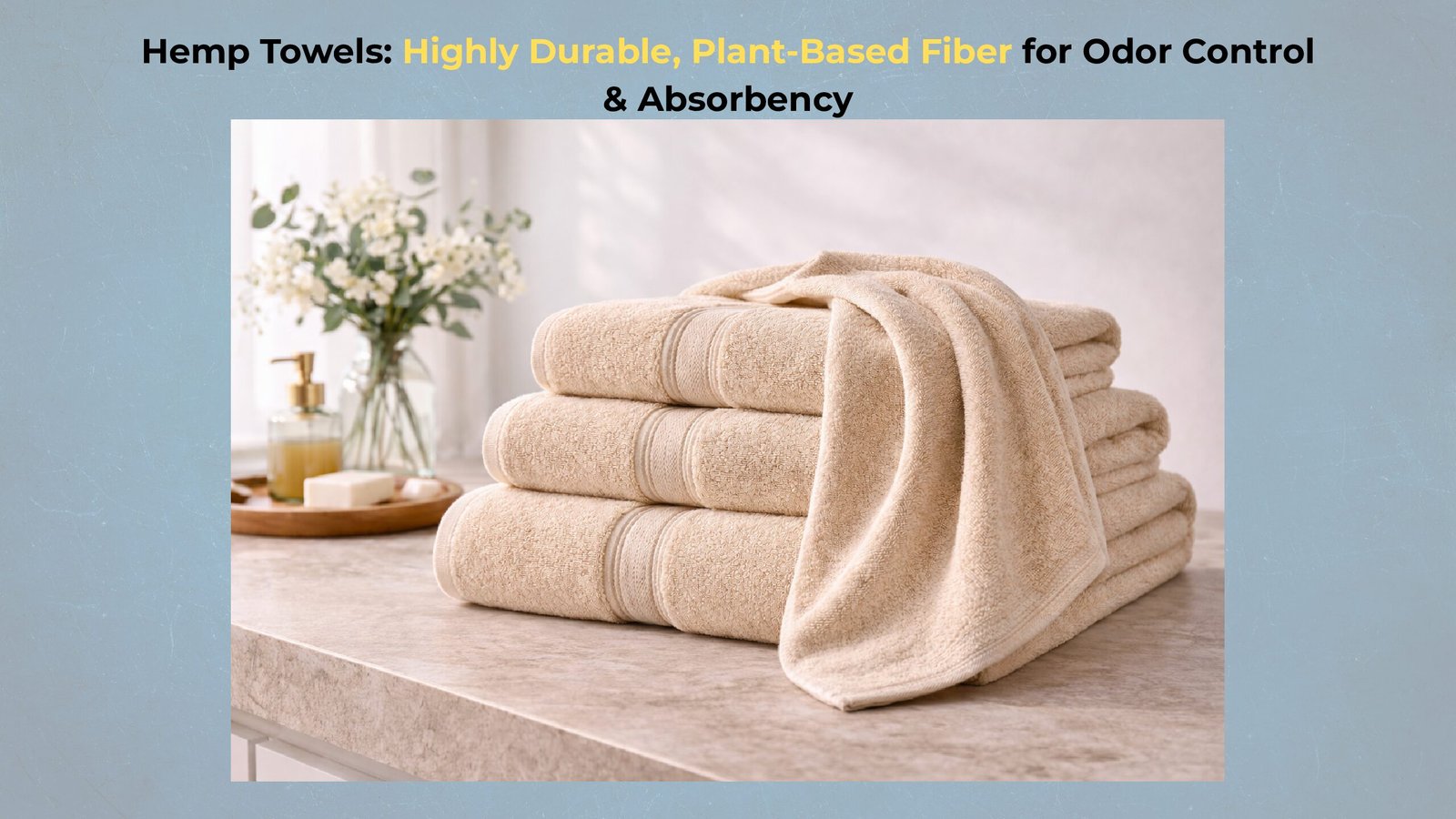
Hemp Towels: Highly Durable, Plant-Based Fiber for Odor Control & Absorbency
An Engineering Audit of Bast-Fiber Morphology and Performance Physics
Hemp towels establish the technical baseline for textile longevity because the high-tenacity bast fibers derived from Cannabis sativa drive extreme tensile strength and rapid atmospheric moisture exchange.
This guide audits the botanical engineering of industrial hemp to verify its evaporative efficiency and structural resilience. Unlike the low-tenacity, seed-fiber profile of standard Upland cotton, industrial hemp offers a rugged, high-friction profile that resists degradation over decades of use. This botanical anatomy dictates the technical identity and long-term utility of the textile asset, a concept explored deeply in our Hemp towels durability and antimicrobial guide.
What Defines the Botanical and Technical Identity of Hemp Towels?
Hemp towels possess a unique botanical and technical identity because the cellulose filaments originate from the phloem sieve-tubes of the plant, providing a structural rigidity unavailable to seed-based textiles.
Phloem Sieve-Tubes represent the high-lignin transport tissue within the hemp stalk that provides the raw material for fiber extraction. [Phloem-origin fibers] -> [increase cellulose polymer alignment] -> [strengthen the core of Hemp towels]. Before focusing only on bast fibers, readers who want a broader comparison can review the towel material categories to see how hemp performs against natural, regenerated, and synthetic alternatives.
What Is the Industrial Hemp Origin of Authentic Hemp Towels?
Hemp towels utilize industrial hemp varieties bred specifically for textile output, resulting in fibers that require 50% less water than cotton and zero synthetic pesticides.
Hemp produces 250% more fiber per acre than cotton while supporting soil phytoremediation. If readers are comparing hemp with cotton, linen, or bamboo for durability and resource speed, the Towel Material Selector helps them choose the most suitable towel material for their exact use case. Natural UV resistance in the hemp fiber protects the textile from the radiation-induced polymer degradation that weakens cotton during solar drying.
How Does the Bast-Fiber Structure Benefit Hemp Towels?
Hemp towels utilize a bast-fiber architecture characterized by extremely long, overlapping cellular bundles that distribute mechanical stress across the entire length of the textile.
A Bast Fiber is defined as the high-strength plant tissue located between the core and the outer bark. While cotton seed fibers are limited to 25-30 mm in length, hemp bast fibers reach several centimeters. Longer fiber bundles reduce the number of yarn “splice” points, which eliminates the primary failure zones found in short-staple textiles.
How Do Hemp Towels Perform During High-Moisture Use and Long-Term Wear?
Hemp towels deliver superior performance during high-moisture use because the porous molecular structure facilitates high capillary wicking and rapid air-flow exchange.
[Porous molecular structure] -> [accelerates moisture wicking] -> [optimizes the drying velocity of Hemp towels]. This mechanical response ensures that the textile remains functional even in high-humidity environments.
How Does Porous Fiber Structure Influence Hemp Towels Breathability?
Hemp towels exhibit high breathability because the irregular cross-section of the bast fibers creates micro-voids within the yarn that accelerate the transition of liquid water into vapor.
Utilizing AATCC 199 drying rate benchmarks, hemp outpaces dense cotton in passive evaporation. Hemp fibers demonstrate 20% higher air permeability than tightly twisted cotton yarns of identical weight. The “rugged” feel of new hemp towels results from these micro-voids, which settle into a soft, breathable matrix. If you mention that these textiles soften and perform better after repeated laundering, how washing improves hemp towel absorbency provides a direct explanation of this physical transition.
Why Is High Tensile Strength Essential for Hemp Towels Durability?
Hemp towels maintain structural integrity for an optimized lifecycle because the high lignin content acts as a natural polymer binder that prevents the fiber-thinning common in utility textiles.
ASTM D5034 grab testing protocols establish that hemp is the strongest natural textile fiber. Hemp towels demonstrate breaking strengths exceeding 50 lbs-force (lbf), which resists the mechanical shearing of high-RPM commercial extractors. This structural strength directly inhibits the stagnant conditions that allow odor-causing microbes to thrive.
Why Do Hemp Towels Inhibit Odor and Microbial Growth?
Hemp towels inhibit odor and microbial growth by utilizing a high-velocity moisture-release mechanism that eliminates the stagnant dampness required for bacterial colonization.
Lignin Polymerization refers to the chemical property where the plant’s natural binder creates an inhospitable surface for mildew. By maintaining a high-velocity drying rate, the textile prevents the metabolic processes of common bathroom microbes, ensuring long-term hygiene without chemical treatments. When the article explains how fast evaporation suppresses musty smells, linking to how hemp towels eliminate odor gives readers a more focused hygiene deep dive.
How Does Moisture Control in Hemp Towels Suppress Odor-Causing Bacteria?
Hemp towels achieve odor suppression because the rapid evaporation rate maintains the textile’s moisture content below the 15% threshold required for microbial proliferation.
Anaerobic Volatile Organic Compounds (VOCs) are the chemical byproducts (such as sulfides) inhibited by rapid fiber drying. [Rapid evaporation rates] -> [starve anaerobic microbes] -> [prevent musty odors in Hemp towels]. Since the page discusses microbial suppression through moisture control, this supports the exact claim that hemp towels inhibit bacterial growth rather than simply feeling fresher.
How Do Hemp Towels Compare to Cotton and Linen for Performance Priorities?
Hemp towels offer a specialized performance profile that prioritizes tensile endurance and odor resistance over the immediate “out-of-box” plushness characteristic of cotton blends.
The technical trade-off involves a longer break-in period in exchange for a multi-decade asset lifespan. Since bast-fiber comparisons are highly relevant in this audit, hemp towels vs linen durability is an ideal contextual link for readers weighing two rugged plant-based options.
How Do Hemp Towels Compare in Moisture-Absorption Capacity and Drying Speed?
Hemp towels prioritize a “dry-turnover” cycle because the bast fibers release moisture faster than the “saturation-capacity” profile of standard cotton. If you compare hemp’s fast dry-turnover cycle with another bast-fiber option, the Linen towels absorbency durability and drying guide is the cleanest supporting internal link.
| Metric | Linen Towels | Hemp Towels | Cotton Towels |
|---|---|---|---|
| Drying Velocity | Very Fast | Fast | Slow |
| Tensile Durability | High | Highest (> 50 lbf) | Standard (< 35 lbf) |
| Moisture Wicking | Moderate | High (Capillary) | Elite (Sorption) |
| Microbial Risk | Low | Low | High |
How Do You Match Hemp Towels to Your Specific Lifestyle Needs?
Selecting Hemp towels involves balancing the requirement for a long lifecycle against the initial maintenance investment required to soften the fibers.
| If your priority is… | Choose this material… | Primary Technical Benefit |
|---|---|---|
| Maximum Lifespan | Hemp Towels | Resists structural thinning over 200+ cycles |
| Fastest Dry Time | Linen Towels | Thinnest profile for maximum airflow |
| Immediate Plushness | Modal or Cotton Blends | Low-lignin fibers for instant softness |
Which Laundry Steps Should You Follow to Soften Hemp Towels?
Softening Hemp towels requires consistent mechanical agitation and the exclusion of waxy chemical additives to facilitate the natural “bloom” of the bast fibers.
The ISO 6330 laundering standard provides the framework for professional care. One must avoid excessive heat, as Cellulose Chain Scission—the brittle degradation of molecular bonds—occurs when fibers are “baked” in a high-heat dryer, leading to premature fraying.
Why Do Frequent Wash Cycles Accelerate Hemp Towels Softening?
Hemp towels achieve peak softness after approximately 10 to 15 laundry cycles because mechanical tumbling breaks the rigid lignin bonds and allows the cellulose loops to expand. This is the best technical insight for the transition from initial rigidity to a softer hand-feel, and users can find more data on how many wash cycles hemp towels need to soften.
Blooming is the process where Hemp towels’ fibers untwist and increase in volumetric loft through repeated use. [Mechanical agitation] -> [breaks lignin cross-links] -> [permanently softens Hemp towels].
Why Must You Avoid Synthetic Softeners with Hemp Towels?
Hemp towels lose wicking efficiency if treated with synthetic softeners because the hydrophobic silicone polymers seal the fiber’s moisture-wicking channels.
To maintain the fiber’s natural capillary action, one must prohibit liquid softeners. Because your care protocol warns against these additives, it is vital to understand how fabric softener reduces hemp towel absorbency. Use wool dryer balls to provide physical agitation without chemical coatings that impede atmospheric moisture exchange.
How Can You Solve Stiffness or Persistent Odors in Older Hemp Towels?
Solving stiffness or persistent odors in older Hemp towels involves executing a chemical reset to dissolve mineral calcification and detergent residues trapped in the weave.
How Do You Execute a Natural Vinegar Soak for Hemp Towels?
Hemp towels regain original pliability if a 5.5 pH acetic acid (vinegar) soak dissolves the alkaline mineral film that causes fiber rigidity.
Execute this restorative protocol: Submerge towels in hot water with one cup of white distilled vinegar. This process neutralizes detergent salts and removes persistent odors trapped within the phloem-origin bundles.
How Do You Repair Pulled Loops in Hemp Towels?
Hemp towels support the safe trimming of snagged loops because the high wet-modulus of the bast fiber prevents the weave from unraveling after a cut.
If a thread snags, snip it flush with the surface using sharp shears. The structural integrity of the weave prevents further mechanical pulling.
Proof Asset: How Do You Use This Hemp Towel Quality and Care Checklist?
Using this Hemp towel quality and care checklist empowers buyers to standardize inventory performance and verify that maintenance protocols match the molecular needs of bast fibers.
How Do You Audit Your Hemp Towels Investment and Maintenance?
Hemp towels require periodic maintenance audits to ensure that the initial high-tenacity purity persists through hundreds of laundry cycles.
Checklist: Hemp Towels Maintenance Audit Checklist
- Fiber Proof: Does the label confirm “100% Hemp” or a high-percentage (>55%) bast-fiber blend?
- Activation Check: Have the Hemp towels undergone at least 5 pre-washes to initiate fiber blooming?
- Chemical Audit: Are liquid fabric softeners replaced with wool dryer balls to protect Hemp towels?
- Thermal Check: Are the Hemp towels dried on “Low-to-Medium” heat to prevent fiber baking?
- Absorbency Verification: Does a water droplet absorb instantly (< 1.0s) into the Hemp towels surface?