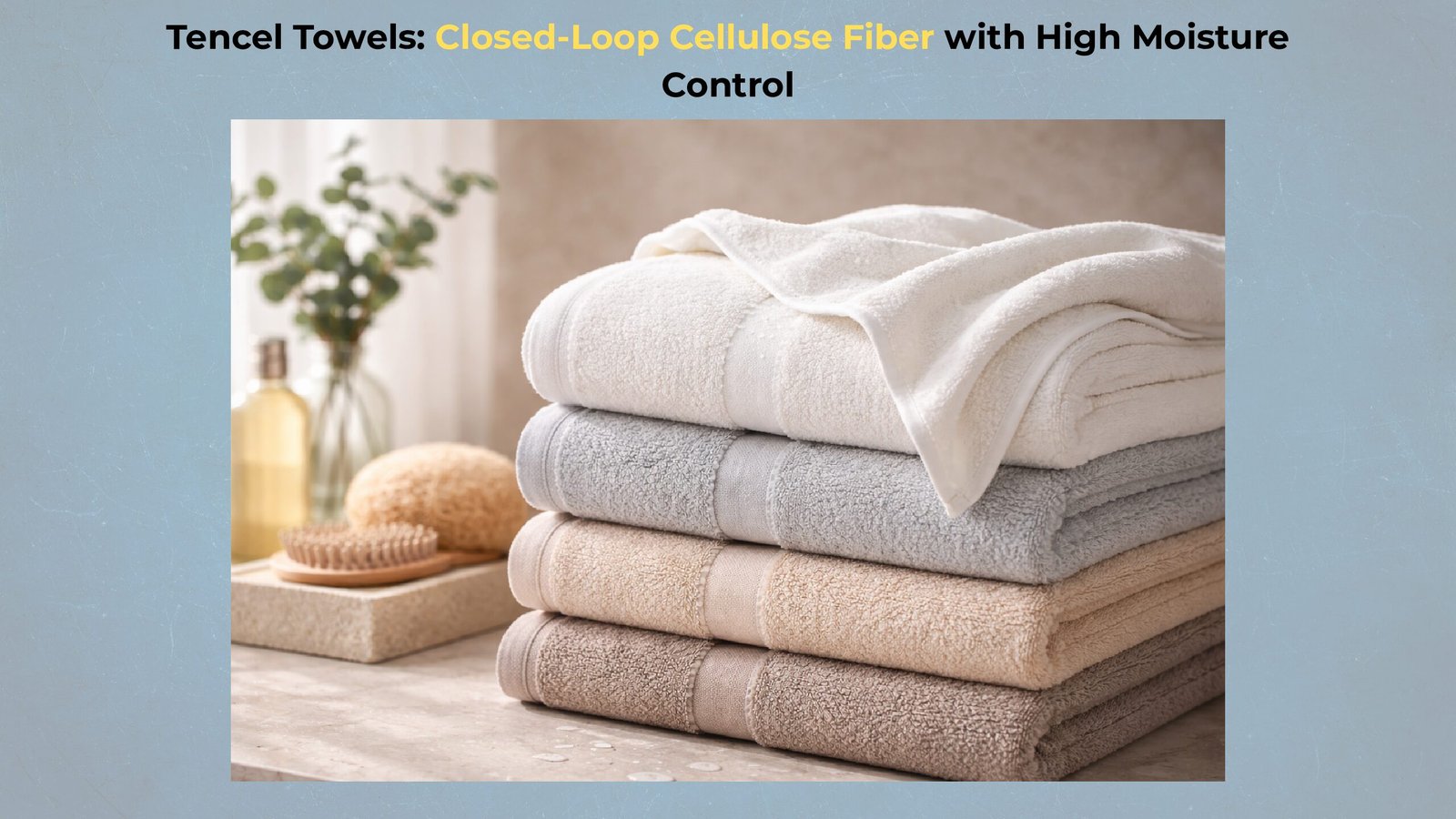
Tencel Towels: Closed-Loop Cellulose Fiber with High Moisture Control
Tencel towels establish the global standard for technical moisture management because the direct solvation of cellulose in NMMO creates a nanofibrillar architecture that drives rapid moisture transport and ecological resource efficiency.
This guide audits the technical specifications of lyocell to verify its antimicrobial efficacy and environmental sustainability. Tencel towels require wood pulp with a degree of polymerization (DP) optimized between 650 and 750 to ensure high dry tenacity and wet-strength retention. This specific fiber morphology dictates hygiene standards and bacterial resistance by sequestering moisture away from the surface.
Why Do Tencel Towels Provide Superior Hygiene Through Moisture Management?
Tencel towels deliver superior hygiene through moisture management because the sub-microscopic nanofibrils within the fiber draw liquid into the cellulose core to prevent the formation of a surface moisture film. This absence of free water on the fiber surface inhibits the first stage of bacterial adhesion, creating a standard of performance referenced in the Tencel towels moisture absorption guide. For users seeking to eliminate musty odors in humid climates, Tencel towels serve as a functional requirement.
How Does Moisture-Wicking Speed Reduce Odors in Tencel Towels?
Tencel towels achieve odor reduction because the internal nanofibril architecture facilitates moisture release rates 20% to 30% faster than conventional cotton. This performance relies on fluid kinetics to selectively suppress pungent Bacillus sp. while primarily reflecting native skin Staphylococcus sp., which validates the long-term effectiveness of Tencel towels odor and bacteria inhibition protocols.
Odor-Producing Volatile Compounds: These chemical byproducts (e.g., sulfides) remain inhibited because Tencel towels starve bacteria of the surface water required for colonization.
Unique Insight: Bacterial growth on Lyocell is 2,000 times lower than on synthetic fibers because Tencel towels eliminate the surface water required for colonization.
Why Are Tencel Towels Hypoallergenic for Sensitive Skin?
Tencel towels possess inherent hypoallergenic properties because the smooth, perfectly circular fiber cross-section prevents the mechanical friction that triggers epidermal inflammation. This structural regularity is why many dermatologists recommend Tencel towels for humid climates, where damp fabric often exacerbates skin irritation. The 9:1 crystallinity ratio ensures high surface regularity, resulting in a 30% reduction in friction coefficients compared to carded cotton or wool.
Stratum Corneum: This protective layer of the skin remains shielded by the smooth morphology of Tencel towels.
Semantic Goal: Circular fiber morphology minimizes mechanical friction and supports skin barrier integrity in Tencel towels.
What Is the Eucalyptus-Based Origin of Authentic Tencel Towels?
Tencel towels originate from the wood pulp of eucalyptus trees which produce 4x the yield of conventional cotton while utilizing 20 times less water. Lyocell production requires 99.3% less water and results in a 33.5% lower chemistry score than cotton.
Lyocell: The specific regenerated cellulose category produced via direct solvation without chemical xanthation.
This botanical origin drives the technically superior closed-loop production cycle.
What Are Tencel Towels and How Does the Closed-Loop Process Work?
Tencel towels result from a sophisticated closed-loop manufacturing process where the N-Methylmorpholine N-oxide (NMMO) solvent is recycled with 99.8% efficiency to eliminate toxic discharge. This verified sustainability profile, documented in the audit of Tencel towels eco-friendliness, prevents the industry “greenwashing” found in generic viscose products.
How Does the Closed-Loop Production Cycle Function for Tencel Towels?
Tencel towels achieve an elite sustainability rating because the multi-stage evaporation and air flotation sequence recovers 99.8% of the solvent used in the spinning dope. Monohydrate NMMO melts at 74°C to prevent the cellulose degradation that occurs at higher temperatures.
NMMO Solvent Recovery: The primary driver of environmental resource efficiency in Tencel towels.
Semantic Goal: 99.8% solvent recapture eliminates wastewater effluent and validates the premium eco-status of Tencel towels.
How Do Tencel Towels Compare to Cotton and Bamboo for Performance?
Tencel towels offer a specialized performance profile that prioritizes a 9:1 crystallinity ratio to ensure high dry tenacity and 85-90% wet-strength retention. Users should match material engineering to local humidity and turnover requirements by utilizing a Towel Material Selector tool.
How Do Tencel Towels Compare in Moisture Transport and Drying Speed?
Tencel towels prioritize a dry-turnover cycle because lyocell fibers release moisture 50% faster than the saturation-capacity profile of cotton. The micro-gaps within the air-jet spun yarn structure significantly enhance Tencel towels drying speed compared to traditional textiles. Cotton acts as a reservoir trapping moisture in a central lumen, whereas Tencel towels act as a conduit moving moisture via internal sorption.
This conduit behavior confirms the technical advantage identified in Tencel towels vs cotton absorbency benchmarks. Egyptian cotton towels of identical GSM air-dry significantly slower because they lack the capillary-driven evaporation found in lyocell fibers.
| Property | Tencel Towels | Conventional Viscose | Natural Cotton |
|---|---|---|---|
| Dry Tenacity | 34–40 cN/tex | 12–16 cN/tex | 18–25 cN/tex |
| Wet Tenacity | 85–90% of Dry | 50% of Dry | ~110% of Dry |
| Drying Velocity | ~50% faster than cotton | Moderate | Baseline |
| Bacterial Resistance | High (Nanofibrillar) | Low | Low |
How Do You Use This Material Selection Guide for Tencel Towels?
Selecting Tencel towels requires matching the fiber’s high tenacity and moisture-release behavior to specific user requirements for skin sensitivity and towel material categories. By prioritizing molecular performance over aesthetics, buyers ensure their linens provide long-term microbiological stability.
| If your priority is… | Choose this material… | Primary Technical Benefit |
|---|---|---|
| Biofilm Suppression | Tencel Towels | Prevents surface liquid film for bacterial adhesion |
| Land Use Efficiency | Tencel Towels | Provides 4x the yield per acre of cotton |
| Structural Luster | Tencel LF Towels | Inhibits fibrillation via chemical cross-linking |
Which Laundry Steps Preserve the Fiber Integrity of Tencel Towels?
Preserving the fiber integrity of Tencel towels requires technical adherence to mechanical agitation limits to prevent surface fibrillation and molecular chain scission. Technical care adheres to the ISO 6330 laundering standard.
How Do You Execute a Cool-Water Wash for Tencel Towels?
Tencel towels require wash temperatures below 30 degrees Celsius because excessive thermal energy triggers the detachment of microscopic fibrils from the fiber surface. Chlorine bleach is excluded to prevent the dissolution of lyocell fiber binders.
Surface Fibrillation: The fuzzy or matted appearance caused by mechanical stress.
Semantic Goal: Cool-water laundering protects molecular cellulose bonds and preserves the tensile strength of Tencel towels.
Why Should You Follow Low-Heat Drying Protocols for Tencel Towels?
Tencel towels require low-heat tumble settings because thermomechanical stress exceeding 60C results in a measurable decrease in moisture-regain capacity. Over-drying causes fibers to acquire a “crunchy” texture by collapsing sub-microscopic channels.
Unique Insight: Tencel towels reach peak tactile softness when removed from the dryer at the 3% residual moisture equilibrium.
How Can You Fix Absorbency Issues or Odors in Older Tencel Towels?
Fixing absorbency issues or odors in older Tencel towels involves executing a chemical reset to remove alkaline mineral films and restore wicking channels.
How Can You Strip Detergent Buildup From Tencel Towels?
Tencel towels regain their original wicking speed if a 5.5 pH acetic acid rinse dissolves the alkaline mineral film trapped within the fibers. This requirement restores the fiber’s electrical charge to support water bonding.
How Do You Repair Minor Snags in Tencel Towels?
Tencel towels support the safe trimming of loose threads with sharp shears because the high wet-modulus of the lyocell weave prevents localized fraying. Wet Modulus identifies the metric for fiber stability that differentiates lyocell from viscose.
Proof Asset: How Do You Use This Tencel Towel Quality and Care Checklist?
Using this Tencel towel quality and care checklist empowers buyers to standardize inventory performance and verify that maintenance protocols match the molecular needs of lyocell fibers.
How Do You Audit Your Tencel Towels Investment and Maintenance?
Tencel Towels Maintenance Audit Checklist
- Brand Proof: Does the label confirm “100% Lyocell” or the “Tencel” trademark?
- Growth Logic: Does the procurement strategy align with the projected 11.1% CAGR for sustainable fabrics?
- Thermal Check: Are the Tencel towels washed at or below 30 degrees Celsius?
- Drying Protocol: Are the Tencel towels removed from the dryer at the 3% residual moisture equilibrium?
- Wicking Check: Does a water droplet absorb instantly (< 1.0s) into the Tencel towels surface?
Frequently Asked Questions About Tencel Towels
Tencel towels: Why is the hygiene rating higher than traditional fabrics?
Tencel towels achieve superior hygiene because the nanofibrillar architecture sequesters liquid inside the fiber core. This engineering removes surface water required for bacterial colonization, resulting in odor-free performance.
Tencel towels: How does the closed-loop production benefit the environment?
Tencel towels support ecological resource efficiency through a process recycling 99.8% of the NMMO solvent. This cycle prevents wastewater effluent discharge and utilizes 20 times less water than cotton farming.
Tencel towels: Do they dry faster than Egyptian cotton?
Tencel towels exhibit drying velocities 50% faster than Egyptian cotton of identical GSM. The micro-gaps within Tencel air-jet spun yarns act as a conduit for rapid moisture release.
Disclaimer: This technical guide regarding Tencel towels provides informational content for textile engineering evaluation. Performance metrics based on industry standards fluctuate according to environmental factors. This content excludes professional medical advice regarding skin sensitivities. Always verify manufacturer care labels.