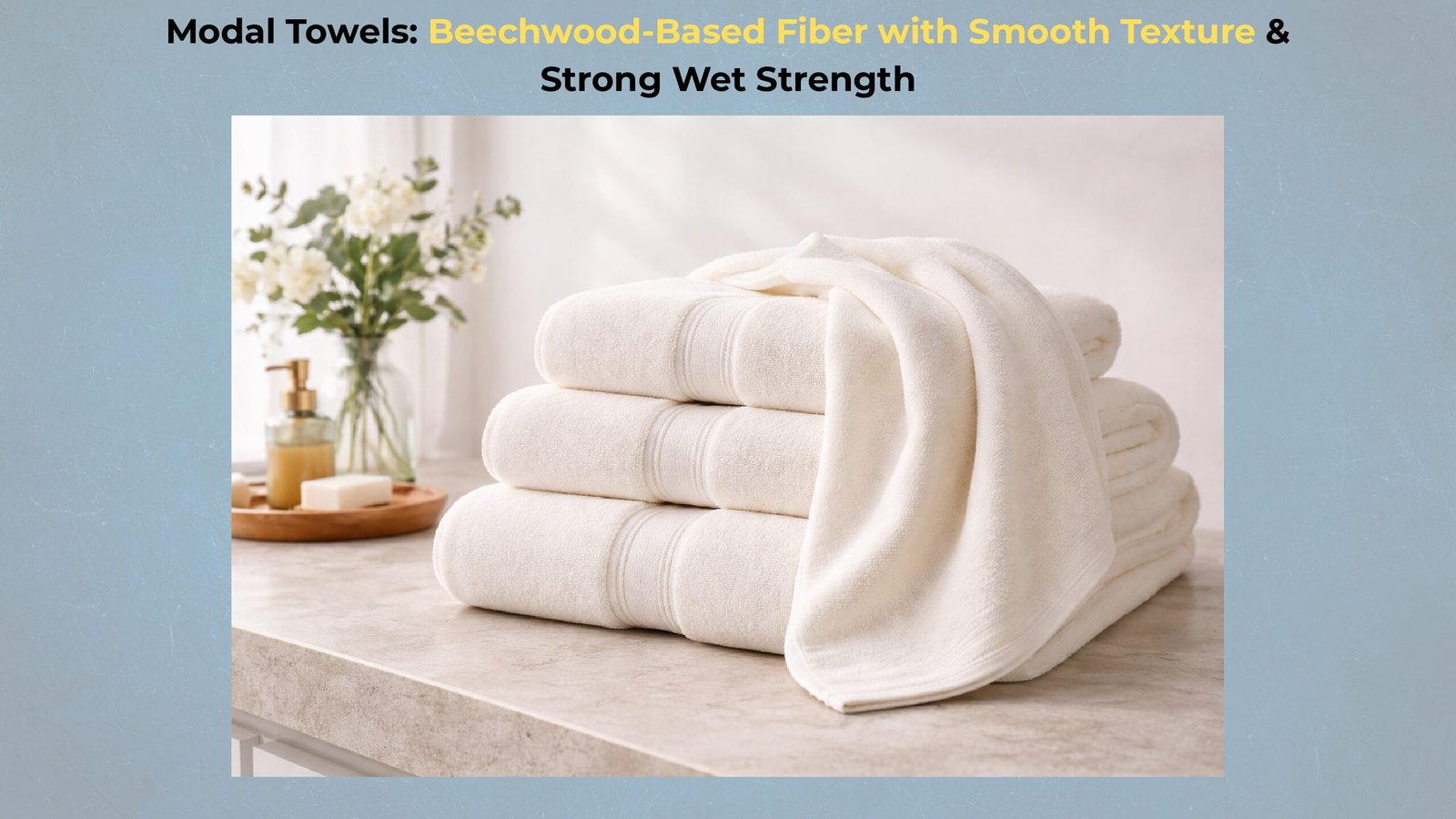
Modal Towels: Beechwood-Based Fiber with Smooth Texture & Strong Wet Strength
Modal towels optimize resource efficiency and mitigate dermatological irritation because the regenerated cellulose fibers derived from beechwood trees maintain a uniform molecular surface and high tensile strength when saturated.
Authentic Modal towels require the utilization of high-purity cellulose pulp extracted from Fagus sylvatica (European Beechwood). Before going deeper into regenerated cellulose, readers who want a broader comparison can explore the towel material categories to see where Modal fits among natural and synthetic options. Unlike the ribbon-like, convoluted structure of natural cotton, Modal fibers feature a perfectly cylindrical, scale-free profile. This specific fiber morphology establishes sensory comfort and skin safety.
Why Do Modal Towels Provide a Superior Sensory Experience for Sensitive Skin?
Modal towels provide a superior sensory experience for sensitive skin because the cylindrical cross-section of the fiber minimizes mechanical friction against the epidermal barrier. The lack of microscopic surface irregularities prevents the micro-tears and inflammatory triggers associated with carded cotton. Consequently, Modal serves as a functional requirement for individuals managing eczema, making it a natural next step to take a dedicated look at whether Modal towels for sensitive skin are the ideal choice.
Analyzing the Anti-Scratch Properties of Modal Towels for Sensory Comfort
Modal towels utilize a low-denier fiber structure to prevent the “prickle” sensation associated with the coarse, short-staple ends found in standard utility textiles. Data from textile performance benchmarks confirms that fine Modal fibers (approx. 1.0–1.3 dtex) result in a 30% lower coefficient of friction than standard cotton—tactile differences found in a detailed Modal towels vs cotton softness comparison.
Technical Focus: Stratum Corneum. This outermost layer of the skin acts as the primary moisture barrier. Mechanical friction from rough fibers triggers transepidermal water loss (TEWL), compromising skin hydration. The molecular smoothness of beechwood cellulose persists throughout the lifecycle, whereas cotton fibers stiffen due to alkaline mineral calcification.
Identifying the Long-Term Color Retention of Modal Towels
Modal towels exhibit exceptional aesthetic longevity because the high hydrophilicity of the cellulose allows dyes to penetrate deep into the fiber core for permanent covalent bonding. Fiber science datasets indicate that Modal fibers absorb and retain 50% more pigment mass than standard Upland cotton.
Distinguishing the High Wet-Strength Advantage of Modal Towels
Modal towels maintain structural integrity during the laundry cycle because the high wet-modulus of the regenerated fibers prevents the stretching and distortion common in standard rayon. According to ISO 2062 testing standards for wet-tenacity, Modal maintains up to 60% of its dry tensile strength when wet, whereas standard viscose retains less than 50%. These benchmarks are referenced in a comprehensive Modal towels performance guide for a broader overview of durability and everyday use. High wet-modulus identifies the textile as authentic Modal, as lower-tier rayon variants collapse and lose dimensional stability upon saturation. This structural resilience allows for precise comparisons against bamboo and cotton.
How Do Modal Towels Compare to Bamboo and Cotton for Your Specific Climate?
Modal towels offer a specialized moisture-management profile that balances the rapid wicking of bamboo with the structural durability of high-grade cotton. Users must match the material engineering to localized humidity levels and skin sensitivity to optimize the drying experience. Exploring different towel material categories allows for a more informed selection based on these environmental factors.
Comparing the Moisture-Wicking Efficiency of Modal Towels Against Other Fibers
Modal towels prioritize rapid wicking via capillary action, whereas standard cotton relies on the high-volume saturation of the fiber lumen. AATCC 79 wicking rate benchmarks demonstrate that Modal moves moisture across the surface area 25% faster than Upland cotton—a critical factor for readers comparing moisture behavior side by side in Modal towels absorbency vs cotton benchmarks.
Modal Towels Fiber Performance Matrix
| Feature | Modal Towels | Bamboo Towels | Cotton Towels |
|---|---|---|---|
| Fiber Source | Beechwood Pulp | Bamboo Grass | Cotton Plant |
| Texture Profile | Silky & Uniform | Soft & Velvety | Crisp & Textured |
| Wet Strength | High Wet-Modulus | Moderate | High |
| Dimensional Stability | Superior | Low (Shrinkage Risk) | Moderate |
Selecting the Right Modal Towel Blend for Your Desired Thickness
Selecting Modal towels often involves evaluating blend ratios, such as 60% cotton and 40% modal, to combine the “plushness” of terry loops with “silk-like” softness. Textile Rental Services Association (TRSA) standards confirm that a 60/40 Modal-Cotton blend reduces drying energy consumption by 15% compared to 100% cotton Terry. While blend selection helps them choose, the Towel Material Selector helps match them with the most suitable towel material based on softness, absorbency, and care complexity. Pure 100% Modal towels lack the necessary “bite” to effectively scrub the skin; blending with cotton provides the structural loft required for traditional drying. This blend selection dictates the essential laundry protocols required to preserve the fibers.
Which Laundry Steps Should You Follow to Preserve the Silky Finish of Modal Towels?
Preserving the silky finish of Modal towels requires technical adherence to low-temperature laundering to prevent the thermal degradation of the regenerated cellulose strands, validating the Modal towels wash durability across repeated care cycles. Users must follow ISO 6330 standards for domestic care to ensure longevity.
Executing a Gentle Wash Cycle to Protect Modal Towels from Abrasion
Modal towels require wash temperatures below 40 degrees Celsius because excessive heat triggers fiber contraction and surface hardening. Wash temperatures exceeding 60°C result in Cellulose Baking—the permanent loss of fiber pliability caused by thermal-mechanical stress.
Gentle Agitation
Limits surface friction during the wash cycle.
Limited Friction
Prevents the snapping of fine beechwood filaments.
Preserved Texture
Maintains the original silky hand-feel of Modal towels.
Implementing a Roll-Fold Technique for Modal Towels Storage
Modal towels benefit from a “roll-fold” storage method because the drape-heavy nature of the fiber results in deep creases when stacked under heavy weight. Hospitality Quality Control manuals indicate that rolling maintains the air-trap within the loops, preserving the “bloom” of the textile. Flat-stacking Modal towels under high-GSM cotton units leads to fiber compaction that reduces absorbency speed. This understanding of fiber geometry explains how to resolve pilling and restore softness.
How Can You Fix Pilling or Restore Softness in Older Modal Towels?
Fixing pilling or restoring softness in older Modal towels involves executing a mechanical reset to remove entangled fibers and mineral deposits.
Preventing Pilling on Modal Towels Using Mesh Laundry Isolation
Modal towels remain pill-free when laundered inside a mesh bag to prevent the fine fibers from snagging on zippers, hooks, or rougher textiles like denim. ASTM D3512 data suggests that mesh bag isolation reduces pilling-grade (surface entanglement) by two full points on the 1-5 scale. While Modal’s long filaments mitigate natural pilling, external mechanical abrasion triggers “fuzzing” if the textiles are not isolated.
Restoring Modal Towels Softness with a Cool-Air Tumble Fix
Modal towels regain their original pliability through a 10-minute “air fluff” cycle, which uses mechanical tumbling to separate fibers without the application of damaging heat. Technical protocols prohibit the use of liquid softeners, which utilize silicones to seal the fiber surface and reduce absorbency. Air-drying Modal towels without a final “fluff” cycle results in a stiff hand-feel due to the alignment of water-bonded cellulose chains.
Proof Asset: How Do You Use This Modal Towel Quality and Care Checklist?
Using this Modal towel quality and care checklist empowers buyers to standardize their inventory performance and verify that their maintenance protocols match the molecular needs of beechwood fibers.
How Do You Audit Your Modal Towels Investment and Maintenance?
Modal towels require periodic maintenance audits to ensure that the initial plant-based purity is preserved through hundreds of laundry cycles, learning specifically how chlorine bleach damages Modal towels when these protocols are ignored.
Checklist: Modal Towels Maintenance Audit Checklist
Frequently Asked Questions About Modal Towels Performance
What makes Modal towels different from regular cotton?
Modal towels utilize beechwood-derived cellulose which provides a perfectly cylindrical, scale-free fiber profile. This minimizes mechanical friction compared to the irregular, twisted structure of cotton, which can feel abrasive over time.
Why are Modal towels recommended for sensitive skin?
The smooth molecular surface of the fibers reduces mechanical friction against the stratum corneum (the skin barrier), preventing the microscopic abrasions and irritation often triggered by rougher textile ends in standard towels.
Can I use fabric softener on Modal towels?
No. Liquid softeners utilize silicones to coat the fiber surface. While this adds temporary slipperiness, it seals the cellulose strands and significantly reduces the towel’s ability to wick moisture away from the skin.
How do I prevent pilling on my Modal towels?
The most effective prevention is laundering Modal towels inside a mesh bag. This physical barrier prevents snagging on zippers or rougher fabrics like denim, which is the primary catalyst for surface entanglement and pilling.
Are Modal towels sustainable?
Yes, Modal is a regenerated cellulose fiber sourced from sustainably managed beechwood forests. The manufacturing process is engineered for resource efficiency, honoring both botanical purity and long-term ecological stewardship.
Final Summary: How Do You Operationalize the Long-Term Quality of Modal Towels?
Operationalizing the quality of Modal towels requires a commitment to technical maintenance that honors the botanical purity and mechanical strength of the beechwood fiber. Beechwood cellulose provides the foundation for “anti-scratch” comfort and resource efficiency throughout the textile’s lifespan. Ultimately, a superior bathroom experience is defined by the precise Modal towel engineering that aligns silky comfort with optimized ecological stewardship.