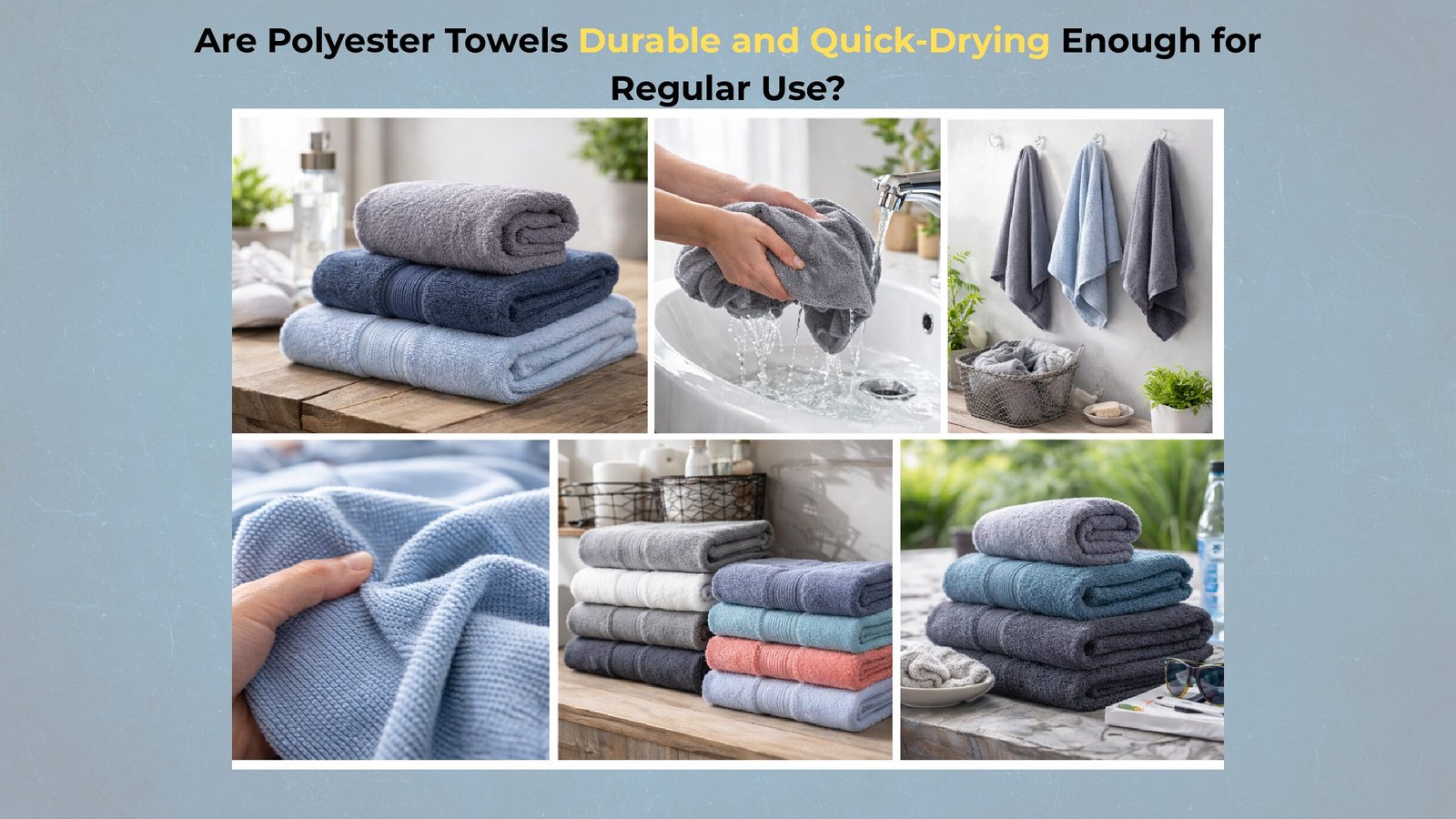
Polyester Towels are durable and quick-drying enough for regular utility use because their synthetic, hydrophobic fiber structure prioritizes speed and resilience over comfort and capacity.
Why are Polyester Towels Engineered for Speed and Resilience?
Polyester Towels are engineered for speed and resilience because their 90% crystalline chemical structure and high Tensile Strength provide maximum resistance to moisture regain and mechanical tearing. This unique molecular alignment is the primary driver behind polyester durability & drying performance in heavy-duty environments. Unlike natural fibers that rely on the hydrogen bonding of cellulose, Polyester Towels are composed of Polyethylene Terephthalate (PET), a polymer characterized by dense molecular packing. This density prevents enzymatic degradation and resists the swelling that typically weakens cotton when saturated.
Crystallinity refers to the degree of structural order in the polymer. In PET, high crystallinity ensures the fibers remain rigid and hydrophobic, directly contributing to the material’s legendary longevity in commercial laundry environments.
Analyzing the Hydrophobic Nature of Polyester Towels for Rapid Drying
Analyzing the hydrophobic nature of Polyester Towels reveals that the material achieves rapid drying by maintaining a moisture regain of only 0.4% to 0.8%, forcing water to remain on the fiber surface. This surface-level moisture management is the foundation for polyester drying speed comparisons, as the water requires significantly less thermal energy to overcome surface tension and evaporate. While a cotton fiber absorbs water into its lumen, causing the fiber to swell and hold moisture internally, Polyester Towels utilize adsorption to manage moisture efficiently.
Correlating High Tensile Strength with Polyester Towels Durability
Correlating high Tensile Strength with Polyester Towels durability shows that their tenacity of 6.0 to 7.0 cN/dtex makes them nearly twice as resistant to tearing as standard cotton. This high tenacity allows Polyester Towels to withstand the aggressive mechanical agitation of industrial washers, proving superior polyester rough-use durability even in commercial fitness settings. Furthermore, an elongation at break of 15% to 25% ensures that these towels retain their geometric shape under stress, resisting the “bagging” or distortion common in natural fibers.
Evaluating the Wicking Mechanics of Polyester Towels
Evaluating the wicking mechanics of Polyester Towels demonstrates that they utilize capillary pressure—defined by the Young-Laplace equation—to transport liquid at speeds of 10 to 15 cm/min. These split-filament structures are often highlighted in the fastest-drying microfiber comparison because they maximize the surface area-to-volume ratio. This creates narrow channels that pull water away from the skin via capillary action, ensuring the user feels dry even when the textile is holding significant surface moisture.
How Do You Compare Polyester Towels Against Traditional Cotton?
You compare Polyester Towels against traditional cotton by measuring the core trade-offs: synthetic wicking and 500-cycle durability versus deep cellulosic absorption and skin-friendly softness. While cotton excels in perceived comfort and high-volume water storage, Polyester Towels dominate in utility performance, specifically where weight-to-dry-speed ratios are critical.
Comparison Matrix: Polyester Towels vs. Cotton Mechanical Performance
This comparison matrix shows the fundamental differences in fiber chemistry and mechanical behavior between Polyester Towels and natural fibers.
| Property Metric | Cotton (Cellulosic) | Polyester (Synthetic) | Impact on Regular Use |
|---|---|---|---|
| Tensile Strength | 3.0–3.5 cN/dtex | 6.0–7.0 cN/dtex | Resists thinning and tearing |
| Wicking Rate | 2–4 cm/min | 10–15 cm/min | Instant moisture removal |
| Moisture Regain | 7–8% | 0.4–0.8% | Does not swell when wet |
| Wash Lifecycle | 50–100 Cycles | 300–500 Cycles | 50% lower cost-per-use |
| Odor Retention | Low (Staph-dominant) | High (Micrococcus-dominant) | Requires specialized laundry care |
Analyzing the Microbiological Challenges of Polyester Towels
Analyzing the microbiological challenges of Polyester Towels reveals that Micrococcus bacteria thrive on synthetic surfaces, breaking down sweat lipids into pungent, volatile fatty acids. A key understanding of polyester odor retention is essential for users, as the oleophilic nature of the material traps sebum more aggressively than cotton. Without targeted laundry protocols, these oils oxidize, creating the persistent “gym smell” often associated with older synthetic textiles.
When Do the Unique Properties of Polyester Towels Become Essential?
The unique properties of Polyester Towels become essential in environments like hot yoga studios or commercial gyms where rapid desiccation kinetics and antimicrobial treated surfaces are required.
Maximizing Hygiene with Antimicrobial Treated Polyester Towels
Maximizing hygiene is achieved in Polyester Towels through the integration of silver (Ag-NPs) or zinc oxide (ZnO-NPs) which can reduce bacterial loads by over 4.0 log CFU. While topical treatments on natural fibers often wash away within 10 cycles, mineral-infused synthetic filaments maintain 90% efficacy after 50 wash cycles because the antimicrobial agents are embedded within the polymer matrix itself.
Managing Dermatological Risks with Polyester Towels
Managing dermatological risks with Polyester Towels requires a “pat-dry” technique to prevent the high coefficient of friction (COF) from stripping the skin’s natural lipid barrier. Aggressive rubbing with microfiber can lead to Transepidermal Water Loss (TEWL) and mechanical irritation, making them less suitable for individuals with sensitive skin conditions compared to soft-loop terry cotton.
How Can You Preserve the Durability and Speed of Polyester Towels?
You can preserve the durability and speed of Polyester Towels by strictly avoiding fabric softeners that block wicking channels and heat levels that exceed the 140°F (60°C) glazing limit.
Data Table: Maintenance Violations and Failure Thresholds
This data table details the maintenance limits for Polyester Towels to prevent critical fiber failure and loss of capillary function.
| Violation | Impact on Towel | Mechanism of Damage |
|---|---|---|
| Tumble Drying >140°F | Fiber Glazing/Melting | Loss of Adsorptive Capacity |
| Fabric Softener | Waxy Coating | Blocks wicking channels; causes beading |
| Cycle 150+ | Performance Decline | 30% reduction in absorption speed |
| Cycle 300+ | Critical Failure | Fiber clumping and increased lint shedding |
Best Practices for Mechanical Wringing to Accelerate Drying
Best practices for mechanical wringing are essential for Polyester Towels, leveraging the lack of internal moisture retention to eject water and achieve a near-dry state instantly. Because PET fibers do not absorb water into their core, mechanical compression forces interstitial water out of the capillary gaps with nearly 90% efficiency. This allows the towel to return to functional service almost immediately compared to the hours-long drying window required by saturated cellulosic fibers.
How Do You Validate Durability Claims in Polyester Towels Before Buying?
You validate durability claims in Polyester Towels before buying by executing a physical audit focused on fiber split-density and chemical safety certifications. For those comparing multiple fiber types, our Towel Material Selector tool can help identify the ideal match for specific utility constraints. Higher quality synthetics use a “multi-filament” approach which is visible under slight magnification as a star-shaped cross-section.
Executing a 4-Step Polyester Towels Quality Audit
The Wicking Test: Does a water drop spread horizontally across the surface instantly (indicates high capillary pressure)? Beading indicates poor capillary pressure or chemical coatings.
The Friction Check: Does the fabric feel slightly “grabby” (signals the split-fiber structure necessary for effective wicking)?
The Certification Check: Is the item OEKO-TEX® Standard 100 certified (ensures absence of irritant disperse dyes or heavy metals)?
The Weight Consistency: Is the towel significantly lighter than cotton but with a denser knit (indicates high-tenacity filament use)?
Frequently Asked Questions
Why do my Polyester Towels develop a permanent odor after regular use?
Polyester is oleophilic, meaning it attracts and bonds with skin oils (sebum). Over time, these oils are broken down by Micrococcus bacteria into volatile fatty acids. Standard detergents often fail to reach the fiber core; using an enzymatic cleaner or a strip-wash protocol is required to remove this lipid-based residue.
Are Polyester Towels eco-friendly compared to cotton?
The sustainability of Polyester Towels is a trade-off. While they require significantly less water during the manufacturing and drying phases, they are derived from petroleum and can release microplastics into the water supply. Utilizing recycled PET (rPET) and washing with microfiber filtration bags mitigates this environmental footprint.
Can I use bleach on Polyester Towels to maintain hygiene?
Bleach is generally discouraged for PET fibers. Sodium hypochlorite can degrade the split-fiber structure and cause “yellowing” of the synthetic filament. For disinfection, oxygen-based bleaches or mineral-infused (Ag-NPs) towels are safer alternatives for maintaining industrial hygiene without compromising tensile strength.
Why do new Polyester Towels sometimes repel water initially?
Initial water repellency is typically caused by factory “finishing agents” used during the textile’s manufacturing to lubricate the looms. A single high-cycle wash without fabric softener is usually sufficient to strip these surfactants and activate the material’s capillary wicking properties.
How do I know if my Polyester Towel has “melted”?
“Melting,” or glazing, occurs when the textile exceeds its thermal threshold (140°F+). You can identify this by a flattened, shiny appearance of the fibers or a “stiff” tactile feel. Glazed fibers lose their split-filament geometry, which permanently inhibits their ability to transport water via capillary action.
Disclaimer: The information provided in this guide is for educational and informational purposes only and does not constitute professional dermatological, medical, or textile engineering advice. While Polyester Towels offer high durability and wicking performance, users with sensitive skin conditions (such as eczema or dermatitis) should exercise caution due to the material’s high coefficient of friction and oleophilic nature.
Toweldaily.com does not guarantee specific results regarding the wash lifecycle or antimicrobial efficacy, as individual outcomes may vary based on laundry chemistry, water hardness, and environmental conditions. Always refer to the manufacturer’s care label before implementing high-temperature maintenance protocols.
Conclusion: Are Polyester Towels Suited for Your Everyday Use?
Polyester Towels are suited for your everyday use if your routine prioritizes mechanical longevity, industrial hygiene, and rapid desiccation over the plush tactile feel of natural fibers.