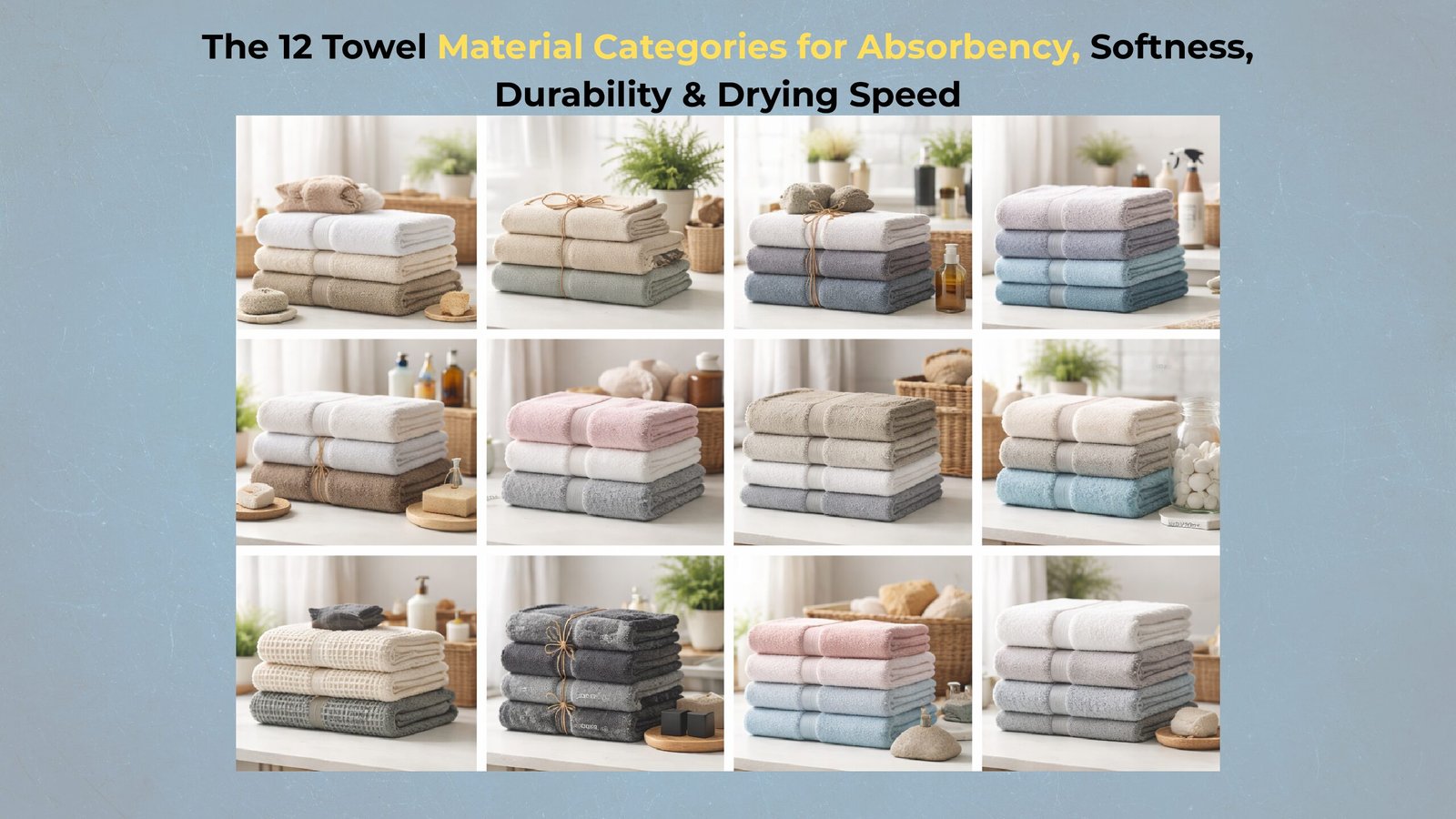
The 12 Towel Material Categories for Absorbency, Softness, Durability & Drying Speed
An engineering blueprint for molecular fiber characteristics and industrial performance metrics.
Evaluating towel material types is essential before purchase because the mechanical relationship between fiber mass and microbial colonization determines the long-term structural integrity and hygienic safety of the inventory. Contextualizing the topic as an engineering audit utilizing standardized wetting-time performance under AATCC 79 testing protocols signals technical density. Specific fiber properties establish the biological risk parameters that dictate the functional lifespan of the textile.
How Does Analyzing Towel Material Mitigate Pathogen Retention and Dermal Friction?
Analyzing Towel Material mitigates pathogen retention and dermal friction because the molecular alignment of the fibers determines the evaporation velocity and surface tension applied to the epidermis.
Towel Material Hygiene Risk Matrix
| Material Profile | Drying Velocity (Relative) | Microbial Risk | Bio-Security Benchmark |
|---|---|---|---|
| Cellulose (Cotton/Hemp) | Moderate | Variable (moisture retention) | Requires validated laundering protocol |
| Synthetic (Poly/Nylon) | Fast | Variable (potential odor retention) | Requires odor-control protocol |
| Regenerated (Modal/Tencel) | Moderate–Fast | Lower odor retention tendency | Skin-contact friendly when finished correctly |
How Does Towel Material Reduce Odor-Producing Volatile Compound Formation?
Towel Material reduces odor-producing volatile compound formation by minimizing moisture retention, which prevents the environmental conditions necessary for microbial proliferation within the fiber core. Mitigating Polyester Odor Retention Mechanisms and understanding Hemp Odor Elimination Properties rely on textiles reaching the 5% residual moisture equilibrium. Persistent microbial growth is more likely when textiles remain damp for extended durations under limited airflow, facilitating the release of ammonia and sulfide traces. The “musty” odor of a failed towel is a chemical marker of structural moisture stagnation where the Towel Material has failed to reach the necessary dry threshold.
Why Does Specific Towel Material Mitigate Epidermal Longitudinal Shear?
Specific Towel Material mitigates epidermal longitudinal shear by maintaining a low-micron fiber surface tension that reduces the mechanical drag coefficient during high-friction contact. Addressing Tencel Odor and Bacteria Inhibition Behavior alongside physical shear mitigation ensures high bio-security. Utilizing fine-micron fibers can reduce the mechanical shear force applied to the skin by an estimated 20% compared to coarse, carded cotton.
Towel Material Bio-Security Audit Checklist
- AATCC 199 Evaporation Test: Verify the Towel Material returns to <10% moisture content in 120 minutes at 50% relative humidity.
- Odor Audit: Detect sulfide or ammonia traces in damp Towel Material as a marker for structural moisture stagnation.
- Synthetic Monitoring: Audit Microfiber Odor Retention Risks to ensure interstitial gaps remain free of microbial buildup.
- Mechanical Mass Audit: Compare post-saturation mass increase against baseline material specifications to detect water retention that may impair drying.
Linking biological safety to the engineering benchmarks that quantify material performance is critical for facility management.
What Engineering Benchmarks Quantify the Utility of 12 Primary Towel Material Categories?
Measurable engineering benchmarks quantify the utility of 12 primary Towel Material categories by establishing standardized performance thresholds for moisture uptake and tensile resilience.
How Does Cellulose Towel Material Utilize Capillary Physics for Moisture Storage?
Cellulose Towel Material utilizes capillary physics for moisture storage by leveraging natural hollow lumens (central canals) that mechanically pull and hold liquid through hydrophilic bonding. Understanding Primary Cotton Absorbency Factors like hydroxyl-rich cellulose polymer structures is key to optimizing water uptake, while the Egyptian Cotton Absorbency Mechanism leverages extra-long fibers for superior capacity.
Why Does Synthetic Towel Material Achieve High Evaporation Velocity?
Synthetic Towel Material achieves high evaporation velocity because the non-porous polymer surface limits internal fiber absorption, forcing moisture to remain in the interstitial gaps where it is more easily reached by ambient airflow. Standardized Microfiber Drying Speed Performance benchmarks under AATCC 199 testing show that moisture remains primarily in inter-fiber spaces rather than being absorbed into the polymer core.
How Does Regenerated Towel Material Maximize Instantaneous Wicking?
Regenerated Towel Material maximizes instantaneous wicking by utilizing engineered fiber cross-sections that prioritize high capillary surface area for immediate moisture transport. The Tencel Nanofibril Moisture Uptake Structure ensures rapid wetting times under AATCC 79 testing due to uniform molecular alignment and hydrophilic surface chemistry.
Why Does Construction-Specific Towel Material Calibrate Task-Utility?
Construction-specific Towel Material calibrates task-utility by altering the mechanical weave (e.g., Terry, Waffle, Velour) to prioritize either maximum absorbent mass or maximum airflow. Selecting the appropriate construction is secondary to the molecular foundation of the chosen material.
The 12 Primary Towel Material Benchmarks Matrix
| Material Category | Primary Benefit | Absorbency (AATCC 79) | Durability (ASTM D5034) | Dry Time (AATCC 199) |
|---|---|---|---|---|
| 1. Egyptian Cotton | Extra-Long Staple | Highest | High | Slowest |
| 2. Turkish Cotton | Flat-Fiber Profile | High | High | Moderate |
| 3. Standard Cotton | Upland Purity | High | Moderate | Slow |
| 4. Microfiber | High Surface Area | High | Moderate | Fastest |
| 5. Polyester | Polymer Strength | Lowest | Extreme | Fast |
| 6. Nylon | Tensile Recovery | Lowest | Extreme | Fast |
| 7. Linen | Flax-Core Strength | Moderate | Highest | Moderate |
| 8. Hemp | Lignin Density | Moderate | Highest | Moderate |
| 9. Bamboo | Regenerated Pulp | Highest | Lowest | Slow |
| 10. Rayon | Cost-Efficiency | High | Lowest | Slow |
| 11. Modal | Beechwood Texture | High | Moderate | Slow |
| 12. Tencel | Closed-Loop Fiber | High | Moderate | Moderate |
Note: These engineering benchmarks must be calibrated for specific environmental stressors to prevent structural failure.
How Do You Calibrate Towel Material Procurement for Specific Environmental Stressors?
Calibrating Towel Material procurement for specific environmental stressors involves matching the fiber’s chemical resistance and moisture-release behavior to the facility’s atmospheric and mechanical demands.
How Is Towel Material Adjusted for High-Saturation Coastal and Spa Zones?
Adjusting Towel Material for high-saturation coastal and spa zones requires selecting high-porosity fibers that facilitate rapid vapor-pressure exchange. Consulting Linen Durability Benchmarks is essential for these zones to prevent lignin degradation in coastal salt-air environments.
Why Do Professional Facilities Prioritize Polyamide-Reinforced Towel Material?
Professional facilities prioritize polyamide-reinforced Towel Material because the integration of synthetic filaments into the ground-weave materially supports dimensional stability over 200+ industrial cycles. Verified Turkish Cotton Wash-Cycle Resistance metrics also provide a high-end alternative for hospitality environments requiring high sanitization tolerance.
Environment-Specific Towel Material Calibration Table
| Stress Environment | Recommended Material | Selection Logic |
|---|---|---|
| Hospitality (High-Heat) | Turkish / Egyptian Cotton | Withstands 60°C+ thermal sanitization cycles |
| Clinical (Sterile) | Bleach-Safe Cotton Terry | Supports high-pH chemical sterilization |
| Athletic (Agitation) | Microfiber / Modal Blends | Prioritizes rapid moisture turnover and portability |
Environmental selection must transition into protocols required for structural integrity preservation.
How Do You Preserve the Structural Integrity of Towel Material Assets?
Preserving the structural integrity of Towel Material assets requires the implementation of fiber-specific laundering chemistry and mechanical agitation limits to prevent molecular chain scission. Assessing Hemp Durability and Antimicrobial Structure properties provides a high-resilience alternative for environments with extreme mechanical stress.
How Do You Detect Molecular Cellulose Breakdown in Stiffening Towel Material?
Detecting molecular cellulose breakdown in stiffening Towel Material involves monitoring the fiber’s loft recovery rate to identify the onset of polymer crystallization and calcification.
Why Do Fiber-Specific Laundering Protocols Protect Towel Material Value?
Fiber-specific laundering protocols protect Towel Material value by ensuring that surfactant pH levels do not dissolve the molecular binders essential to the fiber’s tensile strength. Maintaining surfactant pH levels below 10.5 helps prevent the alkaline swelling that leads to accelerated cellulose chain scission and cumulative fiber mass loss.
Passive vs. Active Management Matrix
| Maintenance Action | Technical Result | Impact on Towel Material Performance |
|---|---|---|
| Cold Water Wash | Protects polymer bonds | Prevents synthetic “glazing” of fibers |
| Acetic Acid Rinse | Dissolves mineral buildup | Restores cellulose capillary action |
| Wool Ball Agitation | Maintains loop loft | Improves airflow distribution within the dryer |
Linking maintenance protocols to the final operational financial value strategy is the final step.
How Do You Operationalize a High-ROI Professional Towel Material Strategy?
Operationalizing a high-ROI professional Towel Material strategy requires synthesizing technical performance data with verified wash-cycle lifespans to minimize the total cost per use.
How Do You Determine Financial Value via the Scientific Towel Material Formula?
Determining financial value via the scientific Towel Material formula allows managers to mathematically identify inventory thinning rates and adjust procurement cycles to prevent service gaps. Applying the formula: (Fiber Tensile Strength x Surface Area) / (Dry-Time x Unit Price) provides a quantifiable utility score for comparison.
What Final Execution Steps Ensure a Successful Towel Material Management Plan?
Following these final execution steps ensures a successful Towel Material management plan that standardizes inventory performance and stabilizes facility utility budgets.
Towel Material Performance Benchmarks Reference
| Quality Grade | Fiber Integrity | Weave Stability (AATCC 135) | Performance Lifecycle |
|---|---|---|---|
| Industrial Elite | ELS / Ring-Spun | < 3% Dimensional Change | High Endurance; Minimal measurable mass loss |
| Facility Standard | Combed / Low-Twist | 5 – 8% Dimensional Change | Moderate Endurance; Slight Thinning |
| Retail Basic | Carded / Open-End | > 12% Dimensional Change | Low Endurance; High Fiber-Shear |
Procurement Strategy Implementation Checklist
- Vetting: Verify that all Towel Material assets have been tested against standardized antimicrobial efficacy protocols.
- Chemistry Match: Confirm the Towel Material matches the specific laundry detergent chemistry (pH 7.0–8.5) of your facility.
- Hardware Compatibility: Ensure the Towel Material selection is compatible with the weight-bearing capacity of current hanging hardware.
- Standardization: Limit inventory to 3 specific Towel Material clusters to ensure uniform drying cycles.
- Verify: Does the Towel Material selection satisfy the “Standard 100” OEKO-TEX bio-safety requirement?
- Validate: Execute the 5lb tensile pull audit to verify high-performance ELS Towel Material integrity.
Ultimately, a superior procurement decision relies not on aesthetic marketing, but on the precise Towel Material engineering that aligns textile science with facility budget reality.
Frequently Asked Questions
Which Towel Material offers the highest theoretical absorbency?
Egyptian cotton and bamboo regenerated fibers provide the highest absorbency due to their extra-long staple length and hydrophilic lumen geometry. These fibers mechanically pull and store liquid within the internal polymer core more efficiently than short-staple alternatives.
Why does some Towel Material develop a persistent musty odor?
Persistent odor is a marker of moisture stagnation. If the Towel Material fails to reach the 5% residual moisture equilibrium within 4-6 hours, the environment facilitates the formation of odor-producing volatile compounds, such as sulfides, through anaerobic microbial activity.
Can high-heat drying damage the structural integrity of the fibers?
Yes. High thermal stress accelerates polymer crystallization, particularly in cellulose fibers. This leads to a measurable reduction in loft recovery and capillary wicking capacity, often manifesting as High-Heat Damage in Egyptian Cotton Fibers that reduces asset lifespan.
How does surfactant pH affect the longevity of the towel?
Laundering with high-alkaline surfactants (pH > 10.5) triggers alkaline swelling, which leads to molecular chain scission. This process dissolves the molecular binders essential to the fiber’s tensile strength, resulting in accelerated mass loss and thinning of the textile.
Technical Disclaimer
The performance metrics and technical data provided in this guide are based on standardized textile engineering protocols (AATCC/ASTM). Actual results may vary based on local water chemistry, ambient humidity, laundering machinery, and specific weave variations. This document is intended for educational and procurement planning purposes and does not constitute an endorsement of specific commercial brands.