TowelDaily · Towel Guide
A task-first guide to choosing, displaying, testing, rotating, and caring for compact bathroom towels.
Fingertip towels work best as compact, replaceable textiles for light hand drying, individual guest use, or coordinated bathroom display. Their value comes from matching a small format to a defined task—not from one standard dimension, fiber, GSM, fold, or laundering formula.
A product called a fingertip towel may overlap in size with a guest towel, small hand towel, or large washcloth. Measure the finished item, decide whether it is decorative, functional, or both, and evaluate its usable surface after any embroidery, border, or fold. That sequence keeps merchandising language from becoming a performance guarantee.
Task first
Display, dry, or clean
Measure it
Do not assume a standard
Test separately
Wetting is not drying
Rotate clean
Dry before storage
What is a fingertip towel?
A fingertip towel is a compact household textile usually positioned near a sink or vanity for light drying, guest presentation, or a narrowly assigned task. The name describes a market format rather than a single technical standard, so dimensions and construction should be read from the product specification.
Eleven by eighteen inches is a common retail example, but it is not a mandatory boundary. Some products sold under the same name are narrower, longer, smoother, more decorative, or closer to washcloth size. A useful definition therefore combines labeled purpose, measured dimensions, construction, and actual placement.
How should fingertip-towel dimensions be measured?
Measure width and length in a conditioned, flat state, then record the same dimensions after the planned laundry trial. Also measure usable face area, because embroidery, stiff borders, labels, and folds can reduce the surface available for hand contact.
AATCC TM135 is intended to determine length and width changes in fabrics subjected to home-laundering procedures. The current method routes standardized laundering conditions through AATCC LP1, which helps make before-and-after measurements comparable. It does not establish the correct size for a fingertip towel. See AATCC TM135.
When does a fingertip towel work as bathroom décor?
A fingertip towel works as décor when its color, texture, border, fold, and scale reinforce the room without hiding the drying option. Decorative success is therefore partly functional: a guest should be able to tell whether the towel may be used and where a used towel belongs.
Choose contrast deliberately. A tone that repeats a tile, soap dispenser, or artwork color can create cohesion, while a quiet texture can add depth to a neutral room. Embroidery and woven bands provide focal detail, but a large stiff decoration can reduce drape and comfortable contact area.
When appearance is the primary goal, how fingertip towels function as bathroom décor helps balance color, texture, folding, accessibility, and usable drying area.
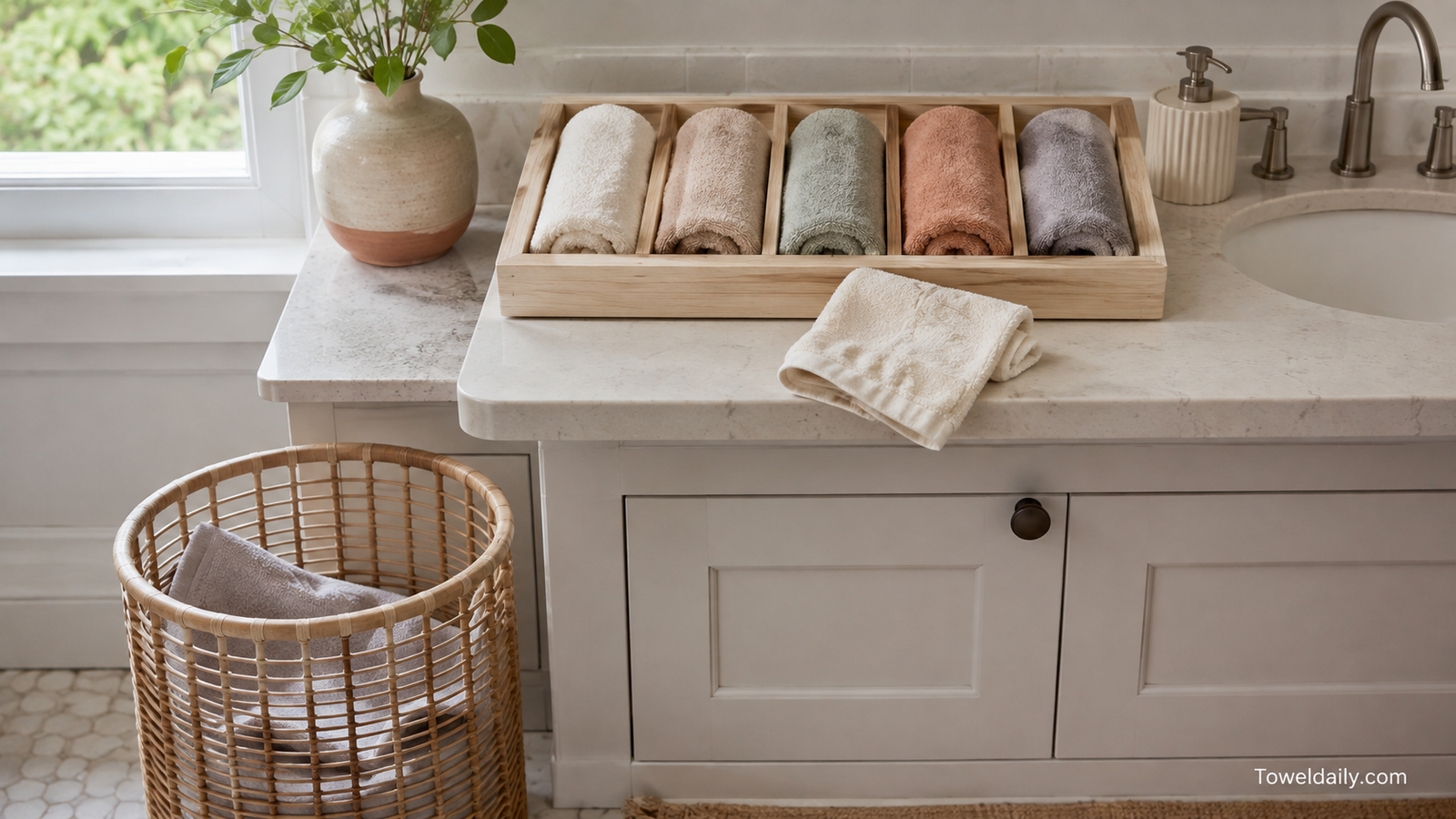
Keep one edge easy to grasp, leave the sink clear, and provide a nearby used-towel basket or hook.
If the styled piece is not for use, place an unmistakable functional towel within comfortable reach.
Avoid folds that expose only a decorative band while trapping damp inner layers. A stacked arrangement can look orderly, but it needs enough space for a user to remove one towel without disturbing the entire display. Visual composition should support replacement, not turn the textile into a fixed ornament.
Which functional tasks suit a fingertip towel?
Fingertip towels suit light hand drying, individual guest rotation, and narrowly assigned vanity tasks when their clean surface and capacity match the expected water or soil. The small format becomes a limitation when several users, repeated contacts, or heavy spills exceed that surface.
| Task | Why the format can work | Main control | When to choose another format |
|---|---|---|---|
| Light hand drying | Compact placement near a small sink | Enough clean area for the expected contacts | High traffic or no rapid replacement supply |
| One towel per guest | Easy identification and rotation | Separate clean and used textiles | Guests cannot tell which towel is theirs |
| Face or cosmetic task | Small area limits unnecessary laundry mass | Personal assignment and cosmetic-compatible color | Active irritation, wounds, or a care instruction says otherwise |
| Countertop moisture | Convenient for a small, clean-water splash | Keep separate from face and hand textiles | Cleaning chemicals, food soil, or large spills are involved |
Do not rotate one towel among incompatible tasks. A cloth used on a countertop should not return to face or hand contact merely because it still looks clean. Color, label, location, or storage compartment can identify assignments without implying that color itself creates hygiene.
If the towels will be offered individually to visitors, how fingertip towels support guest use becomes the next consideration when planning placement, identification, and rotation.
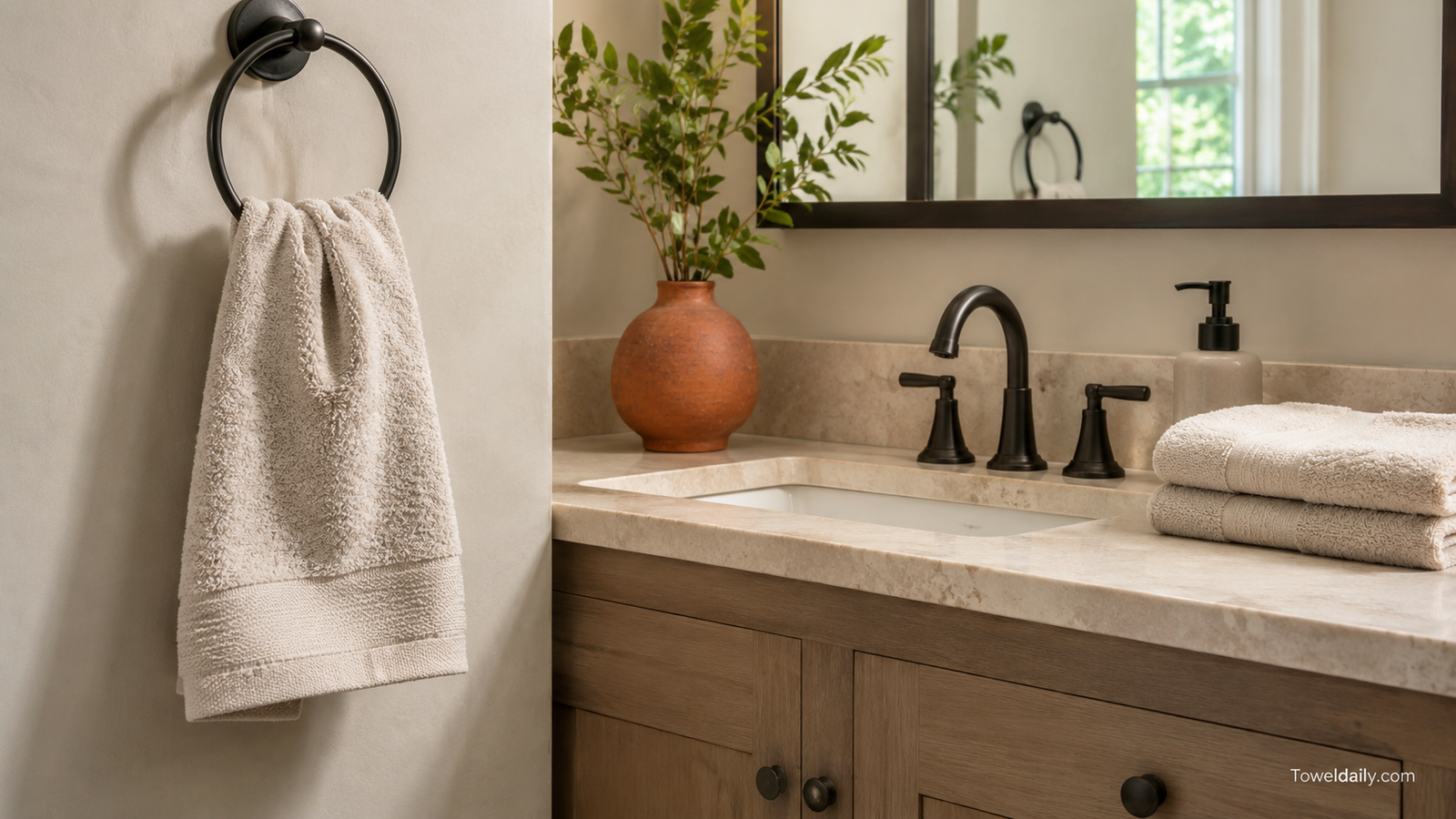
How does a fingertip towel differ from a hand towel or washcloth?
A fingertip towel is usually selected for compact presentation and light drying, a hand towel for greater repeated-use area, and a washcloth for washing or direct skin work. Product names can overlap, so the reliable comparison uses dimensions, construction, intended task, and replacement plan.
| Format label | Typical decision priority | Useful question |
|---|---|---|
| Fingertip towel | Compact fit plus presentation | Does it provide enough usable area for the planned light contact? |
| Hand towel | Repeated hand-drying surface | Can it remain accessible and dry adequately between expected uses? |
| Washcloth | Washing, cleansing, or controlled skin contact | Is its texture and assignment appropriate for the user and product involved? |
| Guest towel | Individual presentation or service | What size and task does this supplier mean by “guest towel”? |
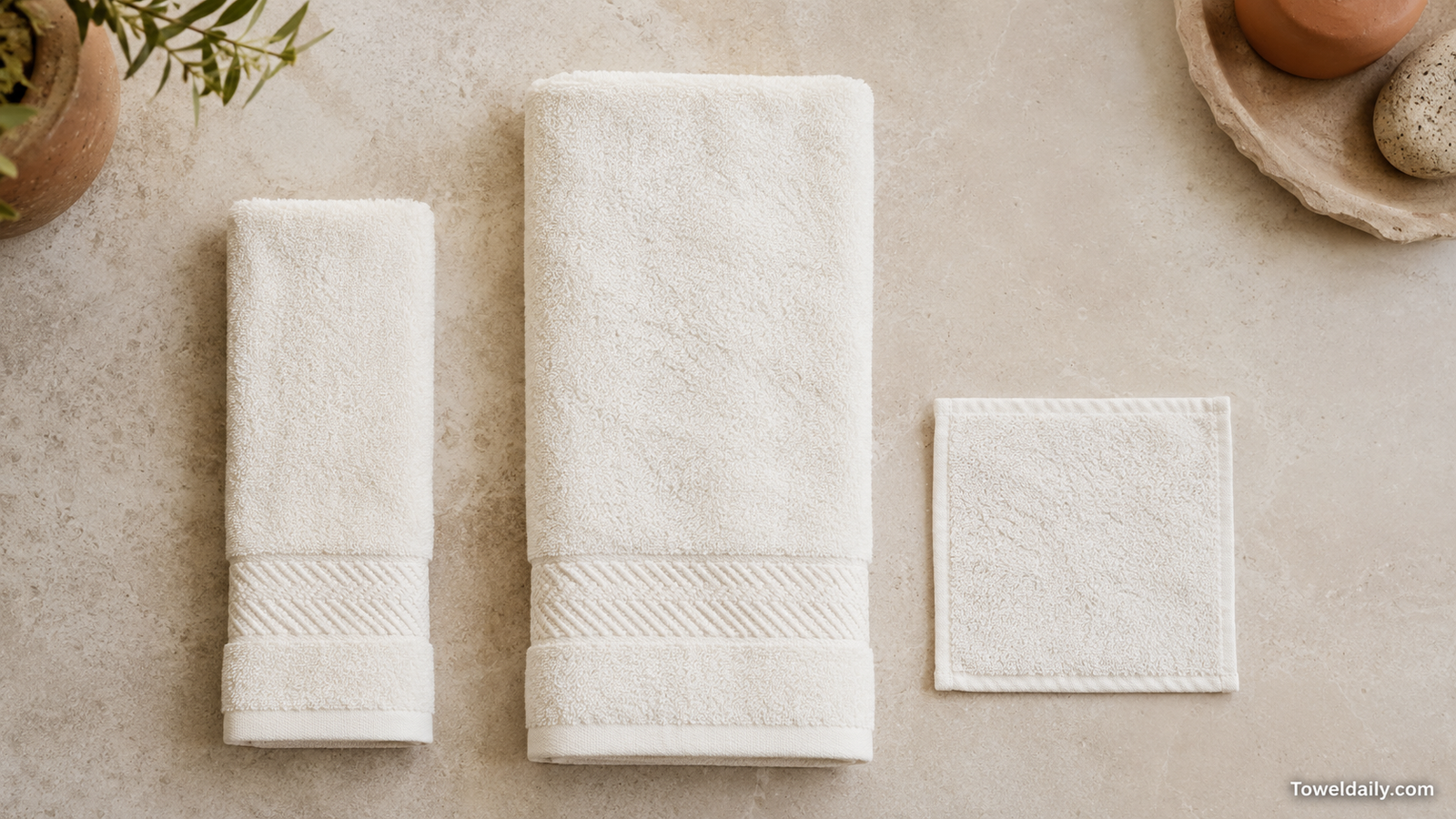
The key trade-off is usable area versus turnover. A smaller towel may be easier to issue one per person, but it can saturate sooner. A larger towel offers more surface, but shared use and slow drying may undermine the intended hygiene or presentation system.
How should fingertip-towel size be chosen?
Choose fingertip-towel size by measuring the holder, folded display, hanging clearance, hand-contact area, and expected water load. The best size is the smallest one that completes the task without touching the counter or floor, bunching in the fixture, or saturating prematurely.
- ☐ Measure the location: ring width, bar length, counter footprint, and clearance below the hanging edge.
- ☐ Simulate the fold: confirm that embroidery and borders remain aligned without consuming most of the usable face.
- ☐ Simulate the task: use the expected number of hand contacts or the planned vanity task.
- ☐ Check wet handling: confirm the towel does not become awkwardly heavy, slippery, or difficult to hang.
- ☐ Re-measure after laundering: record dimensional change before approving additional units.
If a labeled 11 × 18-inch towel fits one holder but not another, the issue is not a defective category standard; it is a fit mismatch. Record the acceptable finished range for the specific bathroom and include shrinkage tolerance in purchasing criteria.
How do material and construction affect a fingertip towel?
Material and construction affect wetting, pickup, capacity, texture, drape, lint, stain visibility, and drying, but fiber name alone predicts none of them completely. Compare finished towels under the same conditioning, water load, contact, and laundry history.
Fiber names become meaningful only when evaluated alongside the materials and constructions used in fingertip towels because pile, weave, borders, and decoration affect the finished surface.
| Construction | Potential advantage | Potential limitation | Validate |
|---|---|---|---|
| Cotton terry | Raised pile can support surface pickup | Pile can add bulk and retain more water | Wetting, pickup, lint, and drying after laundering |
| Low-profile woven cotton or blend | Flat display and reduced visual bulk | May feel less cushioned | Surface pickup and wet feel for the intended contact |
| Synthetic microfiber | Can provide compact construction and fine surface contact | Composition, split, knit, finish, and care vary | Residue, lint, edge quality, and task compatibility |
| Decorated or embroidered textile | Strong visual identity | Stiff or nonabsorbent zones can reduce usable area | Drape, colorfastness, distortion, and contact comfort |
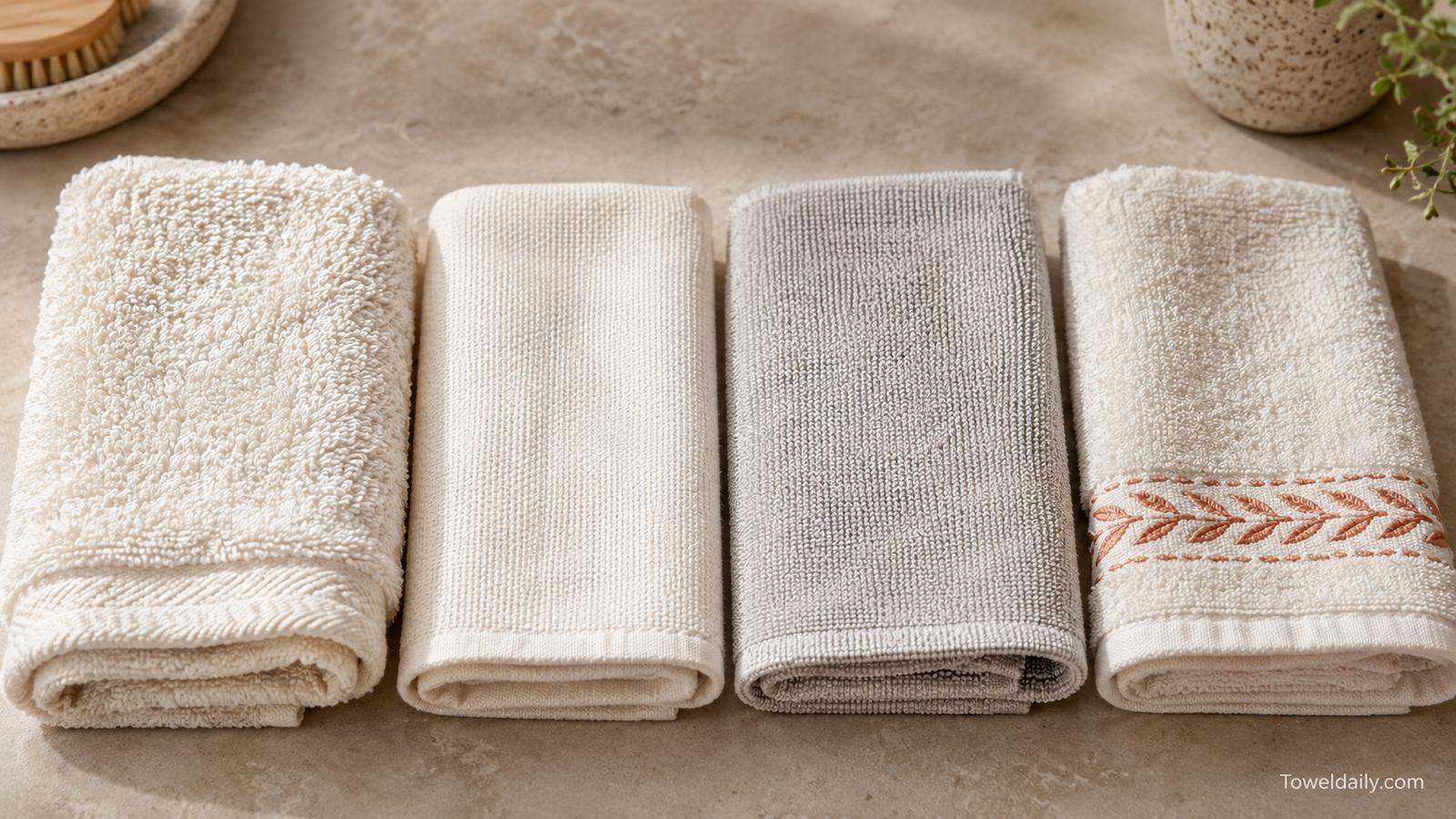
Why can GSM not identify the best fingertip towel?
GSM reports dry mass per square metre; it does not reveal total towel mass, fiber placement, pile geometry, finishes, wetting speed, pickup, capacity, or drying time. A denser sample can feel substantial while performing worse for a particular task.
Use GSM as one controlled description, then compare specimens of equal dimensions through the relevant wetting and drying tests. Decorative bands and embroidery can also raise total mass without adding proportional drying surface, which makes finished usable area more informative than a luxury-GSM claim alone.
How should fingertip-towel absorbency and drying be tested?
Test fingertip-towel wetting, surface pickup, retained capacity, and drying as separate properties under controlled conditions. Use the method that matches the construction and task, and report water load, specimen state, contact procedure, environment, laundering history, and variability.
Once the intended task and usable area are defined, what determines fingertip-towel absorbency should be tested under the expected water load and number of contacts.
ASTM D4772 measures the ability of terry fabric to rapidly absorb and retain liquid water from a surface. Its scope says the method is not applicable to several non-terry formats because runoff or pass-through can make the result invalid. See ASTM D4772-26.
Why do fingertip towels need more than one moisture test?
One test cannot prove every moisture claim because initial wetting, liquid movement, surface removal, absorbent capacity, and evaporation describe different events. A towel can wet quickly yet hold too little for several contacts, or hold more water while taking longer to dry.
AATCC’s moisture-management proficiency program lists nine distinct methods, including TM79 for absorbency, TM197 and TM198 for wicking, TM199 for drying time, and TM200 and TM201 for drying rate under different conditions. That separation is the practical evidence that “absorbent” and “quick-drying” are not interchangeable claims. See the AATCC method group.
A small towel that removes water effectively can still remain damp between users, making the factors that control fingertip-towel drying time important when selecting its hanging position and replacement schedule.
- ☐ Condition: compare specimens at the same temperature, humidity, and dry state.
- ☐ Standardize: use the same water amount, contact area, pressure, and timing.
- ☐ Repeat: test several specimens and report the range, not only the best result.
- ☐ Process: repeat after representative laundering to detect finishes, shrinkage, or residue effects.
How should fingertip towels be assigned for hygienic use?
Assign fingertip towels by person or task, separate clean towels from used ones, and replace them before dampness, visible soil, or uncertain ownership makes reuse inappropriate. A smaller towel supports hygiene only when the rotation system is clear and consistently followed.
CDC advises avoiding the sharing of personal items such as towels and washcloths in its MRSA-prevention guidance. That recommendation does not mean every shared bathroom towel transmits infection, but it supports individual assignment when skin-contact risk or illness is a concern. See CDC MRSA prevention.
For individually assigned or frequently rotated towels, how fingertip-towel hygiene should be managed for guests helps establish clear separation between clean, assigned, and used textiles.
Place clean towels where splashes and used hands will not contaminate the supply. Provide a distinct receptacle for used pieces. If a towel contacts cosmetics, wound drainage, cleaning chemicals, or an uncertain surface, remove it from service and follow the relevant laundering or disposal instructions instead of returning it to the display.
How should fingertip towels be washed and dried?
Wash and dry fingertip towels according to the textile label, washer instructions, and laundry-product directions, using a cycle suitable for the actual soil. Dose accurately, rinse as the appliance specifies, and dry completely before folding or enclosed storage.
Do not assume half-dose detergent, medium heat, monthly stripping, or fixed cups of vinegar suit every towel and machine. Excess detergent can leave residue, but insufficient detergent can leave soil. Heat tolerance also varies with fiber, dye, embroidery, elastic decoration, and finish.
After each service interval, how to care for fingertip towels correctly determines whether laundering preserves their absorbency, appearance, seams, and decorative details.
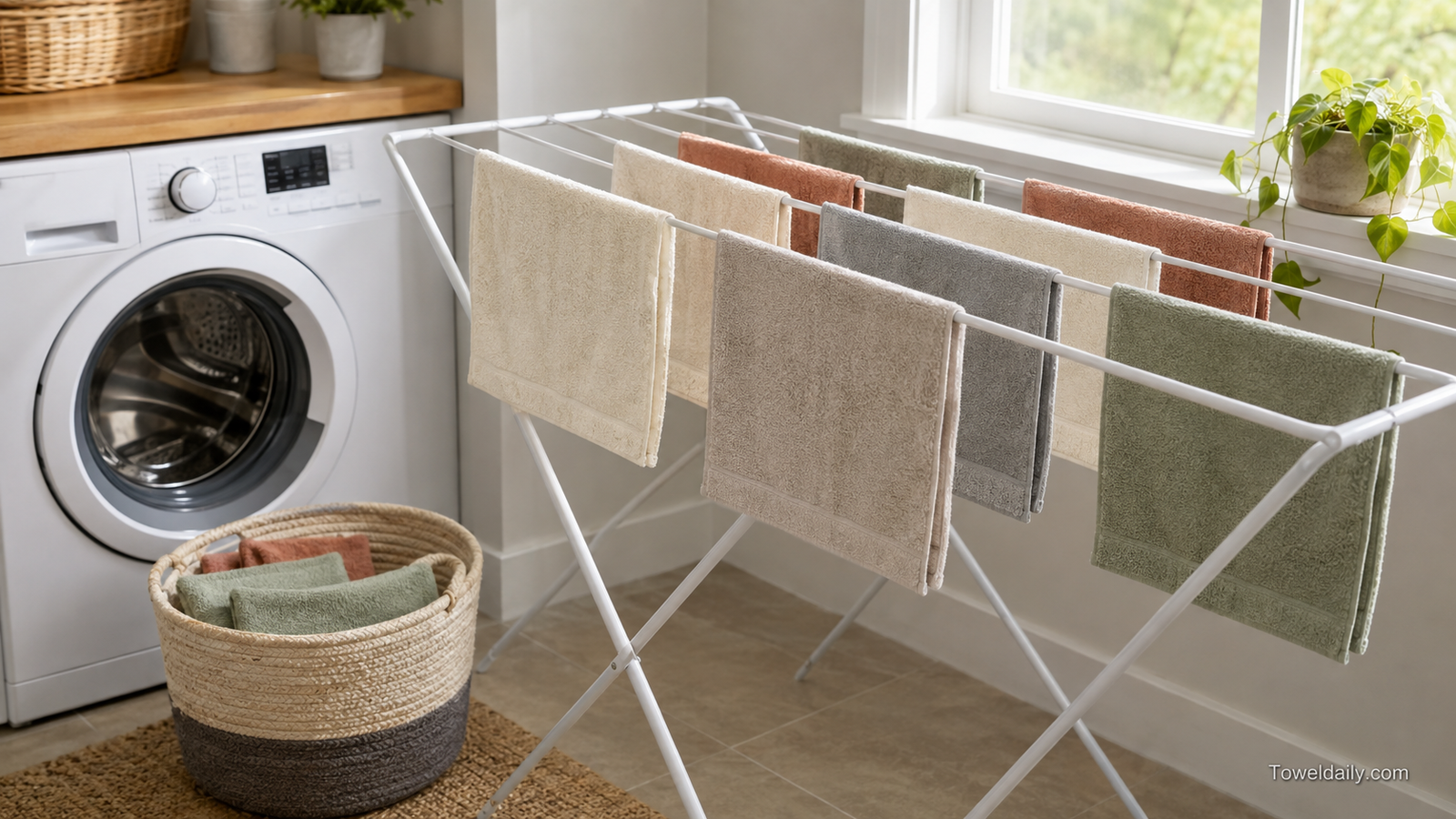
What does the evidence show about softener on cotton towels?
Conventional softeners can improve hand while reducing water absorbency, but the size of the trade-off depends on formulation, dose, textile, processing, and test method. A universal 30% reduction is not supported for all fingertip towels.
A 2021 study from Kao Corporation’s material-science laboratory described the established softness–water-absorbency trade-off and tested a modified hydrophilic approach. Earlier work by the same research group reported nearly complete adsorption of a tested softener onto cotton towels within five minutes under its experimental conditions. These product-development studies explain a mechanism but do not establish one household loss percentage. See the 2021 study and 2015 mechanism study.
If softener is allowed by the towel label and desired for feel, verify whether the finished towel still meets the drying task. If performance declines, compare a controlled softener-free wash before adopting extra chemicals. Never combine vinegar or another acid with chlorine bleach; CDC warns that hypochlorites can release toxic chlorine gas when mixed with acid. See CDC chemical guidance.
How can common fingertip-towel problems be fixed?
Fix fingertip-towel problems by identifying whether the failure involves fit, wetting, capacity, drying, residue, odor, color, or construction, then change one variable at a time. Replacing the towel immediately can hide a correctable care or placement problem.
| Symptom | Check first | Controlled response |
|---|---|---|
| Water beads on a new towel | Finish, conditioning, care instructions, and wetting method | Wash as directed and retest before rejecting the product |
| Towel saturates after one use | Size, fabric mass, water load, and contact technique | Issue a larger towel or increase individual rotation |
| Towel stays damp | Starting water load, fold, airflow, humidity, and hanging contact | Open the fold, improve exposure, or replace with a drier towel |
| Surface feels stiff | Detergent dose, rinse performance, water minerals, and heat | Correct the identified process; avoid unsupported stripping mixtures |
| Embroidery puckers | Dimensional change of base and decoration | Compare pre- and post-laundry dimensions; change product if distortion persists |
| Persistent odor | Delayed washing, incomplete cleaning, damp storage, and cross-contamination | Remove from use; correct washing and complete drying before reassessment |
How many fingertip towels are needed, and when should they be replaced?
The required quantity equals expected clean-towel demand during the service interval, plus laundering-turnaround stock and a small operational reserve. Replace individual towels on failed condition or performance criteria rather than a universal wash count or calendar date.
For example, a one-evening guest bath serving four people with one towel per person, two pieces unavailable during laundering, and one reserve would require seven towels for that scenario. Change any input and the result changes; “four per bathroom” is not a general rule.
Inspect for holes, fraying, seam opening, decoration failure, permanent soil, persistent odor after correct laundering, unacceptable stiffness, and declining water performance. Track wash count if it helps identify patterns, but retire earlier when the item no longer satisfies its assigned decorative or functional task.
When repeated washing produces fraying, stiffness, odor, or declining water performance, what determines the usable lifespan of a fingertip towel provides a more reliable replacement basis than age or wash count alone.
What do buyers ask about fingertip towels?
Buyers most often need clarity about purpose, dimensions, substitution, softener, and replacement. These answers keep each decision tied to the finished towel, bathroom task, and actual care system.
Are fingertip towels decorative or meant for use?
They can serve either role or both. A decorative fingertip towel must remain reachable and replaceable if guests may use it. If it is display-only, provide a clearly accessible drying towel so appearance does not interfere with the bathroom’s functional hand-drying task.
What is the standard size of a fingertip towel?
There is no single mandatory size. Eleven by eighteen inches is a common retail example, but labels and product dimensions vary. Measure the holder, hanging clearance, folded footprint, and usable drying area instead of treating one merchandising dimension as an industry-wide standard.
Can a fingertip towel replace a hand towel?
It can handle light, individual use when it provides enough clean surface and dries fully before reuse. For repeated or shared hand drying, a larger hand towel or a supply of fresh fingertip towels usually provides more usable area and simpler rotation.
Does fabric softener always ruin fingertip-towel absorbency?
Not by one universal percentage, but conventional softeners can reduce water absorbency under tested conditions. Follow the towel and laundry-product instructions. If pickup declines, compare otherwise identical samples washed with and without the product before changing the entire care routine.
When should a fingertip towel be replaced?
Replace it when holes, fraying, seam failure, permanent contamination, persistent odor after correct laundering, unacceptable stiffness, or failed water-performance criteria make it unsuitable. Age and wash count can support records, but neither establishes a universal replacement date for every construction.
What is the best use case for a fingertip towel?
The best use case is a compact bathroom task that benefits from deliberate presentation and frequent replacement: light hand drying, one-per-guest service, or a clearly separated vanity function. The towel succeeds when its measured fit, usable area, water performance, drying, hygiene assignment, and care routine work together.
Treat 11 × 18 inches, cotton, microfiber, GSM, and decorative styling as product descriptors—not guarantees. Define the task, compare finished samples, test the relevant moisture properties separately, launder according to instructions, and replace the item when condition or performance no longer meets the requirement.