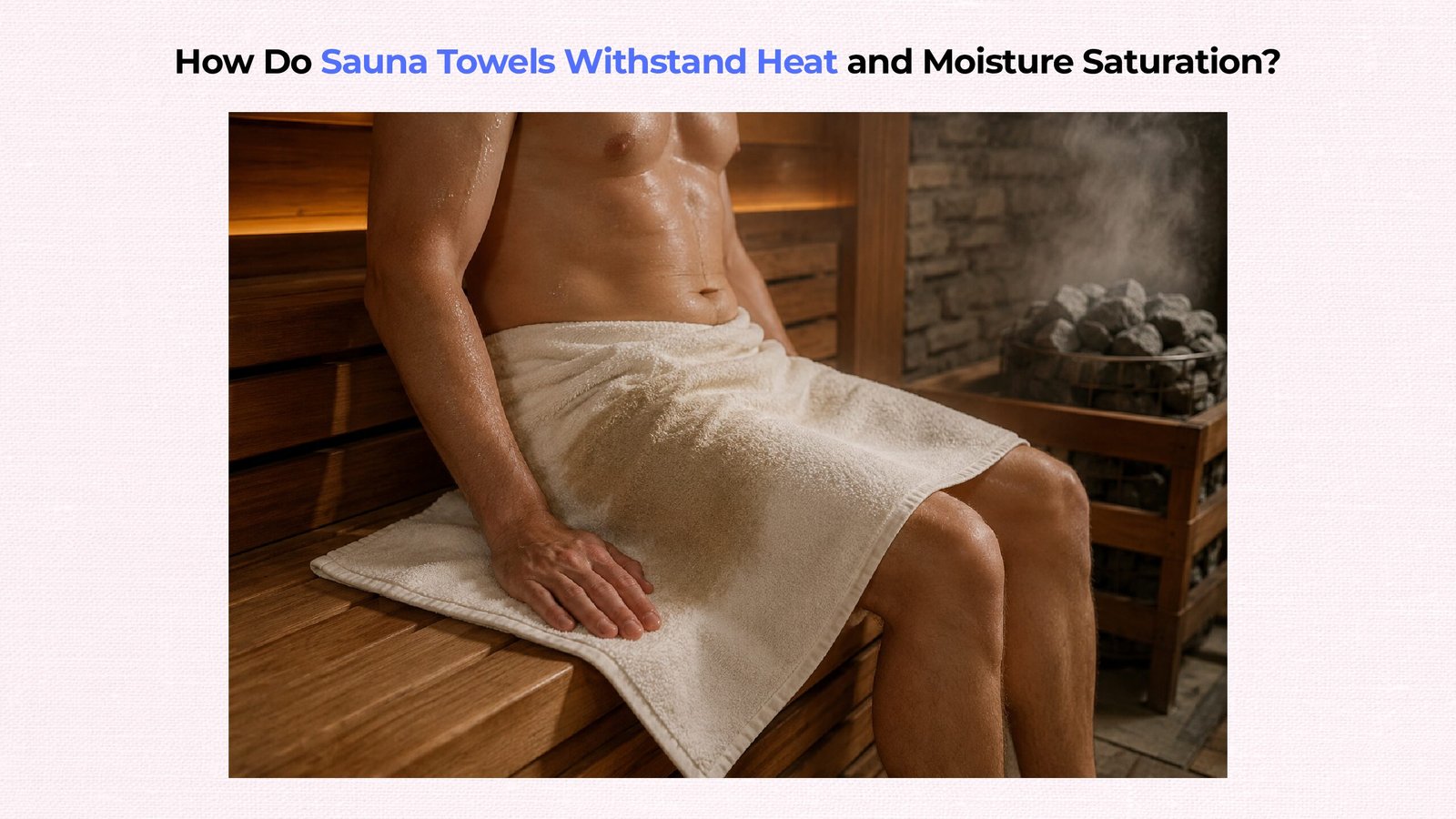
Sauna & Towel Performance
A finished-product guide to heat exposure, moisture control, testing, use, and care.
A sauna towel withstands heat and moisture only when its finished construction, intended task, exposure, laundering, and drying path work together. It is not automatically heat-resistant because it contains cotton or linen, and saturation is not inherently protective. The practical test is whether the towel continues to provide coverage, controlled water pickup, acceptable wet feel, sound seams, and complete between-use drying without contacting the heater or another prohibited hot surface.
Bench barrier, body wrap, or blotting
Wetting, pickup, capacity, and drying differ
Validate the finished towel, not its label
What must a sauna towel do during heat and moisture exposure?
A sauna towel must complete one defined job without becoming unsafe, uncomfortable, or impractical. A bench towel needs stable coverage and low bunching; a wrap needs sufficient dimensions and manageable wet weight; a blotting towel needs usable surface pickup and enough clean area. One towel can perform several tasks, but each task creates a different pass condition.
“Sauna towel” is therefore a use description, not a standardized fiber architecture. Terry loops, flat woven fabrics, waffle structures, microfiber constructions, and blends can all be sold for sauna use. Their performance depends on yarn placement, density, finishing, dimensions, hems, and laundering history as well as fiber content. The care label and facility rules remain product- and location-specific constraints.
How do sauna heat, humidity, airflow, and water load interact?
Heat, humidity, airflow, and starting water load jointly determine a towel’s temperature and drying behavior. Ambient air temperature alone does not establish the temperature inside a folded towel or at a skin-contact surface. Evaporation can remove energy, but only while liquid water is available and the surrounding air can accept additional vapor; greater humidity or restricted airflow can slow that process.
What does current sauna research establish about changing conditions?
A 2026 University of Jyväskylä sauna study found that temperature and relative humidity independently predicted participants’ thermoregulatory responses during ten-minute sessions: each additional degree Celsius corresponded to a 1.4-beat-per-minute greater heart-rate rise, while each percentage point of humidity corresponded to 0.37 beat per minute. This is human-response evidence, not a towel test, but it demonstrates why a thermostat value cannot represent the complete environment. Read the study in Temperature.
For a towel, the defensible inference is narrower: measure or record actual room conditions during a comparison, use the same starting water load, expose equivalent areas, and avoid claiming that a wet towel will remain cool. A damp, folded textile may transfer heat and moisture differently from a dry, unfolded textile, while a saturated towel may feel heavy, smear moisture, or stop providing effective pickup.
Which moisture properties determine sauna-towel performance?
Sauna-towel performance depends on several separate moisture properties: initial wetting, surface pickup, total capacity, spreading or wicking, moisture release, and drying time. A product can wet rapidly yet reach capacity early, or hold substantial water yet dry slowly. “Absorbent” is incomplete unless the test method, conditioning, sample size, water load, and endpoint are stated.
Which textile methods distinguish sauna-towel moisture tasks?
AATCC’s current standards list separate methods for absorbency (TM79), liquid moisture management (TM195), vertical and horizontal wicking (TM197 and TM198), three drying approaches (TM199–TM201), water-vapor transmission (TM204), timed vertical wicking (TM213), and condensation in a humid microclimate (TM214). The number of methods is the insight: one drop test cannot validate every moisture claim. Review the AATCC standards list.
For terry fabrics, ASTM D4772-26 measures rapid surface water absorption and retention. ASTM explicitly limits the method to terry and warns that its geometry may not validly assess waffle, huck, flour-sack, or other non-terry constructions. It also notes that surface absorption is only one consumer-relevant characteristic. See the ASTM D4772-26 scope and limitations.
| Question | What to control | Useful endpoint | What it does not prove |
|---|---|---|---|
| Does it wet promptly? | Prewash, drop volume, surface, conditioning | Time to disappearance or spreading | Total water capacity |
| Does it pick up surface water? | Same water film, pressure, stroke, area | Water retained or surface left dry | Between-use drying speed |
| How much can it hold? | Dry mass, specimen size, immersion and extraction | Water retained per specimen or dry mass | Comfort when wet |
| How does it spread moisture? | Orientation, distance, time, liquid | Wicking distance or distribution | Heat tolerance |
| How quickly does it dry? | Starting load, temperature, humidity, airflow, exposure | Time or rate to defined remaining moisture | Initial pickup |
How do fiber, yarn, weave, and finishing affect a sauna towel?
Fiber, yarn, weave, and finishing interact, so a fiber percentage cannot guarantee wetting, comfort, odor control, drying speed, or heat suitability. Cotton-rich terry may offer cushioning and surface pickup; a flat linen or linen-blend construction may reduce bulk; microfiber may pack compactly. Each can perform poorly if the construction, finish, seams, or care path conflict with the task.
What does controlled terry-towel research show about construction trade-offs?
A 2025 study compared four woven terry samples, each 75 × 75 cm, while varying construction. Increasing thread density increased tensile strength, shrinkage performance, and resilience score but reduced absorbency, overall moisture-management capacity, drape, softness, and smoothness. The samples were not sauna towels, so the result does not name a sauna winner; it shows why “denser is better” fails as a universal rule. Review the woven-terry study and its sample limits.
| Construction | Potential advantage | Trade-off to inspect | Trial question |
|---|---|---|---|
| Cotton-rich terry | Cushioned pile and useful surface contact | Wet bulk, loop pulls, drying demand | Does it retain coverage and dry within the available interval? |
| Linen or linen-blend flat weave | Lower bulk and a broad, flat surface | Crisp hand, wrinkles, different pickup behavior | Is it comfortable and stable on the intended bench or body area? |
| Waffle construction | Textured surface without a tall terry pile | Shrinkage, pocket collapse, seam distortion | Does the geometry remain usable after repeated care cycles? |
| Microfiber or synthetic blend | Potential compactness and low dry mass | Finish-dependent wetting, wet feel, heat-care limits | Do the product instructions and facility rules permit the use? |
How should sauna-towel size, GSM, thickness, and seams be compared?
Compare size, GSM, thickness, and seams as separate variables tied to the intended task. Dimensions determine coverage, GSM reports conditioned mass per unit area, thickness influences bulk and cushioning, and seams affect edge stability. None of these values alone establishes absorption, comfort, heat behavior, or usable life.
Once the intended task is established, how to choose the correct sauna-towel size depends on the bench dimensions, body coverage, handling needs, and clearance from heaters or vents.
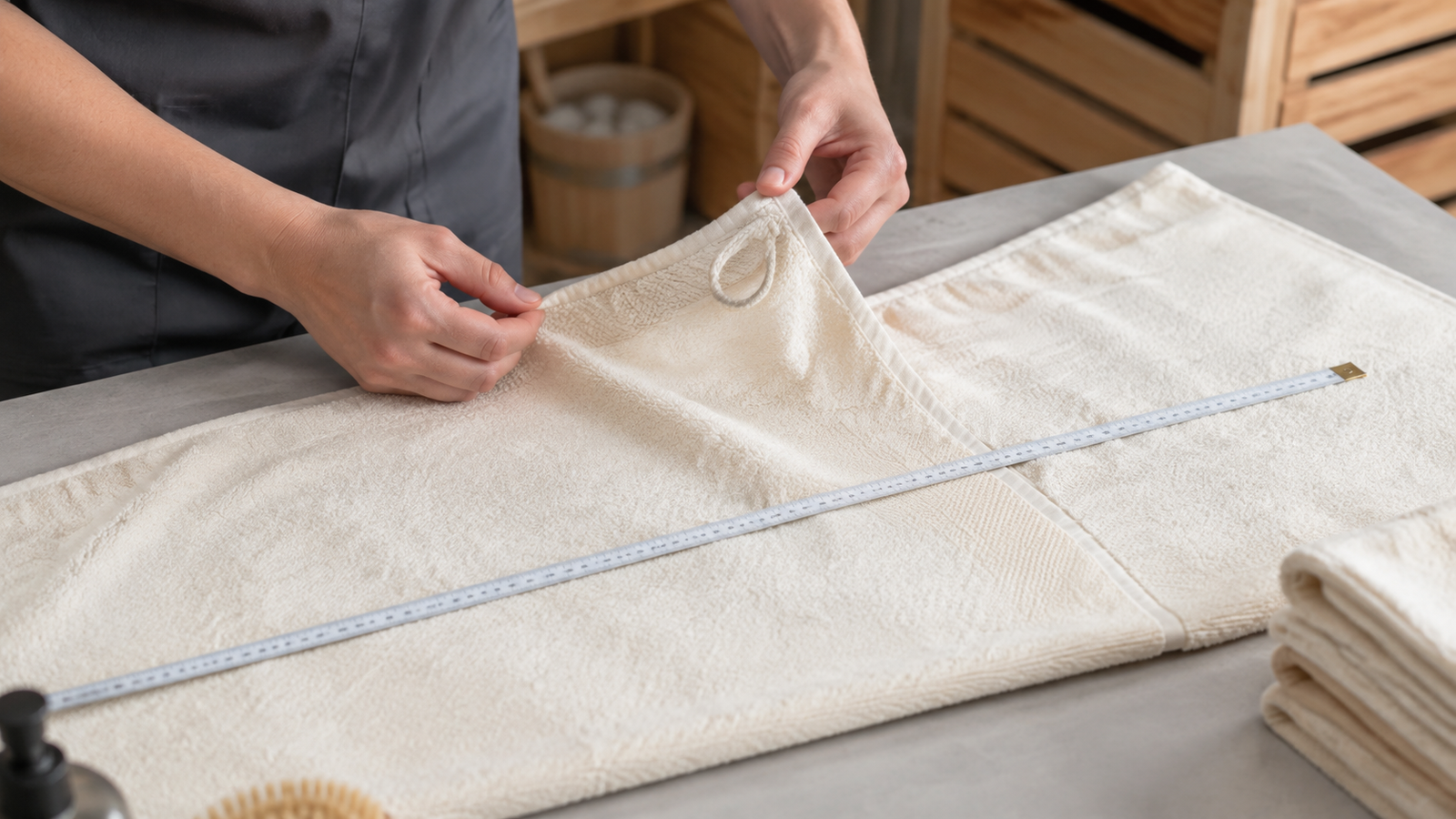
ASTM D3776/D3776M-20(2025) defines four options for measuring fabric mass per unit area, including full pieces, full-width samples, small swatches, and narrow fabrics. A supplier GSM value becomes comparable only when the basis and conditioning are consistent. See the ASTM fabric-mass method. For purchase trials, record both dry mass and wet mass because water load changes carrying, wrapping, and drying demands.
Inspect hems, labels, hanging loops, decorative bands, and transitions between body and border. These areas can curl, scratch, trap water, or distort before the main fabric fails. Wash and dry the sample several times according to its label, then remeasure dimensions and check whether the towel still lies flat and covers the intended contact area without bunching.
After use, the available hanging arrangement makes how a hanging loop affects sauna-towel handling and drying relevant, provided the loop remains clear of heaters, stones, flames, and ventilation openings.
How is a sauna bench towel different from a drying towel?
A bench towel primarily separates skin from a shared or hot bench and must maintain stable coverage; a drying towel primarily removes water after bathing and needs effective surface pickup plus remaining capacity. Using one towel for both tasks is possible only if facility rules permit it and enough clean, dry surface remains for the second task.
A towel placed on a bench may accumulate sweat, water, and body products while being compressed. That history changes the condition presented to the skin later. A separate clean drying towel provides clearer contact-zone control and prevents the final drying step from depending on a product that is already damp or contaminated. This is an operational distinction, not a claim that separation sterilizes either textile.
A bench towel performs a different task from a body-drying towel, making why sauna users sit on towels important when defining coverage, moisture transfer, surface contact, and facility requirements.

Shared-facility hygiene is governed by site policy. CDC consumer guidance recommends avoiding shared towels and laundering with detergent at the recommended water temperature, then drying completely. Those recommendations do not make a sauna towel sterile, but they support personal assignment and prompt care. See CDC advice on personal towels and CDC laundry guidance.
How should a sauna towel be selected?
Select a sauna towel by defining the task, site rules, required coverage, available drying interval, and care equipment before comparing materials. Then test representative finished samples rather than accepting claims based only on fiber, weave, GSM, or the word “sauna.”
Since one construction may not suit both bench coverage and body drying, how versatility affects sauna-towel selection should be evaluated through the actual contact, moisture, carrying, and laundering tasks.
- Confirm that the facility allows the towel’s material, dimensions, and intended use.
- Measure the bench or body coverage needed without creating loose edges near hazards.
- Compare surface pickup, total water capacity, wet feel, and drying time separately.
- Check dry mass, wet mass, folded volume, seam feel, and hanging method.
- Read the care label and verify compatibility with the available washer and dryer.
- Trial at least two finished constructions under the same use and care conditions.
For a bulk purchase, set pass criteria before the trial: maximum acceptable dimensional change, required coverage after laundering, absence of objectionable color transfer or odor, acceptable seam condition, defined surface-pickup result, and complete drying within the real turnaround window. A supplier and buyer can then compare the same endpoints instead of negotiating subjective terms such as “premium,” “quick-dry,” or “high heat.”
How should a sauna towel be tested before regular use?
Test a sauna towel through repeatable preparation, use, laundering, and drying cycles that reproduce the intended environment without placing the towel on a heater or dangerous hot surface. Record the starting condition and endpoints so construction differences are not confused with inconsistent water loads, detergent doses, or airflow.
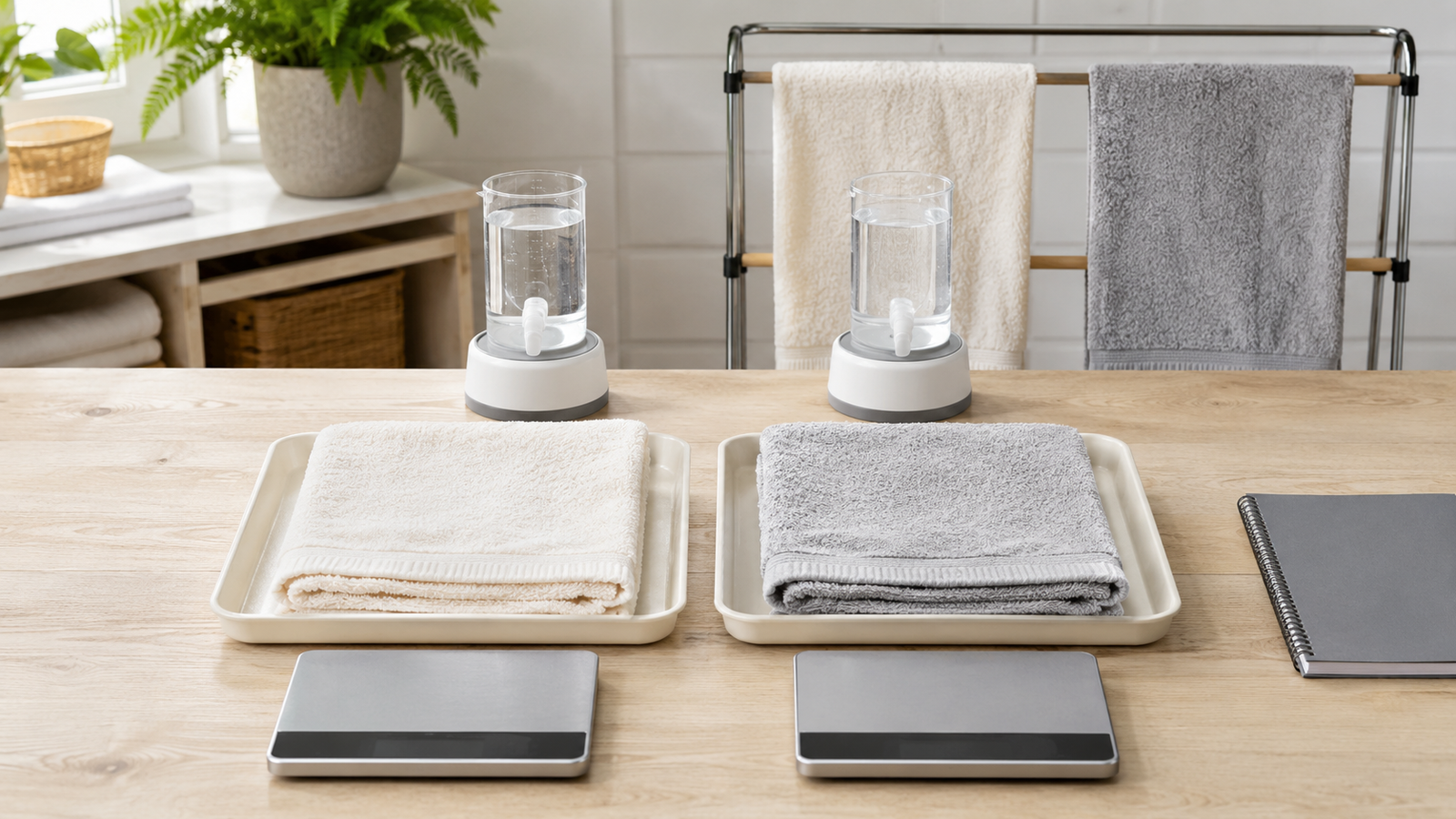
- Condition and identify samples. Use the same prewash procedure permitted by each care label, then dry completely and record dimensions, mass, appearance, and seam condition.
- Test the assigned task. Apply the same water film, contact sequence, pressure, or bench placement. Keep blotting and bench-barrier trials separate.
- Record wet performance. Note pickup, remaining clean area, slippage or bunching, wet hand, wet mass, and whether moisture transfers through the fabric.
- Measure drying under real conditions. Hang samples with equal exposure and record room temperature, humidity, airflow arrangement, starting water load, and time to a defined dry endpoint.
- Repeat the care cycle. Use labeled chemistry, temperature, load size, extraction, and drying settings; inspect shrinkage, distortion, odor, lint, color, and surface change.
- Decide against preset criteria. Reject a sample when it fails a required task even if another property, such as softness or low dry mass, is attractive.
How should a sauna towel be used safely and hygienically?
Use a sauna towel according to the facility’s instructions, keep it assigned to one person, maintain full control of its edges, and keep it away from the heater and prohibited surfaces. Replace or separate it when the intended contact zone becomes heavily damp, soiled, or no longer provides stable coverage.
Because sauna towels contact sweat, skin, and shared environments, the hygiene requirements for sauna towels should govern personal use, bench placement, laundering, complete drying, and clean storage.
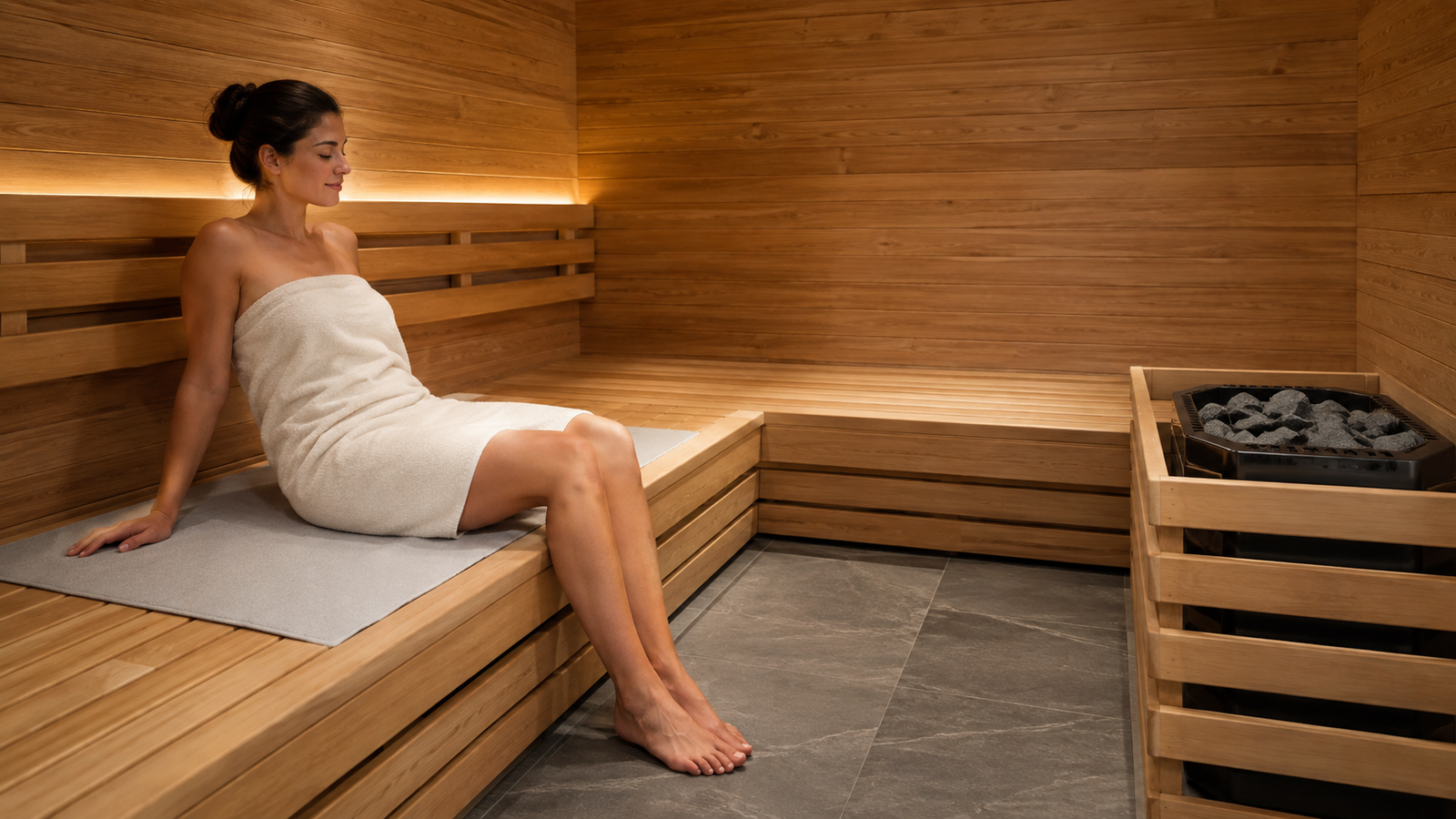
- Shower or follow the facility’s pre-entry hygiene procedure.
- Place a clean, appropriately sized towel flat on the permitted bench area.
- Keep corners, hanging loops, and folds clear of heaters, stones, flames, and vents.
- Blot rather than repeatedly rubbing if the towel is used for sweat control.
- Do not share the towel or return a used towel to clean storage.
- Leave the sauna and follow site safety guidance if you feel unwell; towel choice cannot correct unsafe heat exposure.
Do not rely on moisture as a heat shield. A wet towel can conduct and transfer heat differently from a dry towel, while steam and humidity can change perceived and measured exposure. This article evaluates textiles; it does not set a safe sauna temperature, duration, or medical protocol. People with health concerns should follow qualified medical guidance and the facility’s safety rules.
How should a sauna towel be washed, dried, and stored?
Wash, dry, and store a sauna towel by following its care label, detergent instructions, appliance guidance, facility policy, and any local hygiene requirements. There is no universal 60°C wash, two-use interval, stripping schedule, or dryer setting that is correct for every fiber, dye, finish, seam, washer, and soil load.
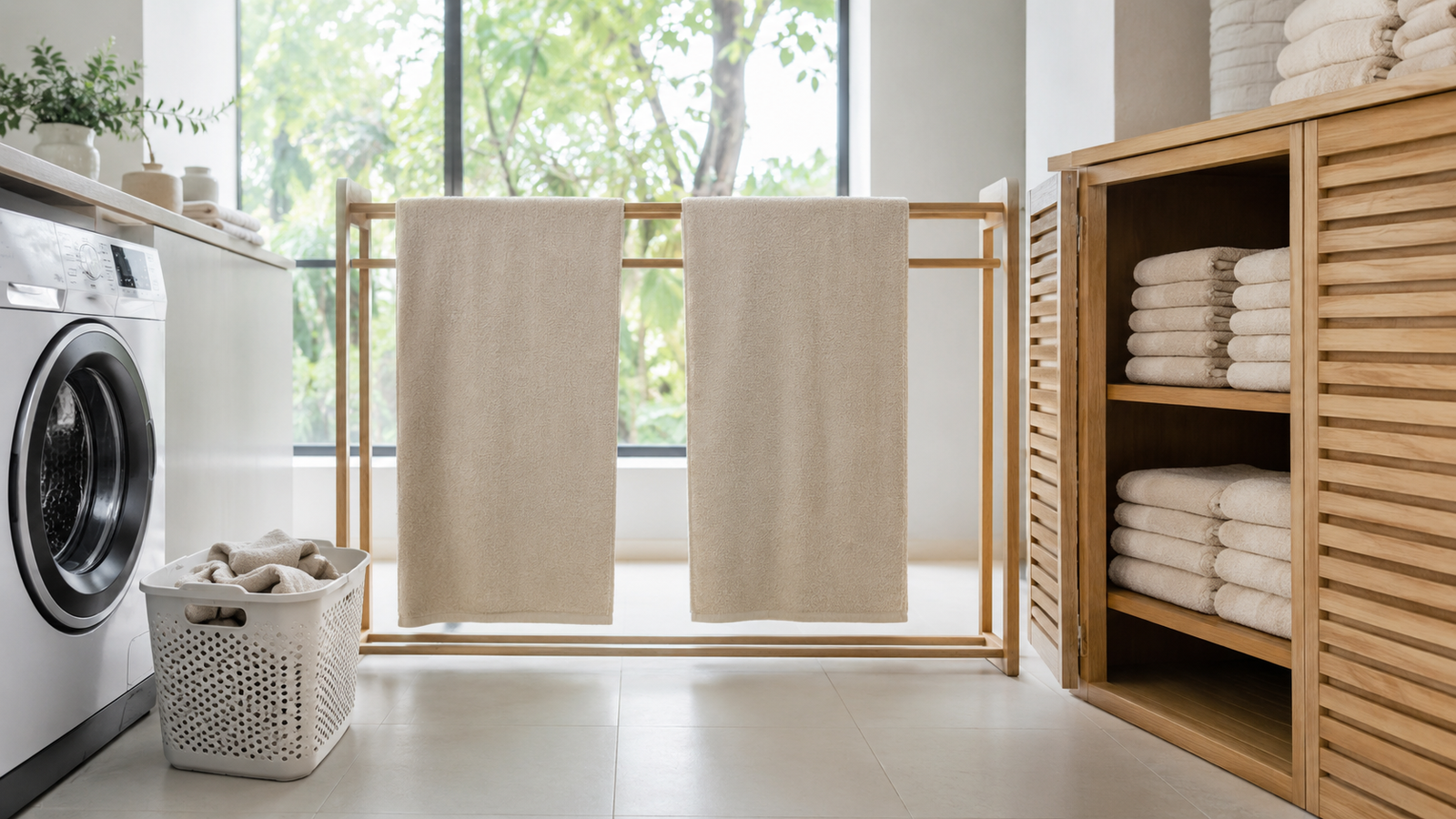
Once the towel leaves the sauna, how to wash a sauna towel correctly becomes important for removing accumulated soil without adding residue that delays wetting or changes surface feel.
How can fabric softener change a sauna towel’s result?
A 2021 cotton-fabric study described a softness–absorbency trade-off with conventional softener treatment and investigated a new hydrophilic surface to improve both properties. Its laboratory fabrics and formulations do not prove that every consumer softener causes the same change, but they show why softener policy should be verified through product directions and post-laundering wetting tests rather than a blanket rule. Review the study scope on PubMed.
Keep detergent dose, load size, water conditions, rinse performance, extraction, and drying exposure consistent during a trial. If wetting slows, first check dosing, overloading, incomplete rinsing, softener use, and a new-product finish. Do not prescribe vinegar, bleach, or a “strip” without confirming care-label and chemical compatibility; never mix laundry chemicals outside their labeled directions.
After use, move the towel promptly to laundering or an open, ventilated drying position. Do not leave it sealed in a bag, hamper, locker, or compressed pile while damp. Store only after it reaches the chosen dry endpoint and the storage area itself is clean and dry. Persistent odor after correct washing and complete drying is a reason to inspect the care process and replacement condition.
Repeated exposure to moisture and laundering also makes how care practices affect sauna-towel durability important when monitoring shrinkage, seam distortion, lint, color change, and declining performance.
What causes common sauna-towel performance problems?
Common sauna-towel problems usually arise from a mismatch among construction, water load, soil, chemistry, mechanical action, extraction, drying, and the assigned task. Troubleshoot one variable at a time with a clean control towel instead of assuming that heat permanently damaged the fiber.
| Symptom | Variables to inspect | Controlled next check |
|---|---|---|
| Slow initial wetting | New-product finish, softener, excess detergent, incomplete rinsing | Compare a labeled prewashed sample with a clean control under one drop procedure. |
| Smearing or poor pickup | Saturation, low remaining clean area, pressure, surface finish | Repeat with equal water load and a fresh dry section; record retained water. |
| Long drying time | Starting water load, thickness, fold, extraction, airflow, humidity | Weigh equal specimens and hang them with equal exposed area. |
| Persistent odor | Delayed washing, damp storage, dosing, overloading, incomplete drying | Audit the full care path and compare with a clean, completely dried towel. |
| Stiffness or scratchy edges | Residue, overdrying, seam distortion, mineral deposition, wear | Inspect wet and dry hand after a compliant wash; separate body and edge findings. |
| Bunching or poor coverage | Dimensions, shrinkage, weave distortion, border weight, bench fit | Remeasure after care cycles and trial the exact bench position. |
| Color or seam damage | Care incompatibility, excessive heat, chemistry, abrasion, hot-surface contact | Stop use near the suspected hazard and follow the label or supplier process. |
If the towel remains damp or develops a persistent smell, how hygiene and complete drying help prevent sauna-towel odor becomes the next practical question before extra fragrance or unsupported antimicrobial claims are considered.
What are the most common sauna-towel questions?
The most common sauna-towel questions concern heat resistance, ordinary bath towels, pre-wetting, wash frequency, and materials. Each answer depends on the finished product and its assigned task rather than a universal fiber rule.
Are sauna towels heat-resistant?
Heat-resistant is too broad a promise for an ordinary towel. A suitable sauna towel should tolerate its intended ambient exposure and laundering without objectionable shrinkage, odor, stiffness, color change, or seam damage, but it must still remain away from heaters, stones, flames, and unusually hot surfaces.
Can a regular bath towel be used in a sauna?
A bath towel may work if the facility permits it and the finished product fits the intended task. Check bench coverage, dry and wet bulk, surface pickup, comfort, drying time, care instructions, and heat-source clearance instead of relying on the bath-towel or cotton label alone.
Should a sauna towel be wet before use?
Not as a universal rule. A towel used as a bench barrier is normally most controllable when clean and dry, while a separate towel may be used for blotting. A deliberately wet towel adds mass, transfers moisture, and may dry slowly, so follow facility instructions and the intended task.
How often should a sauna towel be washed?
Wash a personal sauna towel after the session when it is sweaty, heavily damp, shared contrary to plan, or required by the facility. Follow the care label, detergent directions, washer guidance, and local hygiene rules, then dry it completely before clean storage rather than using a universal reuse count.
Which material is best for a sauna towel?
No fiber name is best for every sauna task. Compare finished cotton-rich terry, linen or linen-blend woven towels, microfiber, and blends for surface pickup, capacity, wet feel, coverage, packability, drying time, shrinkage, seam stability, and care compatibility under the same preparation and use conditions.
What is the best sauna-towel decision?
The best sauna-towel decision is the finished product that passes the intended bench, wrap, or blotting task under the real facility, care, and drying conditions. Choose from measured coverage, controlled moisture results, acceptable wet feel, stable seams, safe handling, and complete drying—not from a universal GSM, fiber hierarchy, wash temperature, or lifespan claim.
Heat and moisture do not produce one predictable outcome. A towel’s condition changes through each session and care cycle, while sauna humidity and airflow also vary. A documented sample trial converts those interacting variables into a practical purchase decision and reveals when a separate bench towel and drying towel provide clearer control than one multipurpose textile.