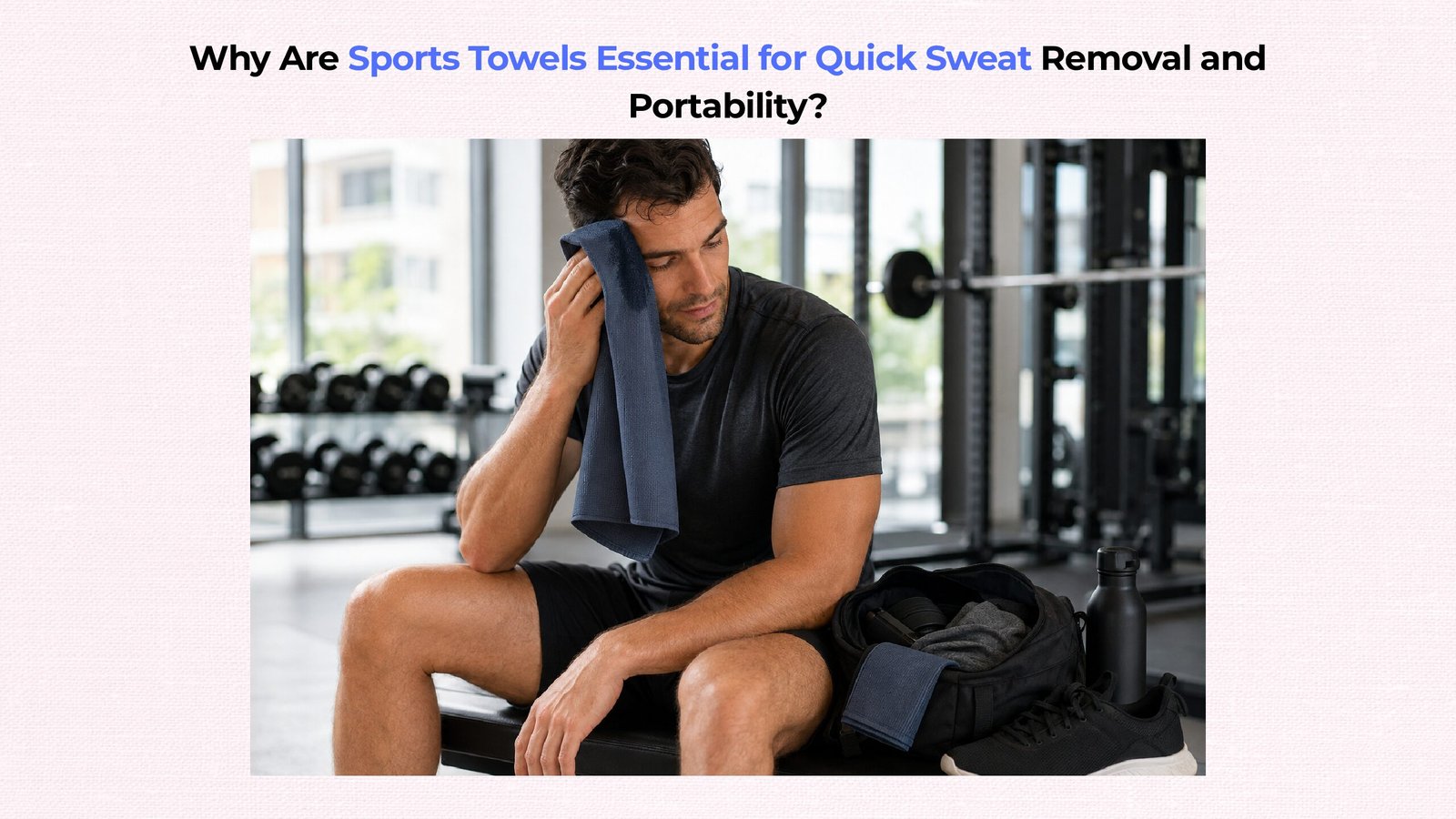
A sports towel supports quick sweat removal and portability when its finished construction picks up surface moisture, provides enough clean working area, remains comfortable against the intended body zone, and fits the athlete’s dry and wet carry limits. Microfiber, cotton, blends, GSM, and size are clues, but none independently proves performance.
“Essential” depends on the activity. A towel can improve comfort, keep sweat away from the eyes, and help separate personal skin contact from shared surfaces, yet it cannot replace hydration, cooling, rest, event rules, wound care, or the correct response to heat illness. The useful decision is therefore task-specific: define the moisture load, contact area, session length, replacement access, storage, and care path before choosing a product.
How does a sports towel support quick sweat removal?
A sports towel removes sweat by transferring liquid from a defined skin area into a clean textile during a pause in activity. Useful performance requires fast surface pickup without immediate smearing, liquid release under pressure, rough contact, residue transfer, or early saturation.
The complete system includes the athlete, sweat and skin products, the towel face, folding or zone rotation, storage location, replacement access, and laundering history. The same towel may work for a short indoor session and fail during a long outdoor event because its starting load, humidity, contamination, access, and drying conditions have changed.
Surface drying is not whole-body cooling. The CDC’s athlete heat guidance says an athlete who feels faint or weak should stop activity and move to a cool place. A towel may remove sweat from the eyes or hands, but it must not delay the applicable heat-safety response.
How variable is athlete sweat production?
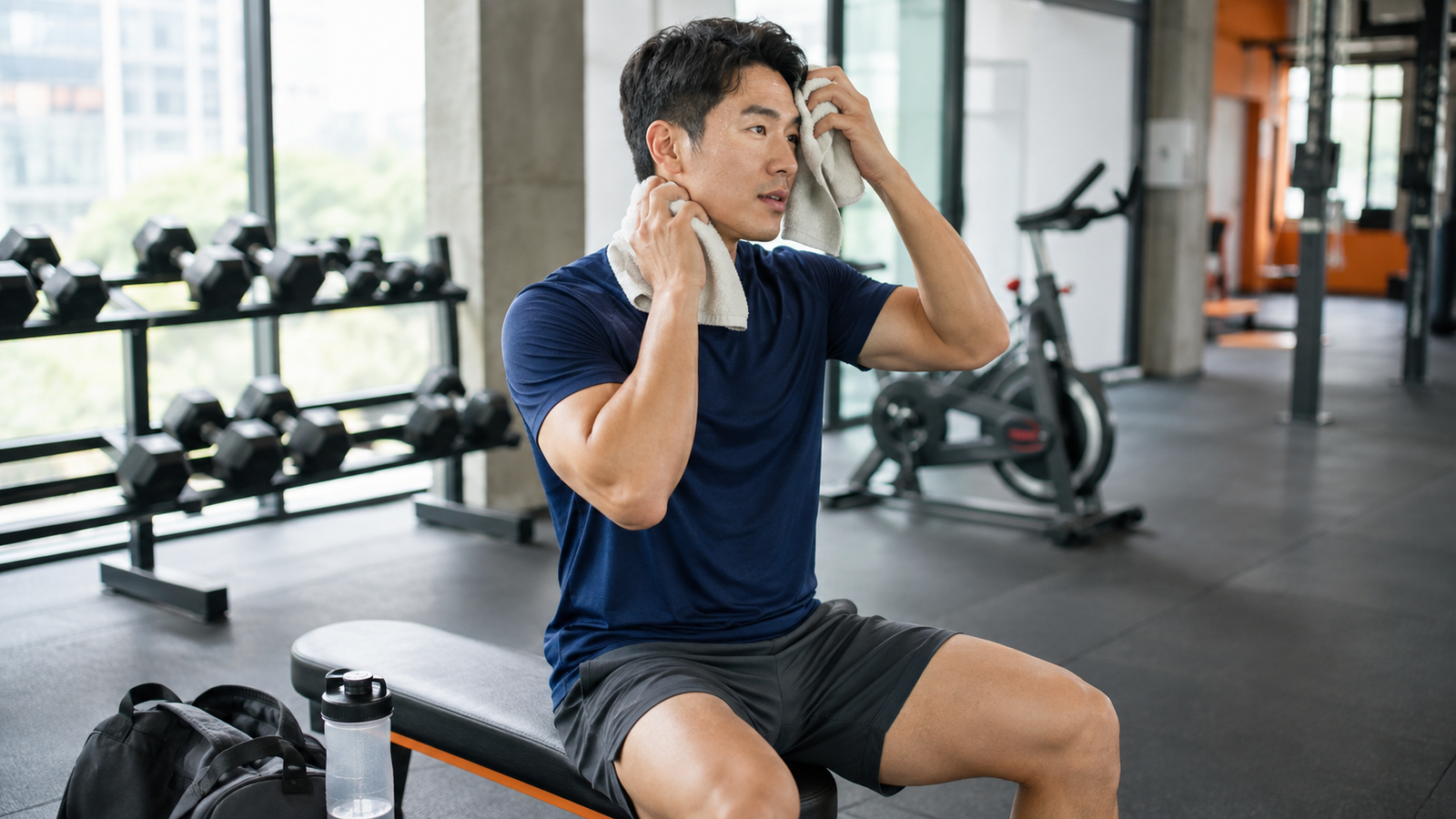
Athlete sweat production varies too widely to support one universal sports-towel capacity. A 2017 Sports Medicine review by Lindsay Baker reported whole-body sweat rates of approximately 0.5–2.0 L/hour in athletes, with differences by sport, environment, intensity, equipment, body size, acclimation, and individual physiology.
That range is evidence for individualized planning, not a towel specification. A sports towel receives only part of total sweat, and the share changes with clothing, evaporation, toweling frequency, body area, session rules, and product access. Measure the towel’s actual use load instead of converting whole-body fluid loss directly into a purchasing threshold.
Which moisture properties determine sports-towel performance?
Sports-towel performance depends on initial wetting, surface pickup, liquid spreading, usable capacity, retention under pressure, damp-surface feel, and drying time. These properties interact, but they are not interchangeable. A towel that wets rapidly can still saturate early, feel slick when damp, release water when squeezed, or dry slowly.
“Absorbency” therefore needs a named endpoint. Wetting asks whether liquid enters the surface. Pickup measures how much leaves the skin or a test plate. Capacity records retained mass under stated conditions. Wicking describes movement away from the contact point. Drying measures water loss over time under controlled temperature, humidity, airflow, orientation, and starting load.
Once a towel has accumulated sweat, what helps a sports towel dry quickly becomes important for preventing prolonged dampness between sessions or repeated uses.
Which test methods apply to sports towels?
No single laboratory method proves complete sports-towel performance. The AATCC moisture-management program currently lists nine separate methods, including TM79 for absorbency, TM195 for liquid moisture management, TM197 and TM213 for vertical wicking, TM198 for horizontal wicking, and TM199–201 for different drying conditions.
ASTM D4772-26 measures rapid surface-water absorption by terry fabric. Its scope does not make it a universal test for every waffle, huck, nonwoven, or low-profile microfiber sports towel. A supplier report should identify the method edition, specimen face, pretreatment, conditioning, sample count, units, variation, and pass rule.
| Property | Controlled question | Record | What it does not prove |
|---|---|---|---|
| Initial wetting | Does a defined droplet enter or spread on the intended face? | Water, volume, face, time, and laundering state. | Capacity, pickup, or session duration. |
| Surface pickup | How much liquid leaves a defined surface after controlled contact? | Starting liquid, pressure, motion, contact time, and residual mass. | Drying speed or skin comfort. |
| Usable capacity | How much water is retained before wiping quality fails? | Dry mass, wet mass, fold, contact count, and failure endpoint. | Fast wetting or residue resistance. |
| Drying | How long does a stated load take to reach the dry endpoint? | Load, temperature, humidity, airflow, orientation, and time. | Pickup, hygiene, or packability by itself. |
How do materials and construction influence sports-towel performance?
Materials influence a sports towel through fiber wetting, moisture regain, stiffness, resilience, heat sensitivity, and exposed-surface behavior, while construction controls contact area, pore geometry, thickness, mass, drape, edges, and folding. The finished towel—not a fiber name or blend percentage—determines the result.
Fiber content becomes more meaningful when considered alongside how sports-towel materials influence sweat absorption rather than being treated as a guarantee of rapid wetting or effective surface pickup.
Cotton-rich terry can provide a raised, cushioned contact face and useful pressure pickup, but its capacity, wet mass, drying, lint, and loop durability vary. Fine-filament polyester or polyester–polyamide constructions can be compact and spread liquid effectively when their geometry and finish support wetting, yet “microfiber” does not confirm splitting, surface treatment, face direction, or drying performance.
Waffle, huck, knit, blended, recycled, and zoned constructions add further options. A lower profile may pack efficiently but feel slick when wet or lack capacity. A plush pile may provide comfortable contact but increase retained water and bulk. Seams, labels, binding, coatings, and attachment hardware also affect complete-product mass and skin contact.

What does woven-terry research show about construction trade-offs?
A 2025 woven-terry study produced four 75 × 75 cm cotton towel designs and assessed shrinkage, strength, absorbency, moisture management, drape, softness, smoothness, and resilience. Within those samples, greater thread density improved strength-related performance while reducing several absorbency and comfort outcomes.
The study demonstrates interacting variables rather than a sports-towel recipe. Its cotton yarns, 3-pick terry bodies, decorative weaves, loom settings, and laboratory conditions do not represent every microfiber, waffle, knit, or mixed-fiber product. The useful insight is to test the complete construction after representative care instead of maximizing density alone.
| Construction clue | Possible role | Trade-off to inspect | Required verification |
|---|---|---|---|
| Cotton-rich terry | Raised contact area and cushioned pressure pickup. | Wet mass, drying time, loop snagging, lint, and shrinkage. | Pickup, capacity, dry time, and repeated-care trial. |
| Low-profile synthetic microfiber | Compact format with broad surface contact. | Finish loss, damp slickness, edge curl, and heat sensitivity. | Wetting and pickup before and after approved care. |
| Waffle or textured weave | Structured pockets with potentially lower bulk. | Pickup may differ from pile; edges can distort. | Task wipe, capacity, dimensional, and drying checks. |
| Blended or zoned construction | Different yarns or surfaces may serve different contacts. | Percentage labels hide placement and exposed faces. | Face mapping, seam inspection, and complete-towel test. |
What makes sports-towel portability measurable?
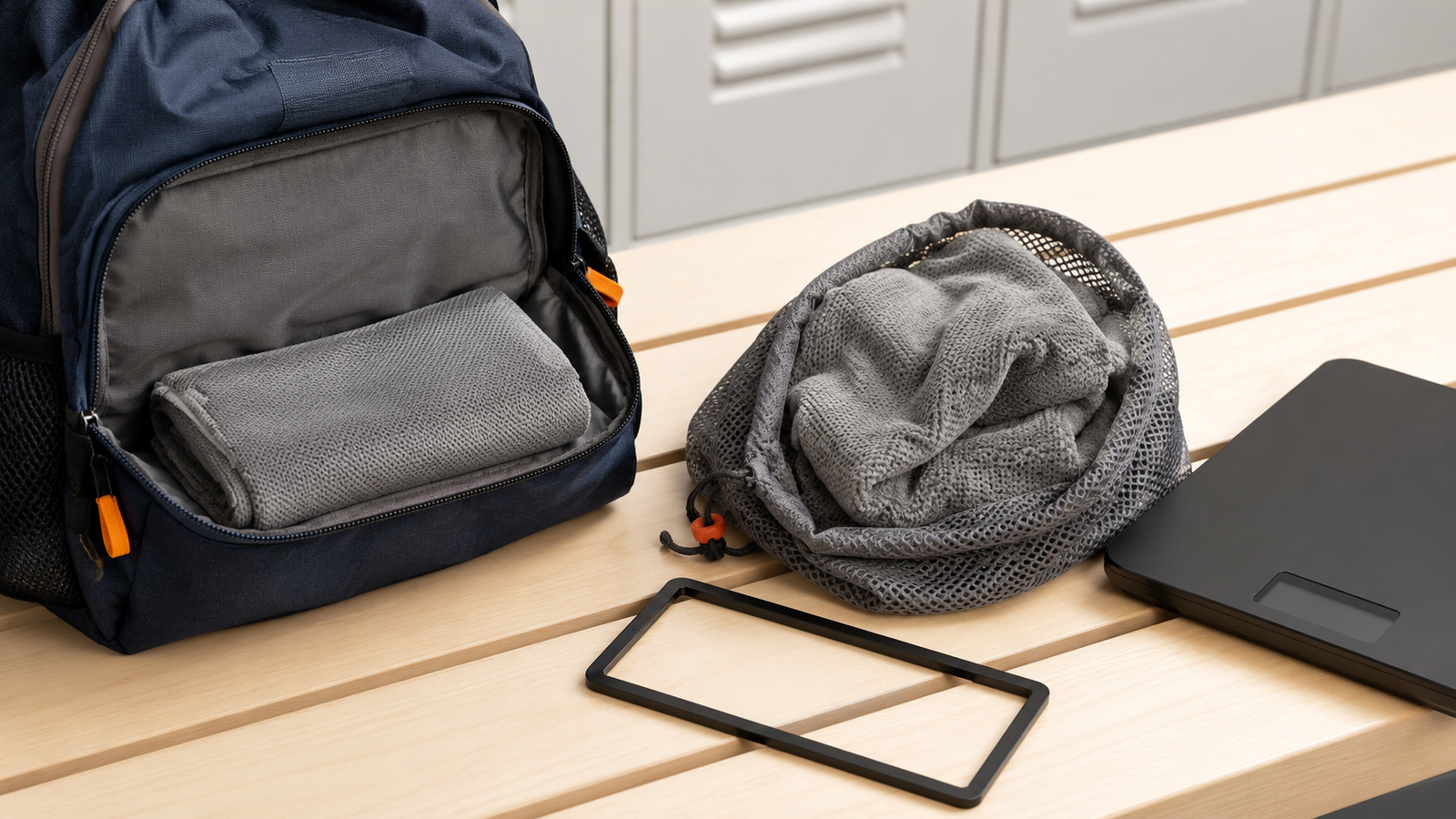
Sports-towel portability is measurable through dry product mass, wet carry mass after the intended task, folded or rolled volume, shape stability, attachment security, and the space needed for drying. A compact dry towel can become inconvenient when saturated, difficult to refold, or sealed in a container without a practical drying path.
Dry mass alone does not establish convenient transport, making how portability and compactness affect sports-towel selection relevant when the towel must fit a pocket, pouch, locker, or equipment bag.
Compare candidates at identical dimensions and conditioning, then repeat the packing check after applying the same water load. Record whether hems, snaps, loops, pouches, or tubes add useful control or merely add weight and drying obstacles. A storage pouch should transport a damp towel temporarily; it should not be treated as a drying system unless the product instructions establish that function.
What does GSM reveal about sports-towel portability?
GSM reveals fabric mass per unit area, not complete sports-towel portability. ASTM D3776/D3776M-20(2025) covers measuring fabric mass per unit area and is applicable to most fabrics. It does not convert GSM into a universal towel weight, packed volume, water capacity, or drying time.
Two towels with the same GSM can differ because dimensions, trims, seams, coatings, pile compression, and folding geometry change the finished product. Record complete dry mass on a suitable scale, calculate retained water from the wet-minus-dry mass, and measure the actual packed envelope instead of inferring all three from GSM.
| Check | Method | Decision use |
|---|---|---|
| Dry product mass | Condition and weigh the complete towel with trims. | Defines the starting carry load. |
| Wet carry mass | Reweigh after the same representative moisture task. | Shows the load returned to a bag or pack. |
| Packed volume | Fold consistently and measure the occupied envelope. | Tests fit in the intended pocket or compartment. |
| Drying access | Check the available hanging area, airflow, and time. | Reveals whether the carry system supports reuse. |
How is a sports towel different from bath and cooling towels?
A sports towel is defined by repeated surface-moisture contact, accessible clean zones, and practical carrying during activity rather than by one size, material, or GSM. Bath towels and cooling towels can overlap in fabric, but their intended starting conditions and water loads differ.
A bath towel usually handles a larger post-wash water load in a controlled changing area. A sweat-removal sports towel handles smaller, repeated contacts while skin products, equipment residue, floors, benches, and bags may be present. A cooling towel is commonly wetted intentionally; that wet starting state conflicts with dry sweat pickup unless a separate dry surface is available.
Athletes comparing bath towels, cooling towels, and other formats should also consider which sports-towel alternatives provide suitable versatility for the intended contact zones, climate, activity, and carrying method.
| Primary task | Starting state | Main checks | Common mismatch |
|---|---|---|---|
| Repeated sweat pickup | Clean and dry. | Pickup, dry-zone rotation, skin feel, capacity, carry, and care. | Too little clean area or poor wet storage. |
| Post-shower drying | Clean and dry. | Larger-area capacity, coverage, comfort, and drying access. | Excess bulk for activity-side carrying. |
| Intentional cooling | Prepared according to product instructions, often wet. | Cooling protocol, contact comfort, and separate dry-wipe access. | Using an already wet surface for dry pickup. |
How should a sports towel be selected for an activity?
Select a sports towel by matching its contact area, pickup, capacity, damp feel, drying, mass, packed volume, attachment, and care requirements to the activity’s duration, climate, sweat pattern, skin products, storage, and replacement access. Test one representative product before buying several.
- ☐ Define the intended contacts: face, neck, hands, body, equipment, or separate towels for different zones.
- ☐ Record the longest expected session, climate, toweling frequency, storage point, and backup access.
- ☐ Inspect dimensions, dry mass, texture, seams, labels, attachments, color transfer, and care instructions.
- ☐ Compare initial wetting, controlled pickup, usable capacity, wet mass, and drying under identical conditions.
- ☐ Measure the actual folded or rolled package and test it in the intended pocket, pouch, or bag.
- ☐ Apply representative sunscreen, grip residue, or body oil to a separate test zone and check transfer.
- ☐ Launder as directed, dry completely, then repeat moisture, feel, dimensional, color, and seam checks.
- ☐ Reject a towel that scratches, smears, transfers dye, sheds excessively, retains odor, or cannot dry in the available time.
How can a sports towel be tested before regular use?
Test a sports towel with a repeatable screening that resembles the real activity without claiming to reproduce a laboratory standard. Keep towel size, water load, surface, pressure, motion, room conditions, folding, and laundering history constant, then record the outcome.
Since microfiber products can differ in composition, construction, and finishing, how microfiber affects sports-towel absorption capacity should be verified under a controlled water load instead of inferred from the label.
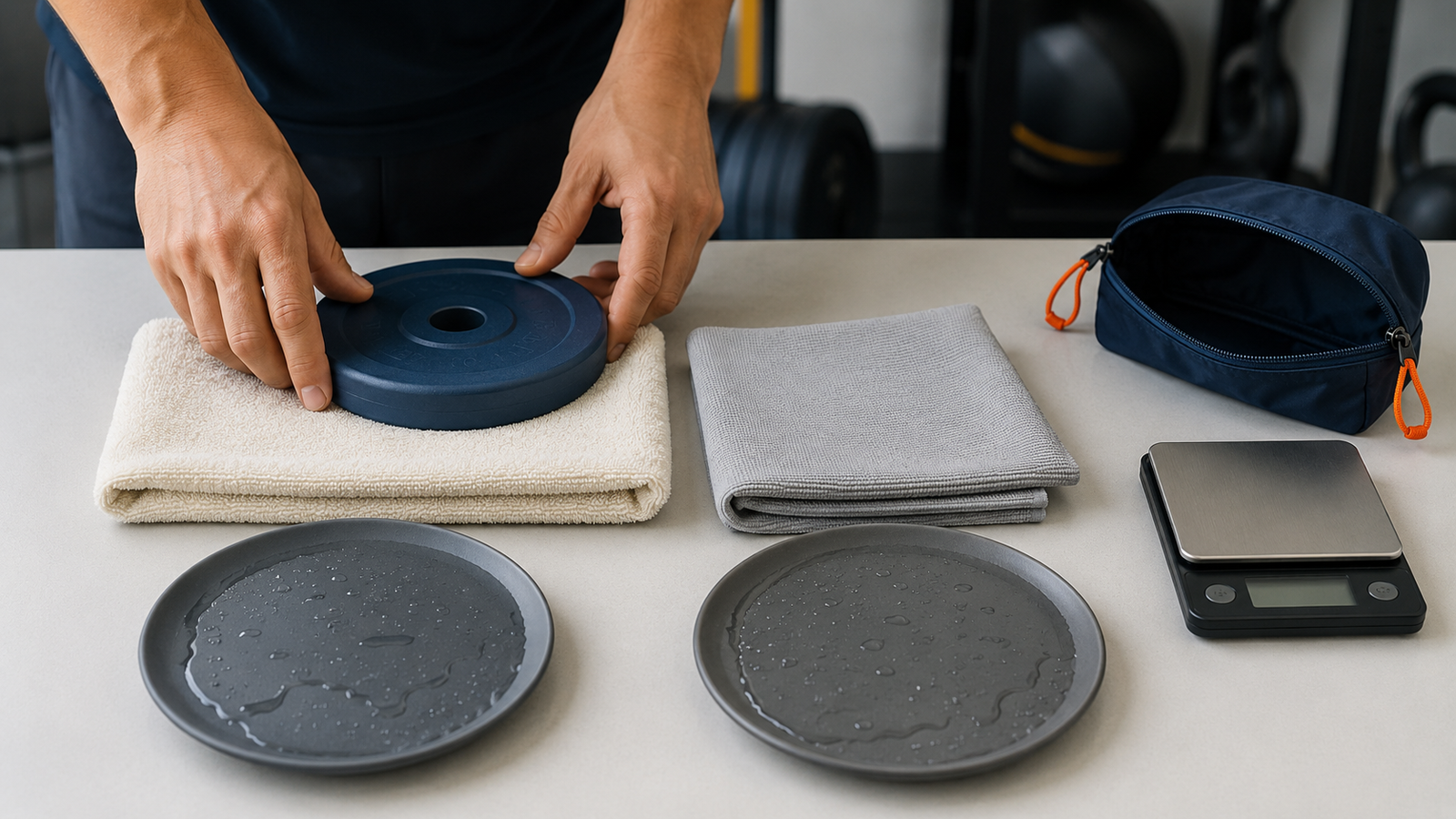
- Condition each clean, dry towel in the same room; record dry mass, dimensions, intended face, and care history.
- Apply the same measured water mass to identical nonabsorbent surfaces; keep skin-product and equipment-residue trials separate.
- Press each folded towel with the same flat load for the same time; do not change rubbing motion between candidates.
- Reweigh the towel and remaining surface liquid; record pickup, visible transfer, damp feel, and release under light pressure.
- Repeat on fresh zones until a defined failure point such as smearing, release, discomfort, or no clean surface.
- Record wet carry mass and packed dimensions, then dry each towel in the planned orientation and environment.
- Repeat after representative laundering and compare change rather than relying on the best first-use result.
Report the screening as a comparison under stated conditions. It does not generate an AATCC or ASTM result, prove hygiene, or predict every sport. Procurement claims requiring formal evidence should use an accredited laboratory and a method whose scope matches the construction and endpoint.
How should a sports towel be used during activity?
Use a sports towel by starting with a clean, fully dry product, assigning contact zones, blotting or wiping only as needed, rotating to a dry area before smearing begins, and replacing the towel when pickup fails. Keep clean skin-contact zones away from floors, shared equipment, and contaminated bag surfaces.
- ☐ Begin with a clean dry towel and a backup when session length, heat, or replacement access justifies one.
- ☐ Assign a facial side and a hand, body, or equipment side, or use separate towels when residue transfer matters.
- ☐ Fold the towel into repeatable zones and rotate before a used zone releases moisture or smears.
- ☐ Blot near the eyes, irritated skin, or wounds rather than rubbing aggressively; stop if contact causes discomfort.
- ☐ Do not share personal towels, and follow the sport, venue, team, and event rules governing towel placement.
- ☐ Replace rather than wring when wringing cannot restore a clean, effective contact surface.
- ☐ After activity, isolate the damp towel from clean gear and begin the approved care process promptly.
Removing visible sweat does not disinfect skin or equipment. A towel assigned to personal skin should not become a general cleaning cloth during the same session. Cuts, abrasions, rashes, eye symptoms, or suspected infection require appropriate hygiene and professional guidance rather than more aggressive wiping.
How should sports towels be washed, dried, and stored?
Wash, dry, and store a sports towel according to its care label and compatible laundry-product instructions, then verify complete drying before reuse or closed storage. Fibers, dyes, prints, hydrophilic finishes, antimicrobial treatments, seams, adhesives, and attachments differ, so one temperature, detergent dose, dryer setting, bleach policy, or stripping schedule cannot fit every product.
CDC athlete guidance says personal towels should not be shared and should be washed and completely dried after each use while following label instructions. Apply that hygiene guidance without overriding the textile’s chemical and heat limits. Clean hands after handling dirty laundry, and keep the damp towel separate from clean clothing and gear.
Dose detergent for the washer, load, soil, and water conditions. More detergent does not guarantee better cleaning and may leave residue when dosing, loading, or rinsing is unsuitable. Keep hook-and-loop fasteners, open zippers, rough hardware, heavy soil, and color-transfer risks away when the towel’s instructions or construction make damage likely.
If a damp towel is left packed with equipment, the conditions that cause mildew and odor in sports towels help identify whether water load, delayed washing, restricted airflow, or incomplete drying is responsible.
Can fabric softener change sports-towel wetting?
Some softener systems can reduce rapid water uptake, but the effect depends on formulation, dose, fabric, and test. A 2021 cotton-fabric study tested softener at 0.05% and 0.1% on fabric weight and described a softness–absorbency trade-off while evaluating a special hydrophilic-particle treatment.
That study does not prove that every conditioner ruins every synthetic or blended sports towel, and its experimental treatment is not a household repair. Follow both labels. When pickup declines, compare an otherwise identical sample without softener and inspect detergent residue, body-oil removal, rinsing, heat exposure, finish change, and wear before assigning one cause.
Does an antimicrobial finish make a sports towel hygienic?
An antimicrobial finish does not by itself establish that a sports towel protects the user from infection. The EPA’s treated-article guidance explains that the exemption under 40 CFR 152.25(a) is limited to protecting the treated product, not supporting public-health claims.
Verify the exact claim, active treatment, durability after laundering, applicable registration or exemption, and qualifying label language. Odor control, product preservation, microbial reduction in a laboratory test, hygiene, and disease prevention are different endpoints. Personal use, washing, complete drying, clean storage, and wound precautions remain necessary.
What causes a sports towel to smear, smell, shed, or pack poorly?
Sports-towel failures usually come from saturation, residue, contamination, incomplete cleaning or drying, unsuitable construction, damaged fibers or seams, or a mismatch between the towel format and activity. Diagnose one symptom under controlled conditions before changing detergent, heat, folding, and product type together.
| Symptom | Likely checks | Controlled action | Retire or escalate when |
|---|---|---|---|
| Smears sweat | Saturation, used zone, residue, finish, or insufficient pressure pickup. | Try a clean dry zone, then repeat a measured pickup comparison after approved washing. | The clean towel still releases liquid or cannot meet the task load. |
| Wets slowly | New finish, soil, softener, detergent residue, face direction, or damaged treatment. | Follow initial-care instructions and compare both faces with a controlled droplet test. | Approved care does not restore the supplier’s verified requirement. |
| Persistent odor | Damp storage, delayed washing, overload, ineffective cleaning, or incomplete drying. | Correct the label-compatible wash and complete-dry process; clean the storage area. | Odor persists after verified care, or visible growth or damage appears. |
| Sheds or frays | Open edges, snagging hardware, abrasion, heat damage, or construction failure. | Isolate rough fasteners and inspect seams, faces, and lint after a controlled wash. | Loose fibers, failed edges, or damaged attachments affect safe contact. |
| Packs poorly | Excess retained water, bulky folds, rigid seams, pouch mismatch, or distorted fabric. | Measure wet mass and use one repeatable fold in the intended compartment. | The required capacity cannot fit the available carry and drying system. |
After the likely cause has been identified, how to prevent odor in sports towels becomes the next practical step through prompt separation, appropriate laundering, complete drying, and clean storage.
What do athletes ask about sports towels?
Athletes most often need help separating material labels from finished performance, interpreting GSM, deciding towel quantity, handling softener, and setting a hygiene routine. The answers below provide decision rules without turning one product specification into a universal standard.
Is microfiber always the best material for a sports towel?
Microfiber is one possible sports-towel construction, not an automatic winner. Splitting, yarn geometry, surface finish, fabric mass, dimensions, edges, and laundering history all affect performance. Compare finished towels under the same pickup, capacity, packed-volume, skin-contact, and drying tests before choosing a material.
What GSM is best for a sports towel?
No universal GSM identifies the best sports towel. GSM describes fabric mass per unit area, not total towel mass, packed volume, water capacity, or drying time. Select a range only after defining the towel’s dimensions, moisture load, carry limit, texture, and care conditions.
How many sports towels should an athlete carry?
Carry enough clean, dry working area for the expected session and replacement access. One towel may suit a short controlled workout; longer, hotter, or shared-facility use may require backups or task separation. Decide from a field trial instead of applying one universal quantity.
Can fabric softener reduce sports-towel performance?
Some softener treatments can reduce wetting, but the effect depends on formulation, dose, fiber, finish, and laundering. Follow both labels and run a controlled comparison if pickup declines. Do not assume every conditioner affects every sports towel equally, or that stripping is universally safe.
How often should a sports towel be washed?
Use a clean personal towel for each session, avoid sharing it, and follow its care label. CDC athlete guidance says towels should be washed and completely dried after each use. Store the towel only when dry, and isolate the damp item from clean gear after activity.
What is the best sports-towel decision?
The best sports-towel decision is the finished product that passes the athlete’s actual pickup, capacity, contact, dry and wet carry, care, and drying trial. Start with the activity, compare separate performance properties, control residue and contamination, verify results after laundering, and carry enough clean dry area without treating microfiber, cotton, GSM, price, or an antimicrobial label as proof.