
Towel Science · Facial Care
How Finished Construction, Light Technique, and Skin Condition Shape the Result
A face towel can feel soft and still provide mild mechanical exfoliation because softness and exfoliating action describe different things. Softness is the perceived hand of the damp finished fabric; exfoliation is an outcome produced when that fabric moves across the outer skin surface. Construction matters, but moisture, cleanser, pressure, stroke count, skin type, and other skin-care products can change the result.
This article helps you understand that mechanism, compare face towels by finished performance, use one with less irritation risk, and diagnose when the towel or technique is too aggressive. A face towel is optional—not a treatment—and no fiber, GSM, loop height, or brand name guarantees safe exfoliation for every person.
Understand how face-towel structure shapes softness and exfoliation
Face-towel performance comes from the finished textile system, not one specification. Understanding the performance differences among face-towel materials requires considering fiber content, yarn design, pile or surface geometry, fabric mass, seams, chemical finishes, laundering, and retained residue together because they determine how the towel bends, wets, drags, and feels against skin.
Compare face-towel pile and fabric mass
A face towel’s pile is the raised loops or fibers above the base fabric. CottonWorks’ buyer guidance, accessed August 2026, separates 400–600 GSM and 600–800 GSM bath-towel bands, yet those figures are not facial-safety limits. Because fabric mass can increase cushioning while also adding bulk and drying demand, how face-towel thickness affects skin safety is more useful than treating a higher GSM as automatically gentler.
Check face-towel stiffness as a finished fabric
Face-towel stiffness is resistance to bending in the finished fabric. ASTM D1388-23 provides two fabric-stiffness procedures: cantilever and heart-loop. That two-method standard highlights the practical point: fiber diameter alone cannot predict hand because yarn cohesion, weave, pile, finishes, moisture, and storage also shape the towel’s bending behavior.
Verify how the face towel wets after washing
Face-towel wetting is the initial spread of liquid into the textile; absorption is liquid taken into its structure. AATCC TM79-2025 applies to yarns, fabrics, and garments of any fiber content or construction. A practical home comparison cannot replace that method, but it can reveal whether a finish or residue makes one washed towel wet more slowly than another.
Explain how a face towel creates mild mechanical exfoliation
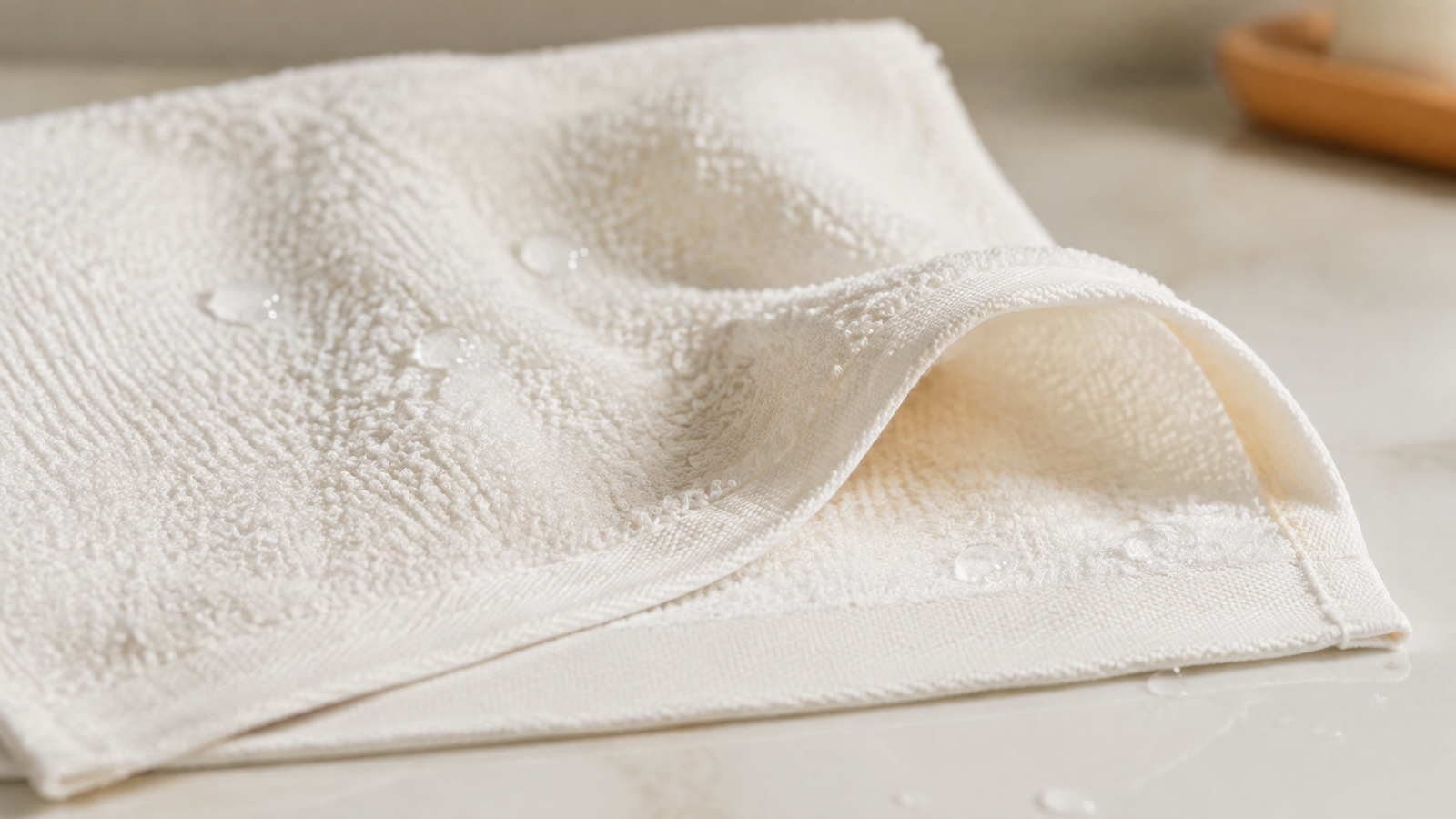
A face towel creates mechanical exfoliation when light movement helps dislodge some material from the stratum corneum, the skin’s outermost layer. The mechanism is surface contact and shear, so how face towels balance exfoliation with gentleness depends on the towel, its water load, any cleanser, the number and direction of strokes, applied pressure, and the condition of the skin.
No validated universal coefficient-of-friction or pressure threshold defines a “safe exfoliating face towel.” Instead, the American Academy of Dermatology’s 2026 guidance makes the user controls explicit: match the method to skin type, use gentle small circles or short light strokes, limit application to about 30 seconds, rinse with lukewarm water, and moisturize afterward.
- Damp contact changes the interface. Water and cleanser can alter fabric flexibility and lubrication, so the same face towel may feel different dry, damp, or saturated.
- Pile geometry changes contact. Loops, cut pile, and smooth surfaces present different contact points, but no geometry is automatically gentle without controlling pressure and motion.
- Technique can outweigh the label. Repeated passes or firm rubbing can make a soft towel irritating; light, brief use may make a modestly textured towel tolerable for some skin.
Separate face-towel softness from exfoliating action
Face-towel softness and exfoliating action can coexist because they are related but non-equivalent attributes. Softness is a sensory judgment influenced by bending, compression, surface smoothness, warmth, moisture, and finishes. Exfoliating action is the result of contact and motion at the outer skin surface.
A flexible pile can conform under light pressure while retaining enough surface texture to move across skin. The counterbalance is important: softness does not prove low friction, and texture does not prove useful exfoliation. ASTM D1388-23 measures fabric stiffness rather than consumer softness or skin safety, so it can support construction comparisons but cannot validate a universal “gentle exfoliation” claim by itself.
Match face-towel exfoliation to skin condition
Face-towel exfoliation is not appropriate for every skin condition or routine. When skin is irritated, sunburned, wounded, or affected by active treatments, the safety limits of face-towel exfoliation become more important than maintaining a regular schedule. The American Academy of Dermatology advises choosing exfoliation by skin type and considering products that already increase sensitivity or peeling, including retinoids, retinol, and benzoyl peroxide. Aggressive mechanical exfoliation may also worsen post-inflammatory dark spots in some darker skin tones.
Avoid mechanical exfoliation on open cuts, wounds, or sunburned skin. People with active irritation, eczema, rosacea, or acne should not assume a “soft” label makes rubbing suitable; for example, the AAD’s 2024 rosacea guidance specifically advises avoiding rubbing, scrubbing, washcloths, facial sponges, and exfoliators. When a condition is active or the correct method is unclear, ask a dermatologist.
Choose a face towel by finished performance
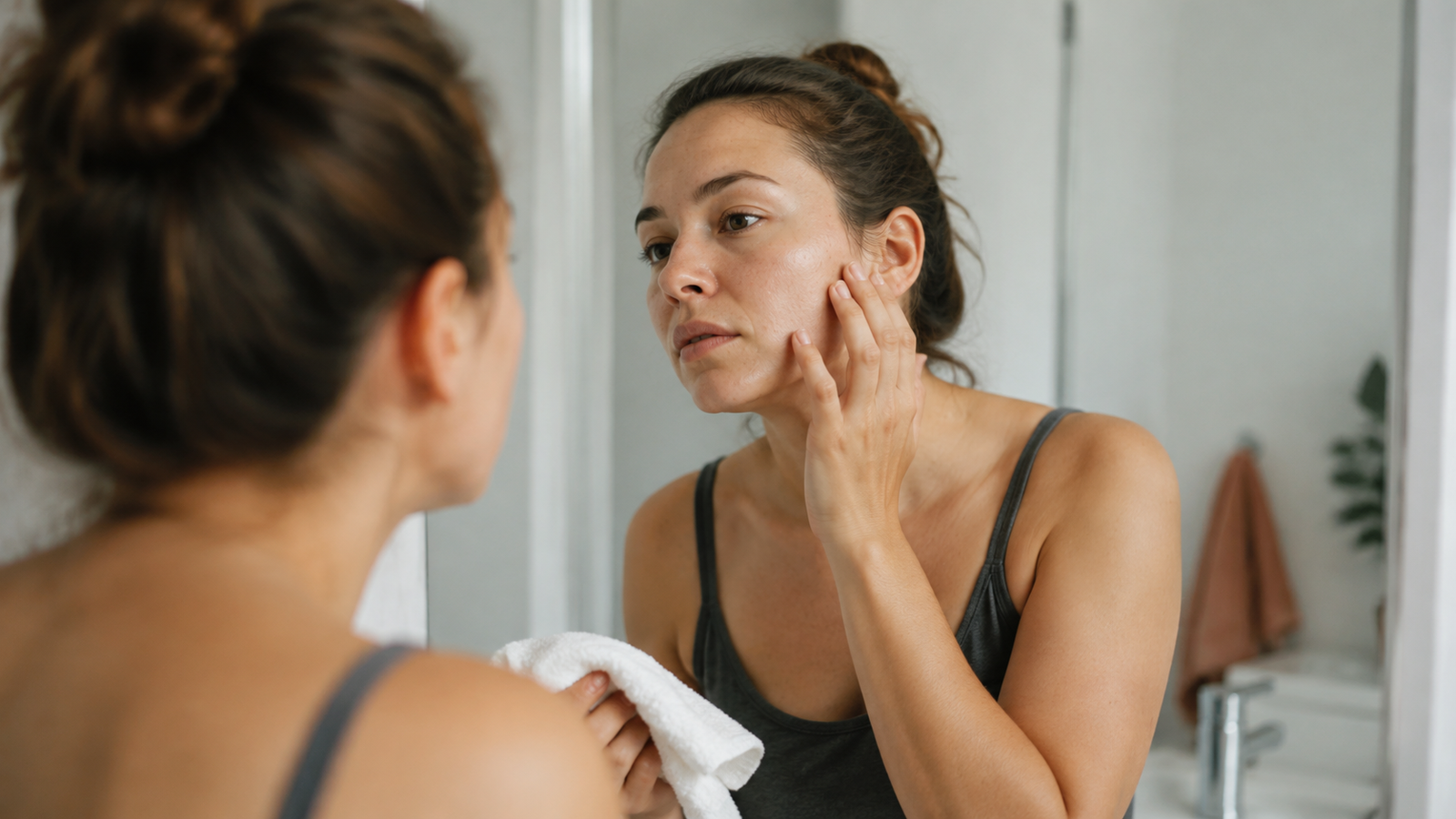
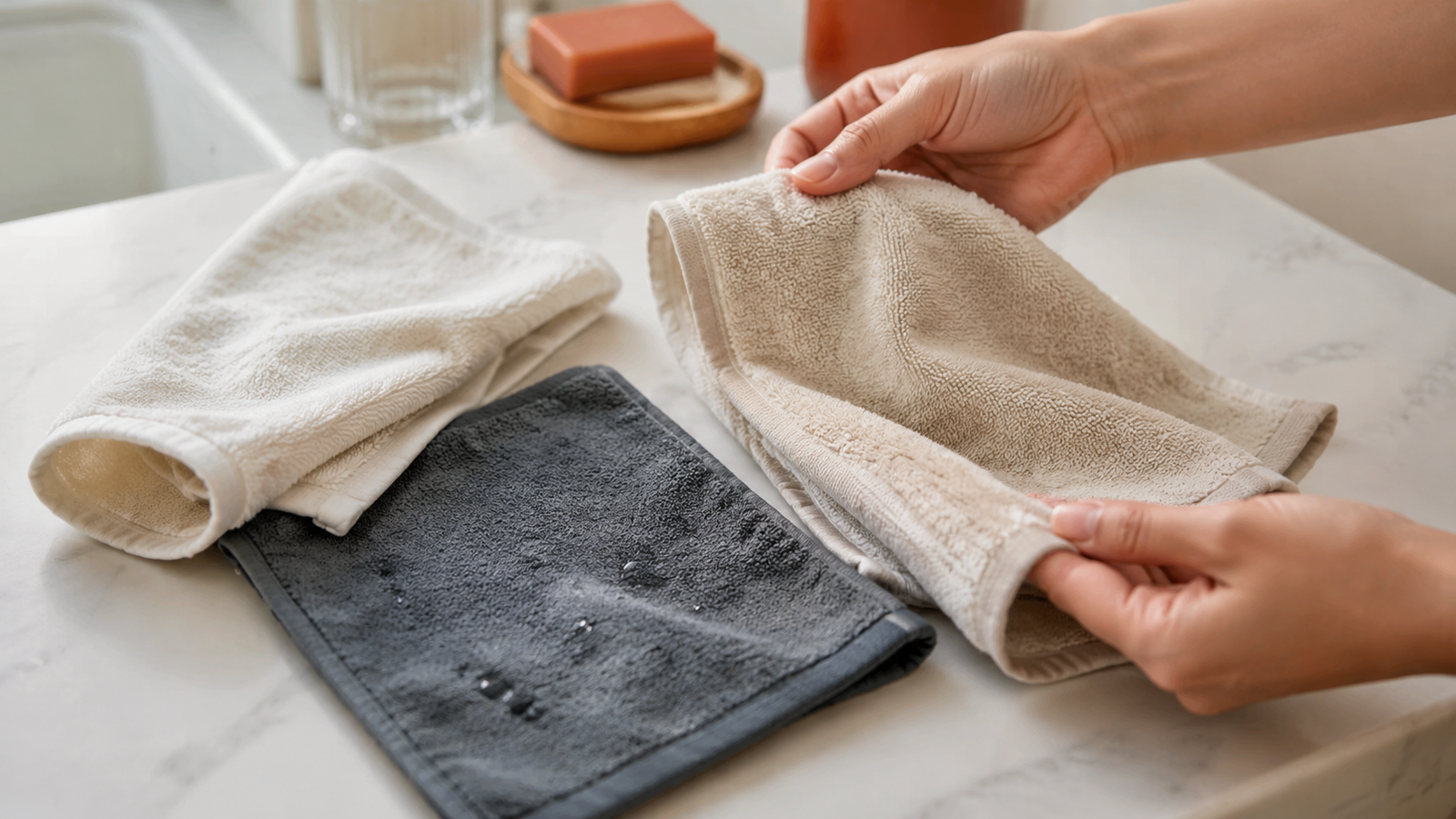
Choose a face towel by how the washed, damp product feels and behaves—not by a single unverified “ideal” specification. Because individual responses vary, how to select a face towel for sensitive skin should be considered alongside seams, stiffness, residue, and damp-surface feel. The matrix below converts common shopping claims into observable checks and shows what to change when a towel feels harsh, slippery, slow to wet, or difficult to keep dry.
| Face-towel variable | What to check | Choose or fix |
|---|---|---|
| Pile or surface | Feel the face and borders when damp; check for stiff ridges, snagged loops, or scratchy decorative bands. | Choose an even, pliable surface and keep borders away from the exfoliating pass. |
| Fabric mass (GSM) | Use grams per square meter to compare weight only; it does not measure skin safety, friction, or softness. | Balance cushion and water capacity against bulk and drying time. |
| Wetting | After laundering, place a drop on the surface and observe whether it spreads or remains beaded. | Rewash and rinse if residue is suspected; persistent slow wetting may reflect the finish or construction. |
| Wet flexibility | Fold and compress the damp towel without rubbing it on the face. | Choose the towel that conforms easily without a board-like or crusted feel. |
| Fiber label | Confirm content, but assess the finished fabric because cotton, synthetic, and blended towels vary widely. | Use the label to narrow options, then let washed performance decide. |
| Drying and hygiene | Check whether the towel dries completely between uses in the available airflow. | Choose a lighter or faster-drying towel, or rotate clean towels, if dampness persists. |
Use a face towel for gentler mechanical exfoliation
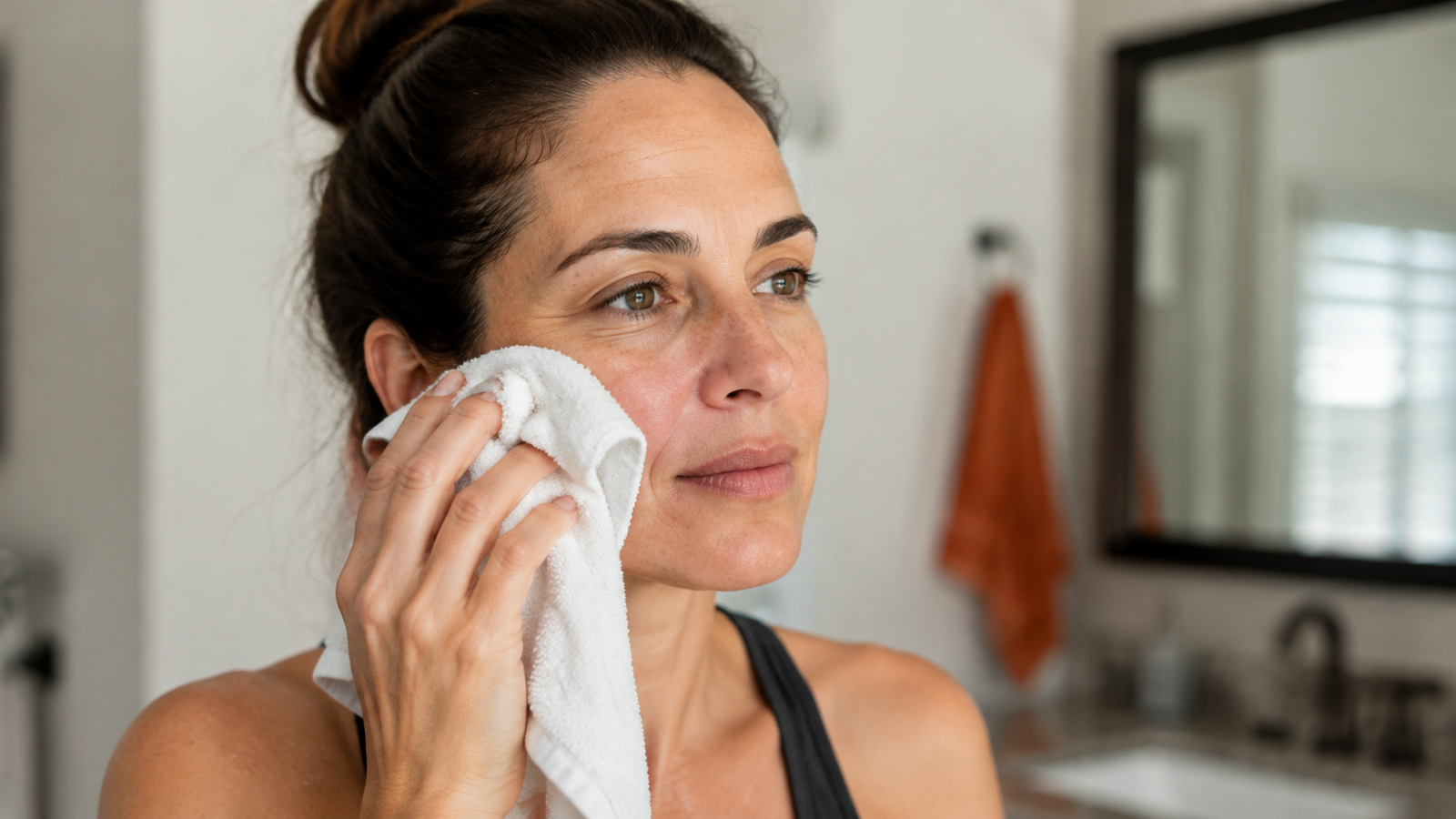
Use a clean, damp face towel with light contact for a brief pass, then rinse and moisturize. Monitoring how face-towel use can affect skin health helps connect redness, dryness, irritation, or comfort to the towel and technique. This sequence follows the AAD’s general mechanical-exfoliation controls, but it cannot make the method suitable for skin that is wounded, sunburned, actively inflamed, or made sensitive by products or treatment.
- Review the rest of the routine. Skip the towel if the skin is cut, sunburned, peeling, or irritated. Check whether retinoids, retinol, benzoyl peroxide, acids, procedures, or prescribed care already increase sensitivity.
- Prepare a clean towel. Wet the face towel with lukewarm water and wring it until damp rather than dripping. Apply a mild cleanser with your fingertips if it belongs in your routine.
- Limit contact. Use small circles or short, light strokes without bearing down. Keep the total mechanical-exfoliation step to about 30 seconds, following the AAD’s 2026 guidance.
- Rinse without extra rubbing. Rinse the face with lukewarm water. Avoid repeating passes to chase a “squeaky” or polished feeling.
- Moisturize and observe. Pat with a separate clean, dry section or towel, apply moisturizer, and note how the skin feels immediately and later that day.
Wash face towels without creating new performance problems
Wash face towels often enough to prevent visible soil, makeup, cleanser, oil, and persistent dampness from accumulating, then dry them completely. This makes how washing supports face-towel hygiene important before reuse. No evidence-based calendar or universal six-month replacement rule applies to every household; frequency depends on use, skin condition, sharing risk, storage, laundering, and whether the towel fully dries.
- Do not share face towels. Understanding how bacterial growth on face towels may contribute to skin irritation helps explain why prolonged dampness and repeated contamination matter. The CDC’s 2025 MRSA prevention guidance identifies towels and washcloths as personal items that should not be shared.
- Follow the sewn care label. Use enough detergent for the load and water conditions, but avoid overdosing; rinse again if residue or stiffness remains.
- Treat softener as a variable. Some conditioners can change wetting and fabric hand. If water beads or the towel feels coated, compare performance after laundering without added conditioner where the care label permits.
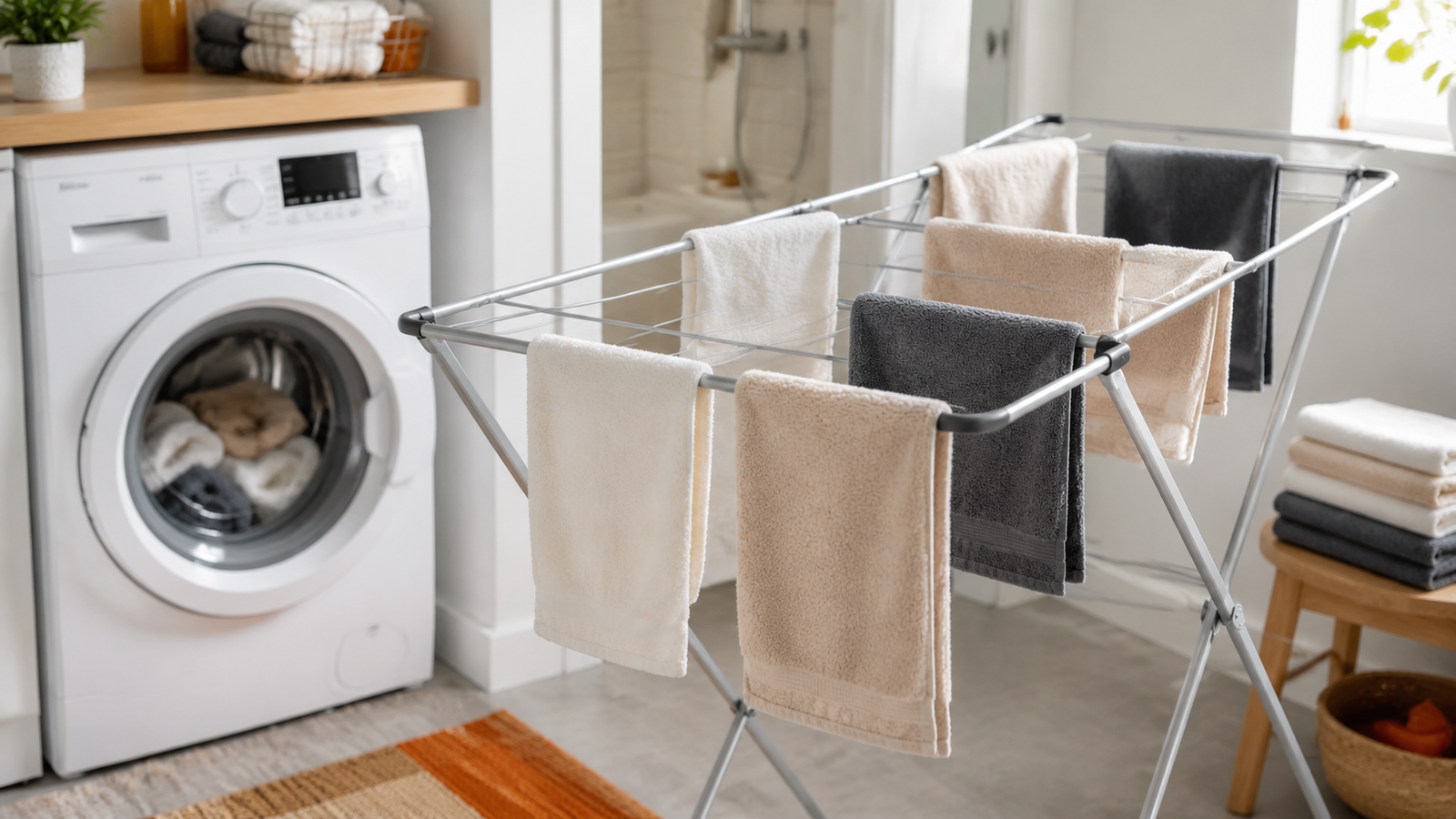
- Dry completely before storage. Spread the towel in moving air or use a label-approved dryer setting. Do not fold and store it while damp.
- Replace by condition. Retire the towel when torn borders, persistent odor, hardened residue, severe loop damage, or an uncleanable surface prevents comfortable, hygienic use.
Answer common face-towel exfoliation questions
These face-towel answers resolve the main frequency, material, comfort, and hygiene decisions without turning variable skin responses into universal rules. Use them as decision boundaries, then give your own skin condition and dermatologist’s instructions priority.
How often should I exfoliate with a face towel?
There is no universal schedule for face-towel exfoliation. Frequency should reflect your skin type, other products, and response. Start less often, use light contact, and stop if redness, burning, stinging, peeling, or persistent tightness develops. Ask a dermatologist when irritation continues.
Can a face towel feel soft and still exfoliate?
Yes. A soft face towel can create mild mechanical action when its damp surface moves lightly across skin. Softness describes perceived fabric hand, while exfoliation describes an outcome. Pressure, stroke count, moisture, cleanser, pile geometry, finishes, and skin condition all affect that outcome.
What material is best for a gentle face towel?
No fiber label guarantees the gentlest face towel. Cotton terry can absorb water and cushion contact, while smooth low-pile fabrics may reduce texture. Compare the finished towel after washing, including seams, stiffness, residue, wet feel, and your skin’s response, instead of choosing by fiber name alone.
How can I tell whether a face towel is too rough?
A face towel is too rough for your routine if light use causes new redness, burning, stinging, soreness, peeling, or prolonged tightness. Stop rubbing, rinse gently, and moisturize. Do not try to compensate by adding more water or cleanser if irritation keeps returning.
Should I keep a separate face towel?
A dedicated face towel is practical because it limits transfer from hands, bodies, makeup, and shared bathroom surfaces. Use a clean section, do not share it, wash it according to the sewn care label, and dry it completely before reuse. Replace it when damage prevents effective cleaning.
Balance face-towel softness, exfoliation, and skin response
A face towel can combine a soft hand with mild mechanical exfoliation, but no material or construction specification guarantees that balance. Choose by washed, damp, finished performance; control pressure and duration; account for skin type and other products; and stop when the skin signals irritation.
TowelDaily’s practical rule is simple: let the face towel support the task without outranking the skin. A clean, pliable towel, a brief light technique, complete drying, and an honest response check give you a safer and more useful decision process than any unsupported “ideal” number.
© 2026 TowelDaily.com · Unraveling the Science and Art of Towels, Daily.
Textile test methods describe material properties; they do not establish medical suitability for an individual user.