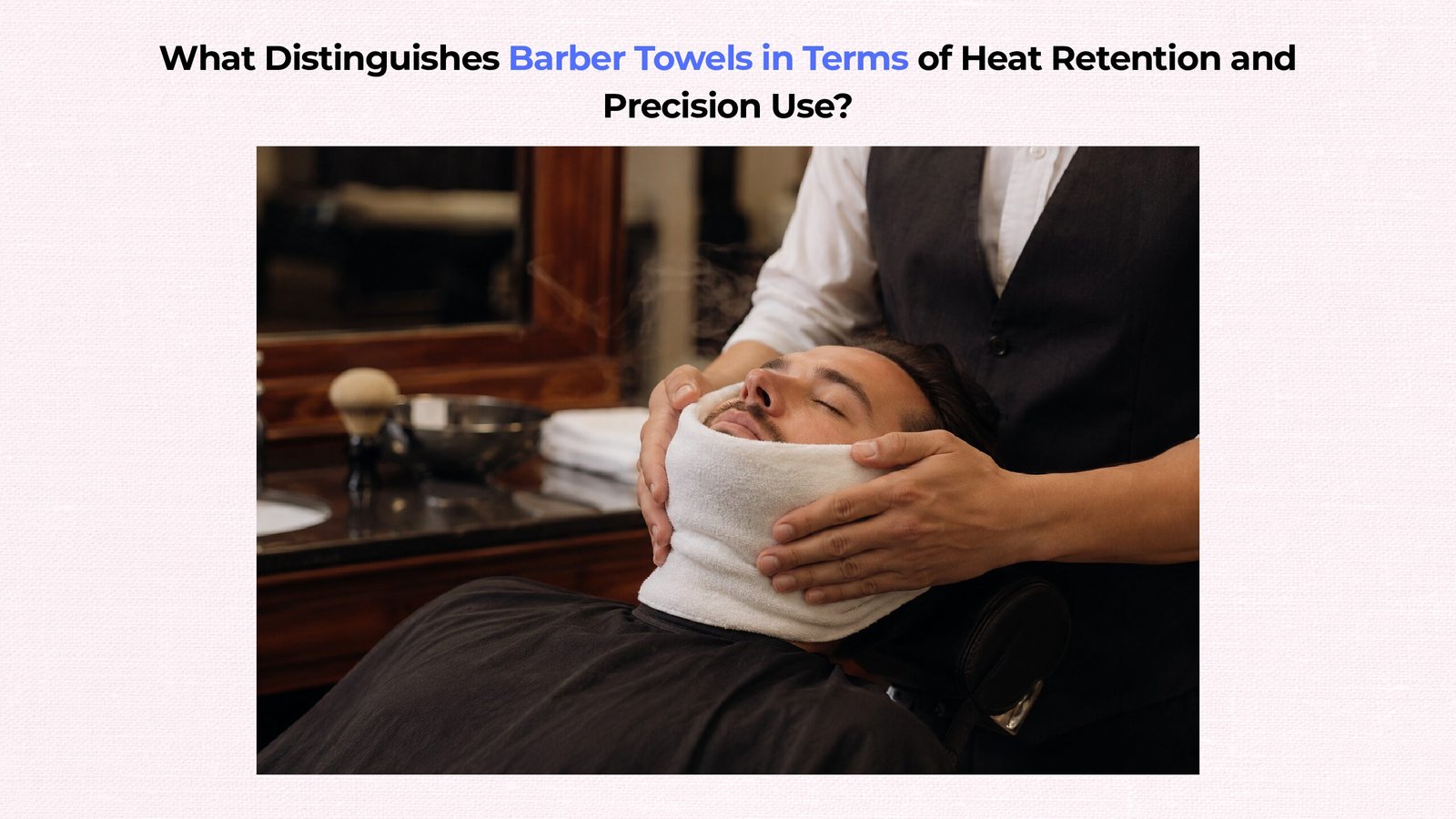
Laundry & Towel Care · Barbering Science
Quick answer: A barber towel is distinguished by verified service fit—not one universal size, GSM, fiber, fold, moisture percentage, or warmer setting. The useful towel heats uniformly, folds around the intended facial zone, maintains smooth contact, limits lint, tolerates the required laundry process, and reaches the client only after surface-temperature and hygiene checks.
Barber-towel heat retention comes from a changing system: dry textile mass, retained water, starting temperature, fold geometry, exposed area, airflow, evaporation, and contact with skin. Precision comes from finished dimensions, flexibility, edge construction, pile profile, and the barber’s placement technique.
This article separates those mechanisms, explains how to compare barber towels with larger towels, provides a safer application sequence, and turns supplier claims into a finished-product validation plan. It does not treat cabinet temperature as towel temperature or a wrist check as a substitute for measurement.
What Distinguishes a Barber Towel from Other Towels?
A barber towel differs when its finished dimensions, surface, flexibility, lint behavior, heat-transfer profile, and care limits match a specific barbering service. “Barber grade” alone does not prove that the towel is compact, low-lint, heat-stable, bleach-compatible, or suitable for a warmer.
Finished size matters because it controls coverage and the number of practical folds, but no single 11 × 17-inch format defines the category. GSM reports mass per area; it does not reveal pile height, yarn twist, border stiffness, total dry mass, retained water, or folded footprint.
More fabric mass can increase thermal capacity while also creating bulk, so how barber-towel weight and thickness affect performance should be considered when choosing a repeatable facial fold.
Cotton terry, cotton-rich blends, flat-woven cotton, and other constructions can all be candidates. Service fit means that the finished towel meets written requirements for the intended task after the actual heating, contact, laundering, and storage sequence.
Fiber content becomes meaningful only when its placement and structure are known, making the materials and constructions used in barber towels important when comparing finished products.
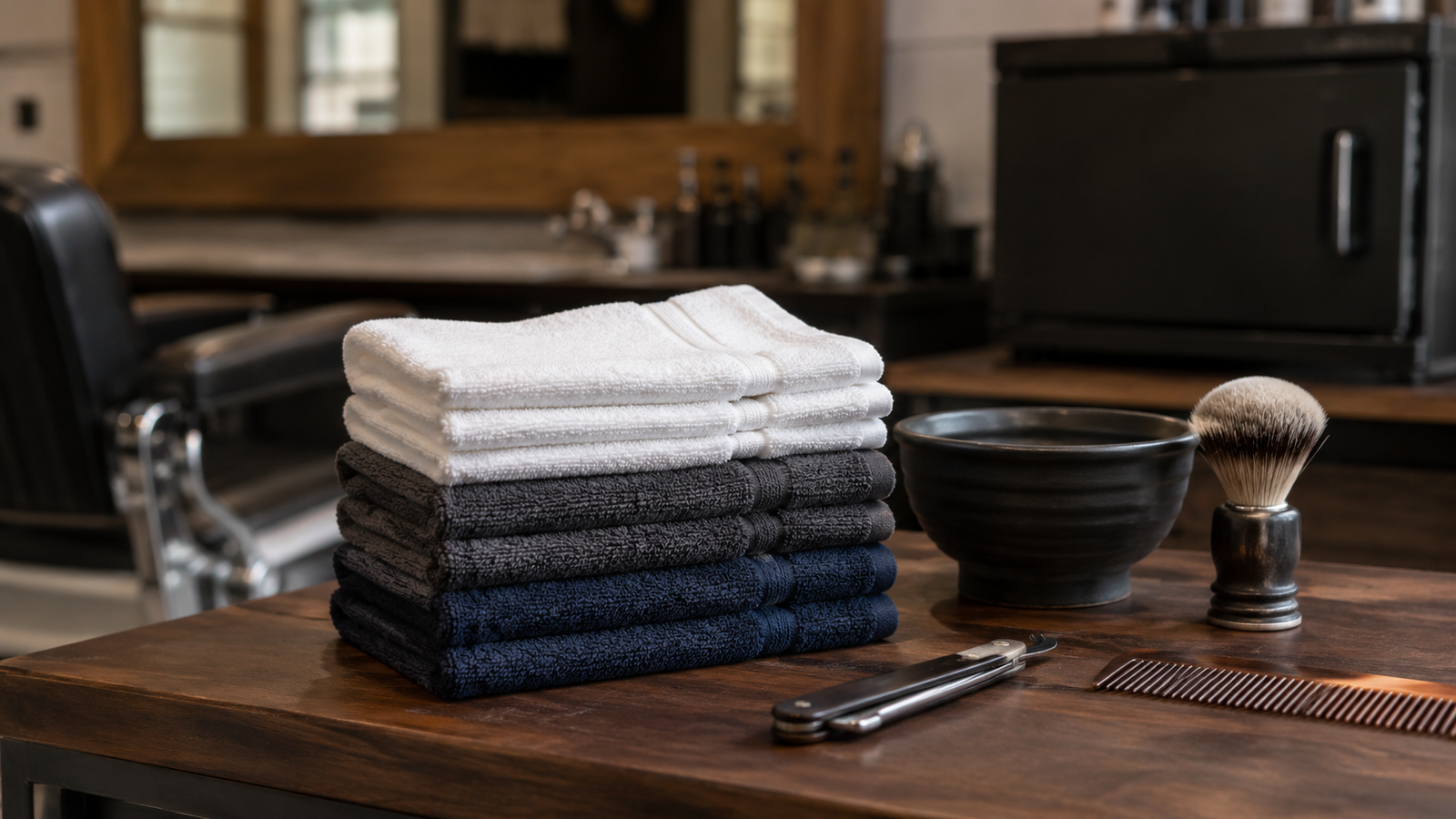
Construction establishes the towel’s potential; controlled thermal testing shows how that potential behaves during use.
How Do Barber Towels Store and Release Heat?
Barber towels store and release heat through the combined heat capacity of the dry textile and retained water, then lose that energy through air exposure, evaporation, conduction into skin, and contact with cooler surfaces. More water can carry more thermal energy, yet exposed moisture can also accelerate evaporative cooling.
Since water load, fabric mass, fold geometry, and airflow change the cooling curve, the factors that control barber-towel heat retention should be measured rather than inferred from fiber or GSM.
Thermal effusivity describes how strongly a material exchanges heat during contact. A towel can feel hotter than another towel at the same measured temperature if its water load, density, surface contact, or thermal conductivity differs. Starting temperature alone therefore cannot rank barber-towel performance.
A 2023 quasi-experimental study tested heat applications with 88 participants. Its towels were validated at 40 ± 2°C, and the moist-towel condition produced a different temperature curve from dry towel heat because evaporation changed heat loss.
That experiment involved young adults’ forearms before intravenous catheter insertion, not facial barbering. It demonstrates the mechanism and the need to control variables; it does not establish a seven-minute shave wrap, a universal moisture percentage, or a safe barber-towel setting.
Once the heat variables are controlled, finished size and folding can be evaluated as precision tools rather than visual traditions.
How Do Size and Folding Improve Barber-Towel Precision?
Size and folding improve barber-towel precision when they create a stable contact zone that follows the intended facial or neck area without covering unnecessary skin, blocking breathing, producing bulky overlaps, or exposing rough borders. Precision is verified by fit and contact—not by one prescribed strip width.
The fold changes thickness, exposed surface area, flexibility, and cooling. More layers may reduce exposure to ambient air, but they also create a hotter core and can make the towel harder to shape. A narrower fold improves localization only when it remains stable and comfortable.
Contact uniformity means that the towel touches the target area without lifted bridges, hard seams, concentrated hot spots, or loose loops near the working edge. Shops should record the exact finished dimensions and folding sequence used in every trial.
Because the working edge remains in direct contact with sensitive facial areas, how barber-towel texture affects client comfort is the next useful check after confirming size and fold stability.
- ☐ Record the barber towel’s finished dimensions and border locations.
- ☐ Select a fold that covers only the intended service area.
- ☐ Keep thick hems, decorative borders, and loose loops away from sensitive contact points.
- ☐ Confirm that the folded barber towel remains stable without obstructing the nose or mouth.
- ☐ Measure surface temperature after the final fold rather than before it.
- ☐ Reject any fold that creates a concentrated hot spot or uncomfortable pressure line.
Fold validation defines the precision requirement that a barber towel and bath towel must meet in a fair comparison.
How Should Barber Towels Be Compared with Bath Towels?
Barber towels should be compared with bath towels under the same service conditions: identical water load relative to dry mass, measured starting surface temperature, repeatable fold, target contact area, airflow, and cooling endpoint. Label, size, or GSM alone cannot decide the result.
Wetting and wringing determine both water load and service control, making the factors that determine barber-towel absorbency relevant when comparing towels under identical preparation conditions.
ASTM D4772-26 measures rapid surface-water absorption and retention in terry fabrics. The standard states that different applications may need different specifications and cautions that interlaboratory precision is poor, making controlled side-by-side testing especially important.
Controlled comparison means changing the towel option while holding the preparation, environment, measurement method, and decision threshold constant. Otherwise, an apparent barber-towel advantage may come from a different water load, fold, or starting temperature.
| Property | Barber-service requirement | Why a bath towel may differ | How to verify |
|---|---|---|---|
| Finished dimensions | Repeatable fit around a defined facial or neck zone | Larger coverage can create extra bulk and overlap | Record fold footprint and target-zone coverage |
| Surface construction | Controlled contact, acceptable lint, and no rough working edge | Plusher pile may change contact and folding | Inspect dry, damp, folded, and post-laundry samples |
| Water handling | Repeatable wetting and wringing without dripping | Greater total mass can retain a different water load | Weigh dry and prepared towels |
| Heat transfer | Uniform surface temperature and controlled cooling | Bulk changes heating uniformity and heat capacity | Map surface temperature against time |
| Processing | Compatibility with required one-client handling and laundering | Care limits may conflict with the shop’s required process | Run the complete service-and-laundry trial |
The fair comparison identifies which finished towel performs the task; it does not assume that smaller always means more precise or that heavier always means warmer.
What Does a Warm Barber Towel Actually Do Before Shaving?
A warm barber towel transfers heat and moisture to the contact area, which can increase perceived warmth and temporarily change skin-surface hydration. The evidence does not justify universal claims that the towel “opens pores,” guarantees easier cutting, prevents irritation, or improves every shave.
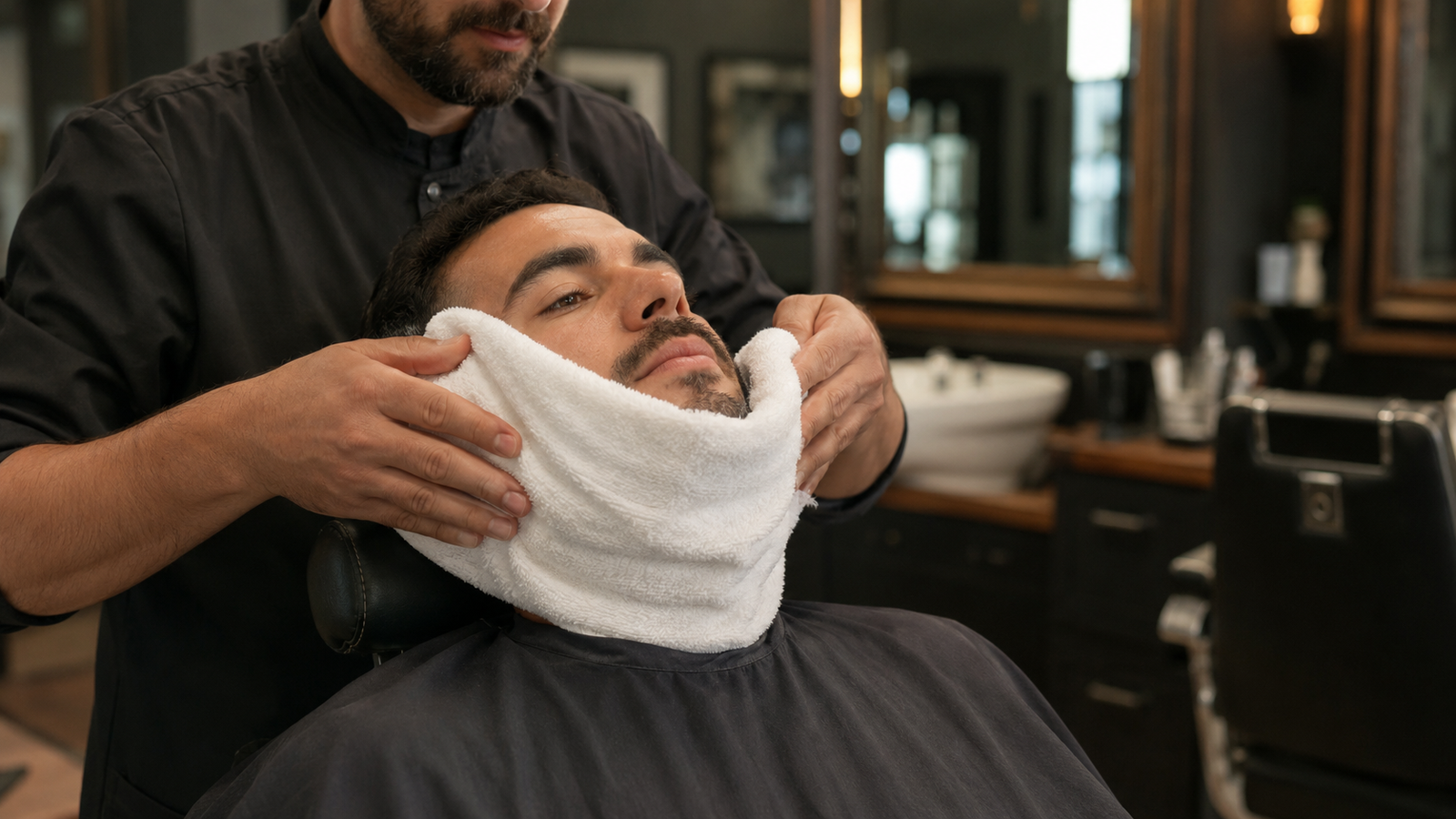
The 2023 heat-application study found that moist towels increased stratum-corneum hydration during heating, yet evaporation reduced temperature afterward. Stratum corneum is the skin’s outer barrier layer. That forearm result explains a plausible surface effect but does not measure beard-cutting force or razor glide.
A 2024 exploratory study exposed 10 healthy men to 60 seconds of electrical shaving on the forearm, cheek, and neck and detected location- and time-dependent skin responses. The small study reinforces that shaving effects vary by body site; it does not prove a benefit from hot towels.
Shops should therefore describe the warm towel as a controlled preparation and comfort step. The barber’s lather, razor, pressure, passes, client sensitivity, and hygiene process remain separate contributors to the shaving result.
This limited benefit claim leads directly to the more important task: controlling contact temperature and exposure time.
How Should Barber Towels Be Heated and Applied Safely?
Barber towels should be heated and applied through a documented process that follows the warmer manufacturer’s instructions, measures towel surface temperature after preparation, accounts for contact time and client sensitivity, and removes the towel immediately when warmth becomes uncomfortable. A cabinet dial and wrist test alone do not verify the client exposure.
A 2024 review of scald mechanisms shows that burn risk depends jointly on surface temperature and exposure duration. Risk also changes with contact pressure, tissue site, age, circulation, sensation, and the thermal mass of the heated item.
The 2023 controlled study used 40 ± 2°C surface temperatures and reported no burns among 88 analyzed participants, but its forearm protocol and population do not establish a universal barbering threshold. A warmer operating at a higher internal temperature may still produce towels with uneven and changing surface temperatures.
Surface-temperature mapping means measuring several points across the prepared barber towel instead of relying on one reading. Mapping reveals hotter folds, cooler edges, and uneven cabinet heating that a single center measurement can miss.
Once a towel’s thermal behavior is understood, how barber towels should be heated safely becomes the next practical question before selecting a warmer setting or contact time.
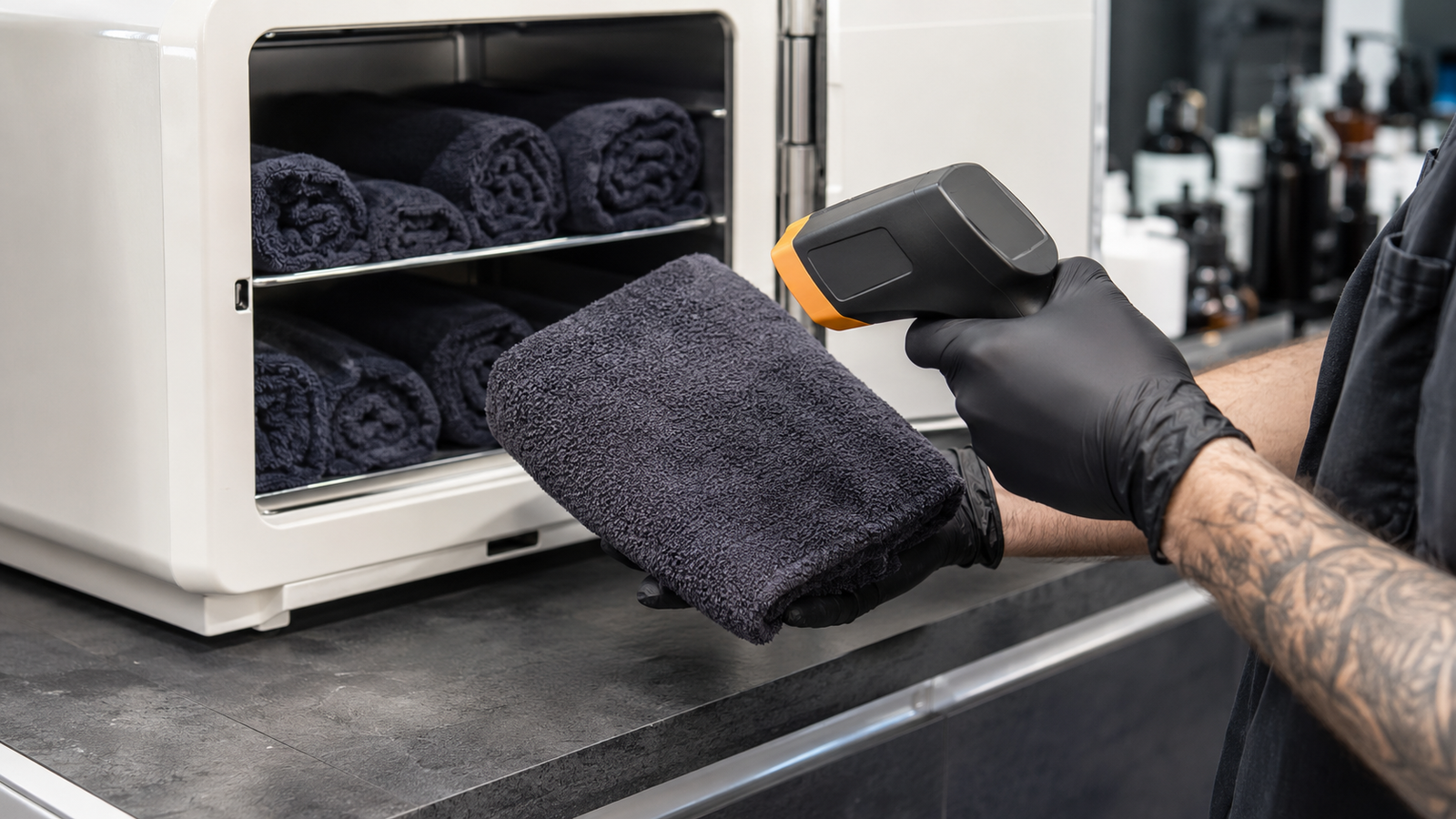
- Confirm the governing instructions. Follow the warmer manual, towel care label, product labels, and local barbering rules.
- Start with a compliant towel. Use a freshly laundered towel prepared with clean hands or gloves where required.
- Control the water load. Apply a repeatable wetting and wringing method that does not leave the towel dripping.
- Heat only as directed. Do not improvise a warmer setting, overload the cabinet, or treat the unit as a sterilizer.
- Measure the finished exposure. Check several surface points after removing, unfolding, shaking, and refolding the towel.
- Assess the contact area. Do not apply heat over visibly irritated, injured, numb, or otherwise unsuitable skin; follow applicable professional rules.
- Maintain communication. Tell the client what to expect and remove the towel immediately if it feels too hot, painful, or uncomfortable.
- Control duration. Use the shop’s validated time-temperature combination rather than a universal two-to-four-minute claim.
- End single-client use. Move the used towel directly to the required soiled-linen container.
Safe application ends with controlled handling, because a towel that transfers heat correctly still fails if it is reused or stored improperly.
How Should Barber Towels Be Laundered and Stored?
Barber towels should be laundered, dried, stored, and loaded into warmers according to the shop’s jurisdiction, contamination category, textile limits, appliance instructions, and chemical labels. No universal 60°C cycle, softener ban, bleach formula, or lifespan claim applies everywhere.
Requirements differ. California rule 987 requires a towel to enter a closed container after one use and specifies commercial laundering or a defined noncommercial route. Ohio’s rule effective January 1, 2026 requires machine washing with detergent as directed and drying before use.
Hot-towel handling also varies. New Mexico requires towel warmers to be disinfected daily, towels to be prepared with washed hands or gloves, wet towels to be prepared fresh each day, and unused steamed towels to be removed and laundered at day’s end.
Safe heat transfer does not replace sanitation, so barber-towel care and hygiene requirements must govern laundering, single-client use, warmer handling, and protected storage.
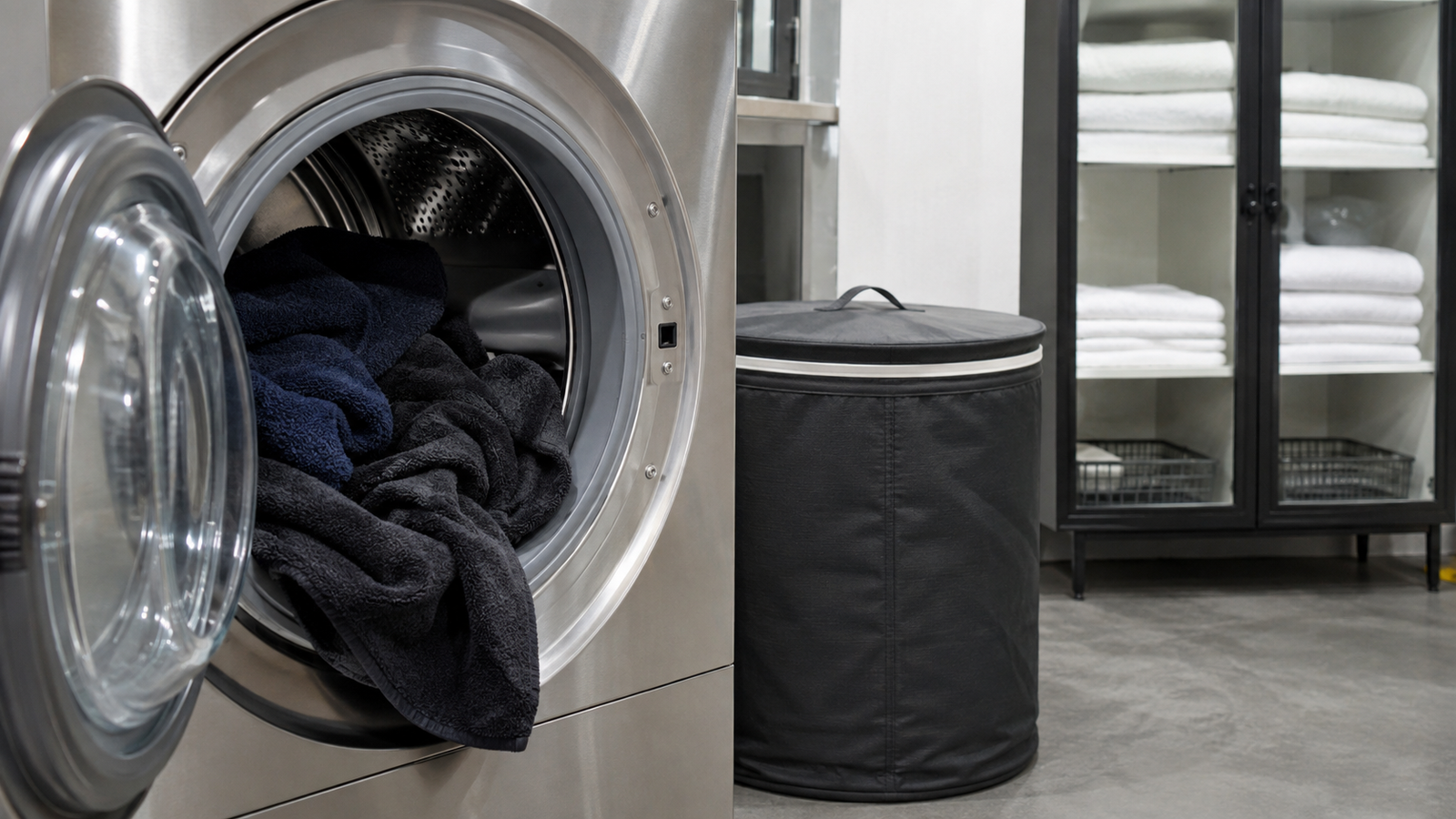
Residue, lint, shrinkage, border distortion, pulled loops, odor, staining, and color loss should be recorded after laundering. Fabric conditioner may change wetting or surface hand, but the relevant decision is whether the product and dose are compatible with the towel’s care label and the shop’s measured performance limits.
Processing compatibility means that a barber towel still meets its hygiene, fit, absorbency, lint, and heat-transfer limits after the required laundering and warmer sequence. A towel that survives washing but fails service performance is not compatible.
- ☐ Use a clean barber towel for each client and service as required.
- ☐ Place used barber towels directly in the required closed or covered receptacle.
- ☐ Separate blood or body-fluid incidents under the applicable exposure rule.
- ☐ Follow detergent, bleach, washer, dryer, warmer, and textile instructions.
- ☐ Dry barber towels fully before protected clean storage unless a local hot-towel rule specifies the next preparation step.
- ☐ Prepare wet towels fresh on the schedule required by the jurisdiction.
- ☐ Clean and disinfect the towel warmer at the required interval and by the manufacturer-approved method.
- ☐ Remove barber towels that fail hygiene, structural, contact, or heat-transfer limits.
The required processing route supplies the conditions for a realistic bulk-purchase trial.
How Can Shops Validate Barber Towels Before Buying in Bulk?
Shops can validate barber towels by testing representative samples through the intended wetting, heating, folding, contact simulation, laundering, and storage sequence, then comparing baseline and post-trial results with written pass limits. Supplier claims should disclose the method and conditions behind every number.
Begin with a construction record: finished dimensions, dry mass, GSM, fiber content, pile and ground structure, border, color, finish, care label, country of origin, and lot. Weigh each towel after the repeatable wetting step so “damp” becomes a recorded water load rather than a subjective instruction.
Map surface temperature at several locations after heating and after the final fold. Record cooling at fixed intervals under a repeatable contact simulation. Repeat the measurements after a disclosed number of laundry cycles, because a cycle count is meaningless without the wash formula, dryer conditions, exposure history, and pass/fail thresholds.
Cooling endpoint is the written temperature or performance boundary at which the barber towel no longer meets the trial requirement. Using one endpoint makes different towel constructions comparable without inventing a universal application time.
After the complete heating and laundry trial, what determines barber-towel durability helps establish whether the product retains its structure, contact quality, and service performance.
| Claim | Control variables | Decision output |
|---|---|---|
| “Retains heat” | Dry mass, water load, start temperature, fold, airflow, contact area | Surface-temperature curve to a written endpoint |
| “Precision size” | Finished dimensions, border position, target zone, folding sequence | Stable coverage without obstruction, gaps, or pressure lines |
| “Low lint” | Conditioning, wet/dry state, rub method, laundry count | Recorded lint result before and after processing |
| “Absorbent” | Construction-appropriate method and conditioning | Comparable water-pickup result with method stated |
| “Long-lasting” | Service exposures, wash formula, drying, warmer use, inspection limits | Cycles completed before the first defined failure |
- ☐ Define the barber service, target area, required hygiene rule, and warmer model.
- ☐ Obtain the complete finished-towel construction and care specification.
- ☐ Condition and test representative towels from the actual production lot.
- ☐ Standardize water load, fold, surface temperature, contact simulation, and cooling endpoint.
- ☐ Run the required service-and-laundry sequence before bulk approval.
- ☐ Repeat dimensions, mass, lint, absorption, hand, color, and thermal measurements.
- ☐ Approve only the barber towel that meets every written safety, hygiene, fit, and performance limit.
This validation path turns “barber grade,” “precision,” and “long-lasting heat” into traceable purchasing decisions.
Which Barber-Towel Questions Need Short Answers?
Barber-towel questions need answers that separate physical mechanisms from product-specific and jurisdiction-specific settings. No universal dimension, GSM, fiber recipe, warmer dial, moisture percentage, fold width, contact time, laundering temperature, or cycle life defines every barber towel.
Are barber towels just small bath towels?
Barber towels are not defined by one size, GSM, or fiber recipe. ASTM D4772-26 tests terry surface-water absorption, while California rule 987 controls towel reuse and laundering. The useful distinction is task fit: compact handling, measurable heat transfer, low lint, safe contact, and compliant processing.
What makes a barber towel retain heat better?
Barber-towel heat retention depends on starting surface temperature, water load, dry mass, thickness, fold geometry, airflow, and contact area. A 2023 study used 88 participants and found moist towels cooled differently from dry towel heat, showing that moisture changes both heat storage and evaporation.
Can a regular bath towel be used for a hot-towel shave?
Barber towels and bath towels can both deliver warmth, but larger finished dimensions may make precise facial placement harder. ASTM D4772-26 warns that different terry applications need different specifications. Compare five controlled variables—water load, fold, surface temperature, contact area, and cooling endpoint—before choosing.
What temperature should a barber towel warmer be?
Barber-towel warmers have no universal setting that is safe for every device, towel, client, or exposure time. A 2023 controlled study applied items at 40 ± 2°C, while burn research shows injury depends jointly on temperature and duration. Follow the warmer manual and verify towel surface temperature before contact.
What Is the Bottom Line on Barber-Towel Heat Retention and Precision?
Barber-towel heat retention and precision come from a verified system. Textile mass and water load shape heat capacity; surface construction and fold geometry shape contact; airflow and evaporation shape cooling; and the shop’s hygiene process determines whether the towel can be safely prepared for the next client.
The strongest barber-towel specification is not 11 × 17 inches, 300–400 GSM, 30–50% moisture, 150–170°F, two-to-four minutes, or “hundreds of cycles.” It is a repeatable result produced under disclosed conditions with written limits for fit, temperature uniformity, cooling, lint, absorption, dimensions, damage, and compliant processing.
TowelDaily’s evidence-based approach makes the ritual safer and more precise by replacing inherited numbers with measurements that travel with the towel, warmer, service, and jurisdiction.