Football Towel Engineering
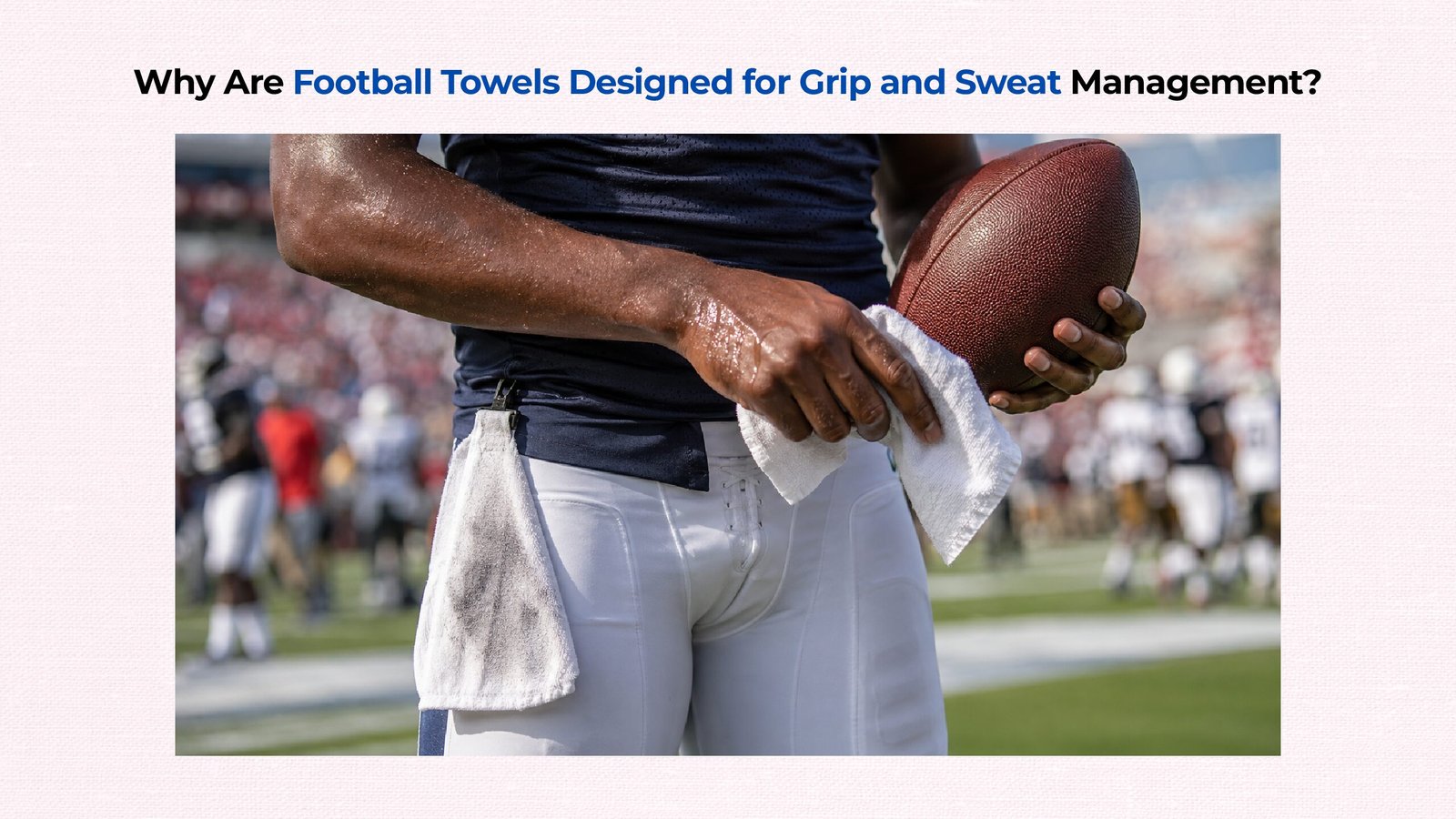
Why Are Football Towels Designed for Grip and Sweat Management?
Football towels provide an accessible wiping surface, but materials, water load, attachment, field conditions, care, and rules determine whether the finished towel performs its job.
Football towels are designed to remove accessible surface moisture without forcing a player to leave the field or reach the sideline. Their useful performance depends on pickup, capacity, dry-back, attachment, access, hygiene, and compliance. A fiber name or “grip towel” label cannot prove all of those outcomes.
This guide separates towel moisture management from actual hand–ball friction, replaces unsupported material rankings with controlled comparisons, and gives players and equipment staff a practical method for choosing and maintaining football towels.
What Jobs Must Football Towels Perform?
Which Football Towel Claims Need Separate Tests?
Football towels perform well when their measured water pickup, retained capacity, drying, attachment, and hygiene fit the intended field task. These properties interact, but one result cannot substitute for the others.
The AATCC 2026 Moisture Management Proficiency Testing Program lists nine distinct textile methods, including absorbency, liquid moisture management, vertical and horizontal wicking, drying time, drying rate, and water-vapor transmission. That range shows why “moisture managing” is not a complete football towel specification.
| Field task | Primary measure | Do not substitute | Useful output |
|---|---|---|---|
| Wipe hands or gloves | Surface pickup per controlled pass | Fiber name alone | Water removed per wipe |
| Remain useful through a series | Capacity and wet handling | Initial wetting speed | Number of equal wipes before saturation |
| Dry between uses | Equal-load mass loss | A touch-only check | Time to a defined endpoint |
| Stay accessible | Attachment retention and clearance | Water performance | Release force and motion interference |
Unique insight: a football towel with the highest capacity can become the heaviest on-field option after repeated wipes, so capacity must be evaluated beside wet mass and attachment stability.
Capacity creates its own trade-off because every absorbed gram increases the mass hanging from the player’s equipment, making football towel weight and its effect on field use especially relevant when comparing highly absorbent constructions.
How Do Football Towels Manage Sweat?
Which Football Towel Moisture Outputs Answer Different Questions?
Football towels manage sweat by making contact with surface liquid, wetting, moving that liquid through textile spaces, and retaining it away from the next contact area. Once those spaces approach capacity, wiping effectiveness can decline and the towel must be replaced or dried.
Since the towel’s first job is removing surface moisture from hands, gloves, or exposed skin, examine how football towels absorb and manage sweat separately from claims about grip or ball-handling performance.
AATCC introduced TM217-2025 to assess moisture movement in two directions—vertical and horizontal—with imaging. The wider AATCC program separates that movement from absorbency and drying. A football towel can therefore spread moisture quickly yet retain too much water for convenient reuse, or absorb a large amount but become heavy and slow to dry.
Unique insight: the driest-looking region is not necessarily the best wiping region; liquid can spread beyond the contact mark while the towel’s total wet mass continues to rise.
How Do Football Towels Relate to Grip?
Why Can’t a Football Towel Guarantee More Grip?
Football towels control accessible surface water before contact, but they do not create a universal friction increase between skin, gloves, and a football. Moisture level, ball cover, surface texture, normal force, motion, gloves, temperature, and contamination all change handling.
Removing excess moisture can support more consistent hand conditions, but it does not guarantee a fixed friction increase; that makes how football towels relate to grip during play the logical next question after moisture management.
In the closest peer-reviewed ball-handling evidence, Liu and colleagues tested eight male rugby players under four moisture conditions. Passing performance improved from natural to moderate hydration for many participants, then generally declined at high hydration and with added water. Finger friction followed a bell-shaped response. Because the study used rugby balls rather than American footballs, it supports a nonlinear moisture principle—not a football towel performance percentage.
Grip also becomes meaningful only when connected to the complete player–glove–ball system, so readers can further examine the relationship between football towel grip support and ball control without treating the towel itself as a guaranteed performance enhancer.
Unique insight: a towel’s defensible outcome is controlled surface moisture; actual grip remains a system outcome involving the player, glove, ball cover, contact load, and environment.
How Do Materials Change Football Towels?
Which Football Towel Construction Trade-Offs Matter?
Football towels made from cotton terry, flat or waffle weaves, and synthetic microfiber can all work when the finished construction meets the required pickup, wet-mass, drying, lint, and durability targets. No material name proves a universal winner.
Fiber name alone cannot predict that moisture response, so comparing how football towel materials differ in sweat absorption helps connect cotton, microfiber, and other constructions to actual pickup, capacity, and retained wet mass.
Cotton and polyester interact differently with atmospheric moisture: Montalvo and Von Hoven report cotton commercial-regain allowances of 7.0% in the United States and 8.5% in the United Kingdom, while Jin and colleagues describe conventional polyester at about 0.4%. Those values are not liquid-water towel capacities. Microfiber can hold liquid between fine filaments, while a terry construction can store water among yarns and pile loops.
ASTM D4772-26 limits its surface-water absorption method to terry and excludes at least five non-terry examples: huck, waffle, crash, flour-sack, and nonwoven fabrics. A terry-specific test should therefore not be used to rank every football towel construction.
| Construction | Likely structural effect | Verify on the finished towel | Potential field trade-off |
|---|---|---|---|
| Cotton terry | Pile loops add contact area and liquid-storage spaces | Pickup, capacity, lint, wet mass, dry-back | More retained water can increase hanging load |
| Split microfiber | Fine filaments create high surface area and small pathways | Split quality, blend, finish, oily-soil response | Performance varies widely by manufacture |
| Waffle weave | Cell geometry can provide texture with lower bulk | Mass per area, pickup, dimensional change, drying | Lower bulk can reduce total capacity |
| Hybrid or zoned towel | Different faces can divide wiping and structural functions | Seams, delamination, access, full-product wet mass | Extra components add failure points |
Unique insight: microfiber describes fiber fineness, terry describes a pile construction, and waffle describes a weave geometry; treating the three terms as equivalent material categories creates invalid comparisons.
How Should Football Towels Attach During Play?
Which Football Towel Attachment Features Need Testing?
Football towels need an attachment that remains secure during position-specific movement, releases safely when required, keeps the wipe face accessible, and does not interfere with equipment. A clip, tuck, loop, or sleeve is useful only after the complete setup passes practice testing and team approval.
ASTM’s textile catalog separates at least two relevant mechanical behaviors: D5034 measures fabric breaking strength and elongation with a grab test, while D2261 measures tongue-tear strength. Neither method alone certifies a waistband clip, but together they show why fabric rupture and attachment retention are different failure modes.
- Test the towel dry and at the heaviest wet mass expected in use.
- Run, cut, backpedal, block, reach, fall, and rise in full permitted equipment.
- Inspect the attachment, fabric around it, hem, and seams after repeated pulls.
- Reject a setup that obscures numbers, catches equipment, or creates unsafe loose material.
Attachment performance also depends on the textile surrounding clips, loops, hems, and other stress points, so how reinforced stitching affects football towel durability is a useful next check for towels exposed to repeated pulling and high-movement play.
Unique insight: adding grip material to a towel’s wipe face can improve holding friction yet reduce skin contact or water pickup, so attachment friction and wiping performance must be tested on separate zones.
Which Rules Apply to Football Towels?
Which Football Towel Requirements Must Teams Confirm?
Football towels must comply with the rules, uniform policies, logo restrictions, and equipment approvals governing the player’s exact competition. A towel allowed in one league, event, team, or position setup is not automatically allowed in another.
NFL Football Operations identifies visible hand towels as uniform accessories and says every game-day uniform component must be issued or approved by the club or league—one clear approval gate. For the 2025–26 NCAA Division I Football Championship, the host manual says bench and sideline towels may not carry corporate logos; it separately requires the host to provide the visiting locker room at least 150 full-size towels. That 150-towel requirement concerns locker-room operations, not player-worn towel dimensions.
| Check | Question for the team | Evidence to retain |
|---|---|---|
| Approval | Is this exact towel and attachment permitted? | Current league, event, and team direction |
| Appearance | Are color, branding, and placement compliant? | Uniform and logo policy |
| Safety | Does length or attachment create interference? | Practice fit check and equipment review |
| Operations | Who supplies player, sideline, and locker-room towels? | Event operations manual |
Unique insight: “football towel” can refer to a player-worn accessory, a bench wiping towel, or a locker-room towel; rules and performance requirements differ across those three contexts.
How Should Players Choose Football Towels?
Which Football Towel Decision Matrix Avoids Position Stereotypes?
Football towels should be chosen from the player’s moisture load, wiping frequency, permitted attachment, reach, movement pattern, weather, and replacement access. Position names can guide questions, but they do not prove that every quarterback needs microfiber or every lineman needs cotton.
AATCC’s use of nine separate moisture methods supports a multi-property decision rather than a one-label ranking. Start with the field task, assign priority measures, compare finished towels under the same conditions, and confirm the complete setup in practice.
| Field need | Prioritize | Verify next | Watch for |
|---|---|---|---|
| Frequent hand wiping | Pickup per wipe and access | Capacity, wet feel, replacement plan | Smearing after the contact zone saturates |
| Rain or high external water | Capacity and replacement frequency | Wet attachment stability and ball policy | A towel that begins the series already wet |
| High movement or contact | Retention, clearance, compactness | Reach with full permitted equipment | Snagging, bunching, unintended release |
| Fast reuse after hanging | Equal-load dry-back | Air exposure and starting wet mass | Folds that block both towel faces |
Unique insight: replacement access can be more important than theoretical drying speed during a game because a saturated towel will not return to dry mass during a brief play interval.
How Can Teams Test Football Towels?
Which Football Towel Screening Protocol Produces Repeatable Results?
Football towels can be screened with equal-size specimens, controlled water doses, fixed wiping pressure, mass measurements, repeated trials, and a full-equipment attachment check. The result supports team comparison; it is not an AATCC, ASTM, or league certification.
AATCC TM200 measures drying at absorbent capacity under airflow, while AATCC TM201 uses a heated plate held at 37°C. A field room does not reproduce those apparatuses. For a practical screen, run three trials per towel, report the median, and state every condition.
Once a towel becomes wet during repeated use, its ability to return toward a usable moisture level depends on the factors that determine football towel drying time, including starting water load, fabric structure, airflow, exposure area, and environmental conditions.
| Step | Control | Record | Decision |
|---|---|---|---|
| 1. Condition | Launder identically; leave together for 24 hours | Room temperature and humidity if available | Reject comparisons from different starting states |
| 2. Baseline | Use whole towels or equal-size specimens | Dry mass and dimensions | Normalize results when sizes differ |
| 3. Pickup | Same water mass, surface, pressure, distance, and passes | Mass gained per wipe | Higher gain wins only the controlled pickup test |
| 4. Capacity | Repeat equal water doses | Dose at which water smears or drips | Compare capacity with final wet mass |
| 5. Dry-back | Apply water equal to 20% of dry mass; hang identically | Mass every 15 minutes | Use time to the same mass endpoint |
| 6. Field fit | Full permitted equipment; dry and wet towel | Retention, access, clearance, damage | Reject unsafe or distracting setups |
| 7. Repeat | Three complete trials per towel | Median and range | Choose by the priority measures |
Unique insight: testing dry-back from equal water mass answers a different question from testing at absorbent capacity; the first compares a controlled load, while the second includes each towel’s different capacity.
How Should Football Towels Be Washed?
Which Football Towel Care Routine Preserves Tested Performance?
Football towels should be laundered after sweaty or soiled use, according to the towel, detergent, washer, and team instructions, then dried completely before storage. Care must remove soil without assuming every fiber, dye, finish, or attachment tolerates the same heat or chemical.
Igarashi and colleagues reported that the tested rinse-cycle softener system reached nearly 100% adsorption within 5 minutes on the cotton towels studied. Deposition can change fiber-surface wetting and friction, but the effect depends on formulation and process. That evidence supports retesting after a care change; it does not justify claiming every softener universally “ruins” every football towel.
- Inspect the care label, fiber label, attachment, printed marks, and team laundry procedure.
- Separate towels contaminated with blood, wound drainage, chemicals, or unusual soils for the applicable protocol.
- Use the specified detergent dose and wash temperature; avoid improvised chemical mixtures.
- Dry completely at a permitted setting and inspect the attachment, seams, odor, residue, and damage.
- Repeat the controlled pickup screen if a new product or process changes performance.
Finally, repeated sweaty use creates a care issue as well as a moisture issue, so understanding why football towels develop odor and how use and care influence it helps connect complete drying and laundering with long-term towel condition without treating odor control as a substitute for hygiene.
Unique insight: a towel that feels softer after laundering has not necessarily become more absorbent; surface friction, pile compression, wetting, and pickup can move in different directions.
How Should Football Towels Be Managed Hygienically?
Which Football Towel Hygiene Steps Reduce Cross-Use?
Football towels should be personal during use, kept away from wound drainage, replaced when contaminated, laundered after sweaty use, and stored only after complete drying. A quick-dry construction or antimicrobial treatment does not replace those controls.
CDC advises athletes not to share towels and other skin-contact items. In a CDC investigation of a community-associated MRSA outbreak among a college football team, sharing towels during training camp was associated with an estimated risk ratio of 8.2. That outbreak estimate is context-specific, but it provides direct evidence for personal towel assignment and no-sharing rules.
EPA explains that many antimicrobial treated articles are protected against odor, discoloration, or deterioration of the product itself; they do not protect users from disease organisms. Clean and wash a treated towel as directed instead of treating the finish as personal-health protection.
- Assign and identify towels so they are not shared during practice or games.
- Keep cuts and abrasions covered according to medical guidance.
- Bag or isolate a towel exposed to blood or wound drainage and follow the team protocol.
- Do not return a wet used towel to a closed equipment bag.
- Replace towels with damaged surfaces or attachments that cannot be cleaned adequately.
Unique insight: faster textile drying changes how long water remains, but it does not reverse skin contact, sharing, or contamination that already occurred.
What Else Matters About Football Towels?
Which Football Towel Questions Need Direct Answers?
Football towels need direct answers that preserve the difference between moisture control, finished-product performance, compliance, and actual ball handling. The eight-player, four-condition ball study is useful precisely because it shows that grip-related moisture effects are not linear.
Why does a football towel help manage grip?
A football towel removes surface sweat or rain from hands, gloves, and exposed forearms before ball contact. It does not create a guaranteed friction increase: skin moisture has nonlinear effects, and ball cover, glove, pressure, texture, and remaining water all influence handling.
Should football towels be cotton or microfiber?
Choose by finished-product results, not fiber name. Cotton absorbs atmospheric moisture differently from polyester, while microfiber can hold liquid between fine filaments. Compare equal-size towels for pickup, retained wet mass, dry-back time, lint, attachment stability, and laundering response.
Can fabric softener affect a football towel?
Fabric softener deposits on fiber surfaces and can change wetting, friction, and absorbency. The effect depends on formulation, dose, fiber, and washing process. Follow the towel and product labels, then compare water pickup before and after any care-process change.
Can I use a regular gym towel for football?
A gym towel can wipe sweat, but suitability for football depends on size, exposed edges, attachment security, interference with movement, league approval, and access during play. Test the complete setup during practice and confirm the applicable team and competition rules.
How often should a football towel be washed?
Use a personal towel and launder it after each practice or game in which it becomes sweaty, visibly soiled, or contaminated. CDC advises athletes not to share towels. Dry the towel completely and follow its care label and team hygiene procedure.
Unique insight: the best short answer names the boundary of the evidence—rugby versus American football, fiber versus finished towel, home screening versus standard testing, and product preservation versus public-health protection.
Which Sources Support This Football Towels Guide?
How Was the Football Towel Evidence Checked?
Football towels were evaluated here with official textile methods, current football-operations guidance, public-health recommendations, and peer-reviewed friction research. The review uses 15 named references and removes the fabricated dataset rather than repackaging unsupported multipliers.
- AATCC. 2026 PTP7 Moisture Management methods.
- AATCC. TM217-2025 vertical and horizontal wicking overview.
- AATCC TM200, Drying Rate at Absorbent Capacity: Air Flow Method.
- AATCC TM201, Drying Rate of Fabrics: Heated Plate Method.
- ASTM D4772-26, Surface Water Absorption of Terry Fabrics.
- ASTM International. Textile standards including D2261, D3776, and D5034.
- Montalvo, J. G., and Von Hoven, T. M. (2008). Moisture methods for lint cotton.
- Jin, X., et al. (2024). Moisture-regain discussion for conventional polyester.
- Liu, J., et al. Understanding Handling Performance of Rugby Balls under Wet Conditions.
- NFL Football Operations. Uniform definition and approval requirement.
- NCAA. 2025–26 Division I Football Championship Host Operations Manual.
- Igarashi, T., et al. (2015). Fabric-softener adsorption on cotton towels.
- CDC. MRSA Prevention and Control for Athletes.
- CDC MMWR. MRSA outbreak investigation among a college football team.
- U.S. EPA. Consumer Products Treated with Pesticides.
Standards, event manuals, and uniform policies can change. Confirm the current edition and governing competition requirements before testing, purchasing, or approving an on-field towel.
Unique insight: evidence quality improves when every number is attached to its study, method, or operations rule instead of being transformed into a universal absorption, drying, or grip claim.
How Do You Choose Football Towels With Confidence?
Which Football Towel Decision Rule Works Best?
Football towels should be selected by matching the player’s moisture task to controlled pickup, capacity, wet-mass, attachment, and dry-back results, then confirming compliance and hygiene. The nine-method AATCC moisture program shows why no single material label completes that decision.
- Define the use: hand wiping, glove wiping, rain management, bench use, or locker-room supply.
- Measure the towel: compare equal conditions and report the endpoint.
- Test the setup: evaluate access, wet attachment, seams, and clearance in practice.
- Confirm the rules: obtain current team and competition approval.
- Control hygiene: assign personal towels, prevent sharing, launder after use, and dry completely.
The practical winner is the compliant football towel that removes the required surface water, remains accessible at its expected wet mass, survives care, and fits the team’s replacement and hygiene plan.
Unique insight: a football towel supports grip most defensibly by controlling one input—surface moisture—while selection and testing acknowledge every other part of the handling system.