How Should a Beach Towel Perform for Sand Resistance and Sun Drying?
Textile Engineering for the Perfect Beach Day
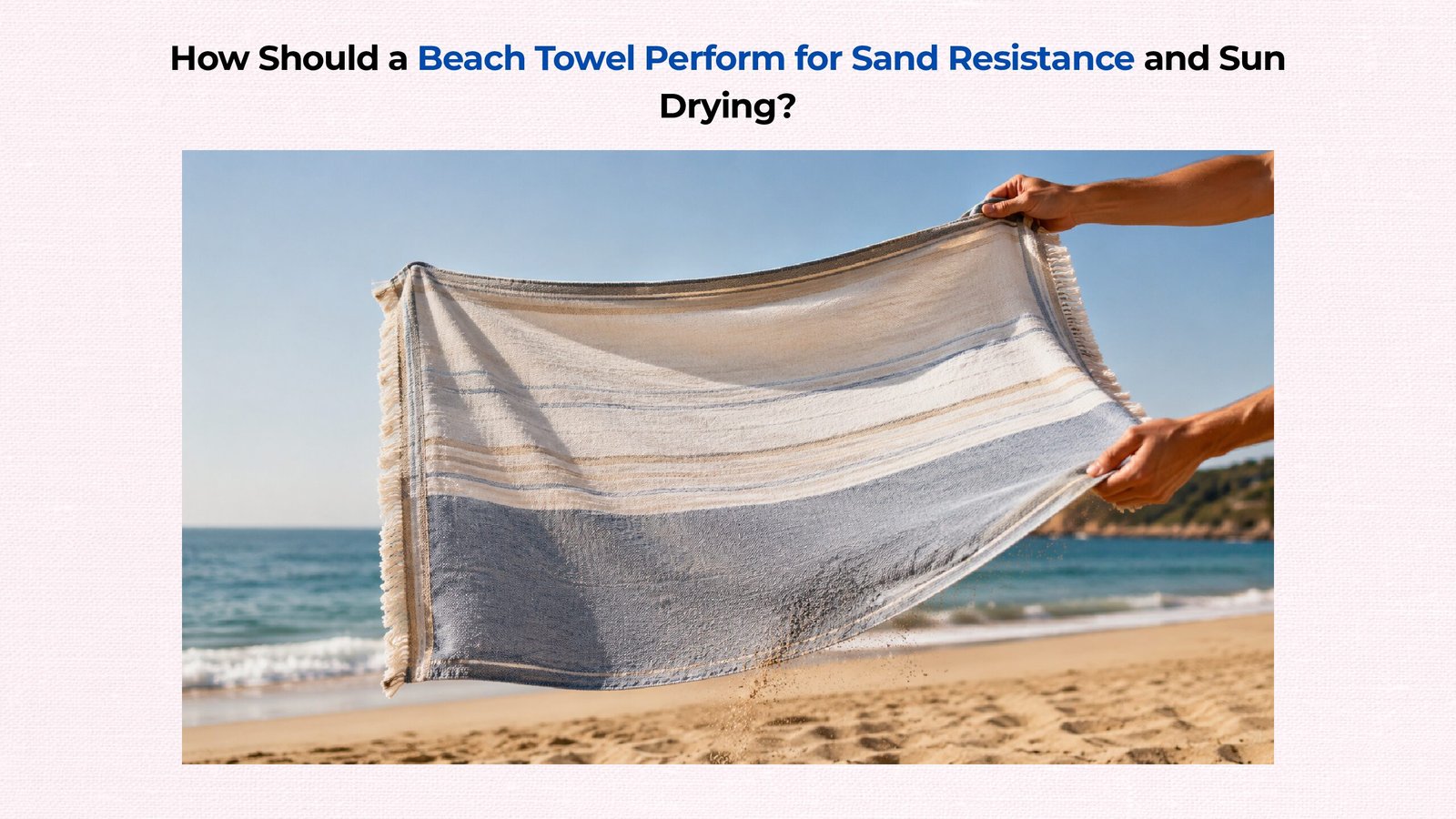
Beach towels perform well when they remove water, release sand, dry between uses, and remain comfortable for the intended trip. Those outcomes do not come from one fiber label or GSM number. Surface construction, pile height, specimen size, starting water load, exposure, airflow, humidity, sand size, and whether the towel is damp all change the result.
A flat, low-pile towel often presents fewer spaces for grains to enter, while a looped terry towel offers more surface and pore volume for water pickup. That is a design trade-off, not proof that every microfiber towel sheds sand or every cotton towel dries slowly. This guide keeps each performance question tied to its own test.
0.0625–2 mm
USGS sand range
37 °C
AATCC heated plate
9 methods
AATCC moisture program
3 trials
Home-test minimum
How Should Beach Towels Perform at the Shore?
Which Beach Towel Properties Need Separate Measures?
Beach towels need separate measures for water pickup, capacity, sand release, drying, and wet handling. AATCC’s 2026 moisture-management program lists nine methods for absorbency, wicking, drying, liquid transport, and vapor transmission. That test diversity shows why one “quick-dry” or “sand-free” label cannot represent total beach performance.
Start with the job. Body drying needs rapid surface pickup and enough capacity. Lounging needs size and comfort. Travel rewards low packed mass and repeat drying. Sand release depends on surface geometry and moisture state. A beach towel succeeds only against the outputs that matter for that use.
| User task | Measure first | Control | Decision output |
|---|---|---|---|
| Dry skin | Surface water pickup | Water dose, contact and pressure | Water removed per contact |
| Leave sand behind | Dry and damp sand retention | Sand mass, grading and shake motion | Sand retained per area |
| Reuse the same day | Mass-based drying time | Starting water and exposure | Time to a defined endpoint |
| Pack for travel | Dry mass and packed volume | Finished towel size | Performance per packed unit |
Why Does Sand Stick to Beach Towels?
Which Beach Towel Conditions Increase Sand Retention?
Beach towels retain sand through geometric entrapment, friction, and liquid bridging when the surface is damp. The USGS separates sand across the range above 0.0625 mm through 2 mm, so one beach sample contains grains that interact differently with loops, yarn gaps, hems, and brushed surfaces. Dry and damp sand therefore need separate comparisons.
Loops and deep texture provide spaces where grains lodge. On a damp towel, water between a grain and the textile forms a liquid bridge; Zhao and colleagues’ 2018 model treats bridge force as dependent on geometry and contact angle. Fiber identity still matters, but construction and moisture state determine the contact that the fiber actually makes.
- Loop depth: deeper relief provides more entry paths and sheltered pockets.
- Yarn and surface roughness: more contact points increase frictional resistance to release.
- Moisture: a liquid bridge adds adhesion that a dry test does not capture.
- Grain distribution: fine and coarse fractions occupy different openings.
- Hems and seams: folded edges form separate traps from the towel face.
How Do Beach Towels Shed Sand?
Which Beach Towel Test Separates Dry and Damp Sand?
Beach towels shed sand when the applied motion overcomes friction, structural trapping, and any moisture-assisted adhesion. ASTM C778-26 controls sand grading for hydraulic-cement testing and even specifies that air-entraining checks occur on a single day by a single operator; it is not a beach-towel sand-release standard. A towel protocol built with that sand must still be labeled a custom comparison.
Keep dry and damp trials separate. Dry sand emphasizes geometry and friction. Damp sand adds liquid bridges and becomes sensitive to water dose and distribution. Report retained mass rather than converting results into invented “excellent,” “acceptable,” or “poor” grades.
Rule → Reason → Example: Control the particle batch → grain distribution changes entry into textile openings → use one mixed batch for every specimen and record its source or sieve range.
- Dry-sand output: retained sand mass ÷ exposed towel area.
- Damp-sand output: retained sand after one measured pre-wet dose.
- Motion record: number, direction, amplitude, and duration of shakes.
- Construction notes: face texture, pile, brushing, seams, and hems.
What Makes Beach Towels Dry Faster Outdoors?
Which Beach Towel Drying Variables Change the Result?
Beach towels dry faster when they start with less water and expose more wet area to moving, unsaturated air. AATCC TM201 uses a prescribed water volume and a plate at 37 °C, while Jerkovic and colleagues reported that one-sided drying took 45% longer on average than two-sided drying in their 2025 study. Exposure geometry can outweigh a fiber-label shortcut.
Outdoor sun adds uncontrolled radiation, wind, shade, ambient temperature, and relative humidity. Fabric mass, thickness, pore structure, color, finish, and the amount of liquid held within fibers and voids determine the load. A towel lying flat on an impermeable chair exposes less area than the same towel opened across a line.
Use the equation for a defined interval: m is specimen mass, A is exposed area, and t is elapsed time. It compares tests; it does not predict a universal sun-drying time.
How Do Beach Towels Hold Water in Their Fibers?
Which Beach Towel Fiber Properties Affect the Drying Load?
Beach towels hold water inside fibers, between fibers, and throughout yarn-and-fabric voids. Montalvo and Von Hoven reported commercial moisture-regain values of 7.0% for natural cotton yarn in the United States and 8.5% in the United Kingdom, while Jin and colleagues cite about 0.4% conventional regain for polyester. Regain describes equilibrium vapor moisture—not the liquid capacity of a finished towel.
Cotton’s cellulose takes moisture into the fiber wall. Polyester absorbs little equilibrium moisture into the polymer, but a microfiber textile can still pick up liquid through capillary spaces between fine filaments and through surface treatments. Pile, thickness, yarn twist, density, finishes, and total towel area often change the starting drying load more than the generic fiber name.
| Water location | Primary control | What it affects | What to measure |
|---|---|---|---|
| Fiber wall or polymer | Fiber chemistry and conditioning | Equilibrium moisture and desorption | Conditioned versus dry mass |
| Between filaments | Fineness, split structure and finish | Wicking and liquid distribution | Wetting and spread |
| Yarn and fabric voids | Pile, density, thickness and compression | Liquid capacity and retained load | Water retained per area and mass |
| Surface film | Wetting, soil and finish | Transfer, dripping and evaporation | Pickup under a defined contact |
How Should You Compare Beach Towels by Material and Construction?
Which Beach Towel Decision Matrix Avoids a Universal Winner?
Beach towels need construction-specific comparisons because fiber content never determines sand release or drying by itself. AATCC’s 2026 moisture-management program lists nine separate methods, and ASTM D4772 addresses surface water absorption specifically for terry fabrics. A valid matrix identifies likely tendencies and tells the reader what to verify instead of inventing universal times or absorption multiples.
Cruz and colleagues’ 2017 cotton-terry study found that fabric weight, thickness, and pile-yarn twist influenced moisture behavior. The same fiber in a flat weave, waffle, short pile, or deep terry therefore behaves differently. Treat each row below as a screening guide, then test the finished product.
| Construction | Likely strength | Likely trade-off | Verify before choosing |
|---|---|---|---|
| Cotton terry | Surface pickup, capacity, cushioning | Loops and higher water load can retain sand and extend drying | Pile height, mass, dry/damp sand retention |
| Flat woven cotton | Lower profile and natural-fiber hand | Less pile volume and cushioning | Wetting speed, finished size, wet strength |
| Polyester-polyamide microfiber | Low packed mass and capillary spreading in well-made constructions | Feel, lint, odor retention, and wet pickup vary by finish and structure | Face texture, blend, brushing, seams, care label |
| Waffle or low-pile blend | Middle ground for texture, water movement, and mass | Performance depends strongly on blend and cell geometry | Absorption, sand release, recovery after washing |
How Can You Test Beach Towels at Home?
Which Beach Towel Protocol Produces Repeatable Results?
Beach towels produce useful home comparisons when area, conditioning, liquid, sand, motion, exposure, and endpoints remain constant. ASTM D4772 measures one specific behavior—rapid surface water absorption of terry fabric—while AATCC TM201 dries a prescribed dose at 37 °C. A home protocol is not either standard, so publish its complete steps and report comparative results only.
Use three equal-size specimens or repeat a whole-towel test three times after equivalent conditioning. Record the median because one trial can be distorted by a seam, fold, gust, uneven water distribution, or inconsistent shaking. Test dry sand, damp sand, water pickup, and drying as separate modules.
- Condition and document. Keep towels in the same room, then record fiber label, construction, dimensions, dry mass, and GSM if supplied.
- Compare surface pickup. Apply the same water mass to a smooth waterproof surface; use one contact time and pressure, then weigh water transferred to the towel.
- Compare dry sand. Apply one mixed sand batch to equal exposed areas; use one settling interval and repeatable shake sequence, then weigh retained sand.
- Compare damp sand separately. Pre-wet each specimen with the same water mass before applying the same sand and motion.
- Compare drying. Add the same water per specimen area or start each at the same percentage above dry mass; expose the same area and weigh at fixed intervals.
- Repeat and report. Run three trials, report the median and range, and include temperature, relative humidity, wind or fan condition, sun or shade, and support surface.
| Field | Towel A | Towel B | Why it matters |
|---|---|---|---|
| Area, dry mass, construction | _____ | _____ | Controls material amount and geometry |
| Median water pickup | _____ g | _____ g | Compares body-drying transfer |
| Median dry sand retained | _____ g/m² | _____ g/m² | Compares geometric trapping |
| Median damp sand retained | _____ g/m² | _____ g/m² | Adds liquid-bridge conditions |
| Time to shared dry endpoint | _____ min | _____ min | Compares drying under recorded exposure |
How Do You Choose Beach Towels by Use Case?
Which Beach Towel Features Fit Sand, Lounging, and Travel?
Beach towels fit a use case when their construction solves the highest-priority task without creating an unacceptable trade-off. Jerkovic and colleagues found that restricting textile drying to one side increased drying time by an average of 45% in their study. A towel used on a chair, line, body, or sand therefore needs a choice based on actual exposure—not a universal minute target.
Choose low relief and few bulky edge traps when sand release dominates. Choose more surface texture and water capacity when body drying and cushioning dominate. Choose low dry mass, compactness, and adequate wet strength when travel and repeated same-day use dominate. Measure rather than assuming that a material name guarantees the result.
| Use case | Prioritize | Inspect | Acceptable trade-off |
|---|---|---|---|
| Dry, windy beach | Low-profile face and secure corners | Brushing, hems, dry-sand retention | Less plush cushioning |
| Swimming and body drying | Surface pickup, capacity and wet handling | Pile or texture, towel area, wet strength | More drying load |
| All-day lounging | Size, comfort and surface temperature | Finished dimensions, texture, color | Higher packed volume |
| Travel or repeated use | Low packed mass and exposed-area drying | Dry mass, pack volume, hang points | Thinner hand feel |
How Do You Care for Beach Towels?
Which Beach Towel Care Steps Protect Wetting and Structure?
Beach towels retain performance when sand is removed before washing and the product’s care instructions control chemistry, heat, and agitation. Igarashi and colleagues reported nearly 100% adsorption within 5 minutes for the tested softening agent on cotton towels, while the FTC Care Labeling Rule requires at least one safe cleaning method for covered products. Surface treatments interact with towels, so the label outranks a blanket temperature rule.
Shake out loose sand outdoors before it enters the washer. Wash heavily sandy items separately when practical, dose detergent for the load and water conditions, and use softener only when the towel manufacturer permits it and the resulting wetting remains acceptable. Dry using the labeled method; normal dryers do not automatically melt polyester, but unsupported high-heat rules can damage finishes, edges, or blended components.
If wetting slows or residue appears → review detergent and softener use → rinse and retest under the same pickup method. If texture, seams, or dimensions change → compare the care label with the cycle used → select the permitted lower-stress option.
- Before washing: dry and shake the towel so loose mineral grains leave the textile.
- During washing: follow the label, avoid overloading, and use a measured detergent dose.
- During drying: open the towel fully and use an allowed line-dry or tumble setting.
- After care: recheck water pickup, sand retention, dimensions, seams, and odor.
What Else Matters About Beach Towels?
Which Beach Towel Questions Need Direct Answers?
Beach towels become easier to compare when fiber claims are replaced by controlled task questions. AATCC’s 2026 program includes nine moisture-related methods, confirming that absorption, wicking, drying, and vapor transmission are distinct. The direct answers below preserve that boundary for sand, GSM, fiber, and outdoor conditions.
Do microfiber beach towels always shed sand better?
Not always. A flat, low-pile microfiber construction often gives grains fewer loops to enter, but weave, brushing, hems, moisture, grain size, and test method change the result. Compare dry and damp sand release on equal-size specimens instead of relying on fiber name alone.
How long should a beach towel take to dry in the sun?
Beach towel drying has no universal minute target because initial water load, exposure area, airflow, temperature, humidity, solar radiation, color, mass, and construction all change the result. Compare towels under the same recorded conditions and report time to the same mass-based endpoint.
Why do cotton terry beach towels stay damp longer?
Cotton terry often carries a larger water load because cellulose holds moisture and pile creates substantial fiber and pore volume. Drying also slows when the towel is folded, lies on a solid surface, or receives weak airflow. Weight loss under controlled conditions provides the useful comparison.
Is a lower-GSM beach towel always better?
No. Lower mass per area often reduces material and retained water per unit area, but GSM does not reveal fiber chemistry, thickness, pore structure, surface area, size, or wet strength. Use GSM as one input and measure absorption, sand release, and drying separately.
How can I test beach towel sand resistance at home?
Condition equal-size towel specimens, record dry mass, apply the same dry sand mass and particle distribution, use one contact and shaking procedure, then weigh retained sand. Repeat three times and report the median. Run a separate damp-sand test because liquid bridges change adhesion.
Which Sources Support This Beach Towels Guide?
How Was the Beach Towel Evidence Checked?
Beach towels were evaluated with standards, peer-reviewed research, and official guidance rather than anonymous benchmarks. This guide uses 13 named sources covering moisture tests, terry absorption, sand grading, capillary bridges, fiber regain, fabric drying, laundering, and care. Every numeric result remains attached to its test or sample boundary.
- AATCC TM201 — drying rate of fabrics by heated plate
- AATCC 2026 proficiency program — moisture-management method set
- ASTM D4772-26 — surface water absorption of terry fabrics
- ASTM C778-26 — standard sand for hydraulic-cement testing
- USGS — sediment grain-size analysis
- Zhao et al. (2018) — capillary bridge force and contact angle
- Montalvo and Von Hoven (2008) — cotton moisture test methods
- Jin et al. (2024) — moisture content of polyester fabric
- Cruz et al. (2017) — cotton terry moisture absorption
- Jerkovic et al. (2025) — textile drying and exposed surfaces
- Igarashi et al. (2015) — softener adsorption on cotton towels
- Pušić et al. (2023) — fabric change after 3, 10, and 50 wash cycles
- FTC — Care Labeling Rule
How Do You Choose Beach Towels With Confidence?
Which Beach Towel Decision Rule Works Best?
Beach towels are the right choice when measured water pickup, sand release, drying, comfort, and packed size match the planned use. AATCC’s nine moisture methods reinforce the central rule: no single material label or GSM value replaces task-specific testing. Prioritize the job, compare finished constructions, and keep each result inside its method boundary.
For dry sand, favor surfaces with fewer deep traps and verify the hems. For body drying, measure surface pickup and capacity. For same-day reuse, control the starting water and maximize exposed area. For care, remove loose sand first and follow the product label. The best beach towel is the one that completes your highest-priority task with an acceptable trade-off.
Final beach towel checklist: define the use → inspect face, pile, hems, size, and mass → test dry and damp sand separately → compare water pickup → dry from the same starting load → record conditions → follow the care label.