Paper Towel Science · Textile Engineering
Why Are Paper Towels Preferred for Fast Liquid Absorption and Disposability?
The science of cellulose wetting, porous-sheet engineering, wet strength, single-use hygiene, and responsible disposal.
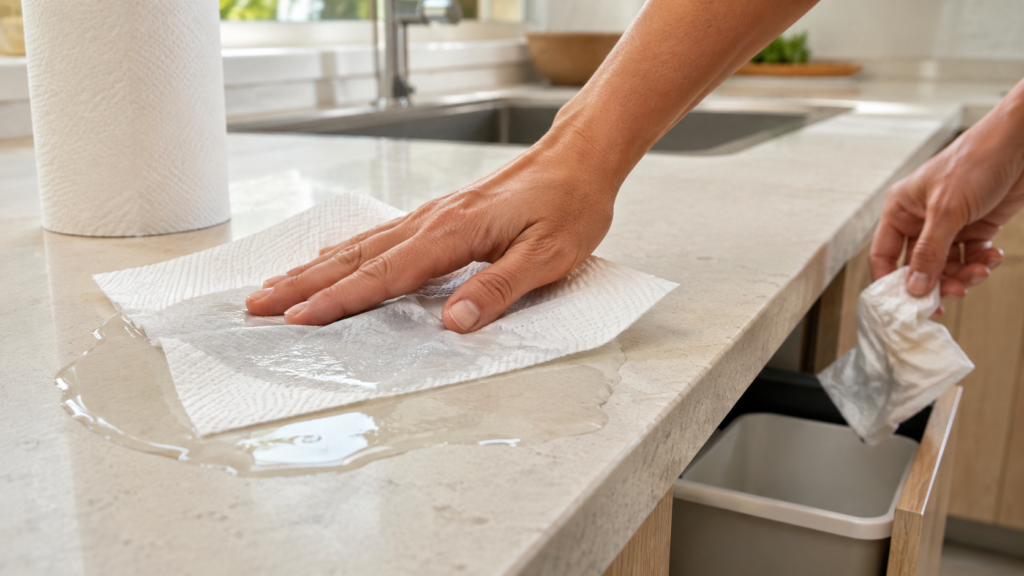
Paper towels are preferred when a task needs rapid uptake, usable wet strength, a fresh single-use surface, and immediate removal of the used sheet. That advantage is context-specific: it fits contained spills and many hygiene-sensitive tasks, but it does not make paper universally faster, cleaner, cheaper, or environmentally better than every reusable cloth.
Finished performance comes from fiber furnish, bonding, creping or through-air drying, embossing, ply design, grammage, and wet-strength engineering. This guide separates absorption time, capacity, wet strength, hygiene, reuse, and disposal so each claim receives the correct test.
2 outputs
ISO absorption test
6 products
2022 wetting study
9–14 g/g
Tested 2024 products
4 options
FDA hand drying provision
Why Are Paper Towels Preferred for Certain Tasks?
Which Paper Towel Tasks Benefit From Single Use?
Paper towels fit tasks where uptake and removal must occur in one short workflow. The FDA Food Code 2022 lists four compliant hand-drying provisions—including individual disposable towels, a clean continuous-towel system, heated air, and an air-knife device. Paper is one validated option, not the only acceptable system.
A fresh sheet avoids the previous-user pathway of a shared cloth and carries absorbed liquid or soil to a bin. For repeated low-risk wiping, a dedicated washable cloth often reduces material throughput when safe laundering and complete drying are available.
| Task | Paper towel advantage | Limit to manage | Decision output |
|---|---|---|---|
| Small water spill | Fast placement, uptake, and removal | Sheet count and saturation | Capacity per sheet |
| Hands in a shared setting | One-user drying surface | Dispenser and bin management | Dryness, access, and hygiene protocol |
| Food or body-fluid cleanup | Removes the used wiping surface | Applicable safety and waste rules | Containment and disposal route |
| Repeated routine wiping | No laundering step | High material use and recurring waste | Paper-versus-reusable comparison |
Tasks involving more demanding wiping also require enough wet integrity to survive repeated contact, which makes how paper towels perform during heavy-duty cleaning a useful next question beyond simple water pickup.
How Do Paper Towels Wet and Store Water?
Which Paper Towel Absorption Properties Need Separate Tests?
Paper towels absorb through surface wetting, liquid spreading, fiber-wall swelling, and storage in connected voids. ISO 12625-8 reports two distinct outputs—water-absorption time and water-absorption capacity—using a basket-immersion method. A fast wetting result never establishes how much water the sheet ultimately retains.
Since rapid wetting and total water retention measure different outcomes, start by examining what determines paper towel absorbency before treating a fast initial pickup as proof of greater overall capacity.
Cellulose presents polar hydroxyl groups that support wetting and hydrogen bonding with water. Most retained liquid occupies the sheet’s fiber network and pore volume, so furnish, bonding, bulk, ply geometry, and compression matter alongside cellulose chemistry.
Rule → Reason → Example: Name the absorption property → time and capacity answer different questions → report “3-second immersion time” separately from “water retained per gram” under the same method.
How Does Manufacturing Make Paper Towels More Absorbent?
Which Paper Towel Structures Create Usable Pore Volume?
Paper towels gain usable pore volume through fiber selection, web formation, creping or through-air drying, embossing, and ply assembly. Bytomski and colleagues tested commercial kitchen tissues with basis weights of 39–56 g/m² and measured 9–14 g of water per gram of fiber; higher values occurred among the tested virgin-fiber and TAD products. Those ranges describe the sample set, not every paper towel.
Dry creping scrapes a dried web from a Yankee cylinder, creating folds, bulk, stretch, and altered bonding. Through-air drying supports a more open three-dimensional sheet while air passes through it; embossing and ply lamination then alter contact, channels, thickness, and wet handling.
How Does Liquid Move Through Paper Towels?
Which Paper Towel Wetting Model Fits a Real Fiber Network?
Paper towels transport liquid through irregular, connected paths rather than identical cylindrical straws. Abedsoltan’s 2022 study examined six products—three conventionally wet-pressed and three through-air-dried—and varied injection flow from 50 to 800 nL/s. The maximum wetted area depended more on the tested sheet and liquid than on that imposed flow range.
The Lucas–Washburn relation gives a useful idealized starting point for a single capillary, but a paper sheet has fiber overlaps, swelling, anisotropy, changing contact angles, and transport in both the plane and thickness direction. Use the equation to understand variables, not to assign a product speed without measured geometry and conditions.
A sheet that wets quickly may still hold less total liquid than another product, making paper towel absorption capacity the next logical measurement when comparing how much water remains after a controlled drain procedure.
Idealized capillary form: L = penetration distance, γ = surface tension, r = capillary radius, θ = contact angle, η = viscosity, and t = time. Real paper requires network-aware measurement.
- Surface chemistry establishes whether the liquid initially wets the fibers.
- Pore connectivity establishes continuous routes through the sheet.
- Grammage and thickness change how much fiber and void space occupy an area.
- Machine and cross directions produce unequal spreading in some products.
How Do Paper Towels Stay Intact When Wet?
Which Paper Towel Strength Measures Predict Wet Handling?
Paper towels stay usable when their wet fiber network resists the pulling and puncturing forces of wiping. ISO 12625-5:2024 defines wet tensile strength after soaking and accommodates two tensile-apparatus orientations, vertical and horizontal. Absorption capacity alone never proves that a saturated sheet will lift a spill without tearing.
Fiber length, bonding, sheet direction, ply attachment, embossing, and wet-strength chemistry all influence integrity. Stronger bonding often competes with softness, bulk, and accessible pore volume, so manufacturers balance strength against absorption rather than maximizing one property in isolation.
Absorption alone is not enough for real cleanup because a saturated sheet must remain usable, so understanding what determines paper towel strength helps explain why some products resist tearing better during wet handling.
| Measure | Question answered | Common confounder |
|---|---|---|
| Wet tensile strength | How much pulling force per width survives after soaking? | Sheet direction and soak procedure |
| Wet burst or puncture | How well does a wet area resist concentrated force? | Probe shape, speed, support and wetting |
| Absorption capacity | How much water remains after a defined drain procedure? | Specimen mass, ply count and compression |
| Lint or fragment release | What material remains on the wiped surface? | Surface type, wetness and wiping force |
When Does Using Paper Towels Improve Hygiene?
Which Paper Towel Hygiene Contexts Justify Single Use?
Paper towels improve hygiene workflow when one-use drying or wiping removes a contaminated surface from circulation. Huang and colleagues’ 2012 review assessed 12 studies published from 1970 through March 2011 and concluded that most favored paper towels for efficient drying, bacterial removal, and lower washroom contamination; the authors also noted major variation among methods and results. The evidence supports a context-specific decision, not an unsupported universal percentage.
The CDC advises patients in healthcare settings to dry with a paper towel if possible and use it on the faucet or door when needed. A fresh sheet is not sterile, and correct washing, dispenser protection, full drying, waste removal, and surface cleaning remain part of the system.
If reuse creates an unacceptable transfer pathway → choose a fresh sheet → discard it through the approved route. If a dedicated cloth is safe for the task → launder and dry it correctly → reduce single-use material consumption.
When Should You Choose Paper Towels Over Cloth?
Which Paper Towel Decision Matrix Avoids a Universal Winner?
Paper towels outperform cloth only when the task weights single use, immediate containment, and disposal above reuse. The Huang review covered 12 hand-drying studies, yet the FDA Food Code still recognizes four drying provisions because performance, hygiene, access, maintenance, and regulation differ by setting. A head-to-head table needs criteria, not invented wicking speeds or blanket risk labels.
Reusable cloth also carries production and laundering impacts, while paper carries pulping, manufacturing, transport, dispenser, and waste impacts. A 2022 Journal of Hospital Infection assessment found reusable cleaning cloths worth considering as an environmentally preferable alternative to single-use surface wipes; the result depends on the system boundary and safe reprocessing.
Single-use convenience also creates a recurring waste stream, so a complete paper-versus-reusable decision should consider the environmental impact of paper towels alongside absorption, hygiene, laundering requirements, and frequency of use.
| Decision factor | Choose paper when | Choose cloth when | Verify |
|---|---|---|---|
| Transfer risk | The wiping surface must leave after one task. | A dedicated cloth remains isolated and reprocessed. | Hygiene protocol and local rules |
| Use frequency | Events are occasional and contained. | Wiping repeats frequently. | Sheets or wash loads per period |
| Wet handling | A fresh sheet meets uptake and strength needs. | Repeated scrubbing or wringing is required. | Capacity, wet strength, lint |
| Infrastructure | A protected dispenser and approved bin exist. | Safe collection, laundering, and drying exist. | Labor, water, energy, storage, waste |
| Environmental goal | Source reduction and responsible disposal are optimized. | High reuse count and efficient laundering are realistic. | Comparable lifecycle boundary |
How Can You Compare Paper Towels at Home?
Which Paper Towel Test Protocol Produces Repeatable Results?
Paper towels produce useful home comparisons when specimen area, dry mass, water, timing, contact, and draining stay constant. ISO 12625-8 deliberately reports two outputs—absorption time and capacity—so a home test must keep them separate. Run three trials and report the median without converting results into a universal pass/fail grade.
Condition every roll in the same room before testing. Compare equal sheet area for task efficiency and also normalize retained water by dry mass so larger or heavier sheets do not win solely because they contain more material.
When comparing rolls at home, controlled testing is more useful than marketing claims, and comparing paper towel brands by absorbency can extend the same equal-area, equal-water, and repeat-trial approach to actual product choices.
- Prepare specimens. Cut or fold equal areas, preserve ply count, label them, and condition them together.
- Record dry mass. Use a scale with enough resolution for the small specimen.
- Compare entry time. Apply one measured water dose to the same sheet location without pressing; record a defined disappearance endpoint.
- Compare capacity. Use the same immersion, contact, lift, and drain procedure; weigh immediately after draining.
- Calculate retained water. Subtract dry mass from wet mass, then report water per specimen and per gram.
- Compare wet handling. Use a separate, equal-water specimen for one standardized lift or wipe; record tearing and lint descriptively.
- Repeat. Run three trials per product and report median results with the complete procedure.
Wet strength should also be considered alongside what the sheet leaves behind, because paper towel lint and fraying during use can affect whether a product is suitable for particular surfaces or cleanup tasks.
| Field | Product A | Product B | Purpose |
|---|---|---|---|
| Area, plies, dry mass | _____ | _____ | Controls material amount |
| Median entry time | _____ | _____ | Compares liquid entry |
| Median water per specimen | _____ | _____ | Compares task-level capacity |
| Median water per gram | _____ | _____ | Normalizes for dry mass |
| Wet handling and lint | _____ | _____ | Records use behavior separately |
How Should You Dispose of Paper Towels?
Which Paper Towel Disposal Route Matches the Used Sheet?
Paper towels need a disposal route based on contamination, product design, and local acceptance. The FTC Green Guides address compostable claims in 16 CFR §260.7, while the EPA identifies only one paper product for flushing: toilet paper, not paper towels. Cellulose biodegradability alone never proves that a used sheet is accepted by a local composting program.
Start with source reduction: use the fewest sheets that complete the task. Then check the manufacturer’s product guidance and the rules of the collection program that will actually receive the waste. Food-soiled, uncoated paper may be accepted by some organics programs; sheets contaminated with cleaning chemicals, grease that a program excludes, bodily fluids, or other hazardous material require the approved trash or regulated-waste route.
Finally, cellulose content does not automatically determine the correct waste route; distinguish when paper towels may actually be compostable from general biodegradability claims, and always follow the rules of the receiving local waste program.
Paper towel disposal checklist: use only what the task needs → identify the contamination → read product instructions → check the receiving program’s rules → place the sheet in the approved stream → never flush it.
What Else Matters About Paper Towels?
Which Paper Towel Questions Need Direct Answers?
Paper towels make more sense when common claims are separated into testable properties and task decisions. ISO 12625-8 uses two absorption outputs rather than one overall score, and the same discipline applies to hygiene, reuse, and disposal. These answers state the useful boundary with each conclusion.
Why are paper towels more absorbent than copy paper?
Paper towels are engineered with a bulky, porous fiber network that wets, spreads, and stores liquid, while copy paper prioritizes a smoother, denser printing surface. Creping, through-air drying, embossing, ply design, furnish, and bonding all alter the finished towel’s absorption behavior.
Are paper towels biodegradable or compostable?
Cellulose fibers biodegrade under suitable biological conditions, but that fact never guarantees every used paper towel belongs in compost. Check the product, coatings, additives, and contamination, then follow the local compost program’s acceptance rules. Chemical-soiled towels generally belong in trash.
Do paper towels eliminate cross-contamination?
No. A single-use sheet removes the reuse pathway associated with a shared cloth, but dispensers, hands, surfaces, storage, and disposal still introduce contamination routes. Paper towels are not inherently sterile. Effective handwashing and correct dispenser and waste-bin management remain essential.
Are paper towels always better than cloth towels?
No universal winner exists. Paper suits contained single-use cleanup and some hygiene-sensitive settings; washable cloth suits repeated low-risk wiping when laundering and drying are controlled. Compare the soil, transfer risk, absorption need, durability, labor, water, energy, waste route, and local rules.
How do I compare paper towel absorption at home?
Condition equal-size specimens together, record dry mass, apply the same water dose, use one contact and drain procedure, and weigh retained water. Run three trials per product and report the median. Keep absorption time separate from absorption capacity.
Which Sources Support This Paper Towels Guide?
How Was the Paper Towel Evidence Checked?
Paper towels were evaluated with primary standards, peer-reviewed studies, and official public guidance instead of anonymous performance figures. The guide uses 14 named sources to distinguish standardized tests, experimental samples, hygiene guidance, disposal requirements, and broader engineering interpretation. Numeric ranges remain attached to the samples or methods that produced them.
- ISO 12625-8 — water-absorption time and capacity by basket immersion
- ISO 12625-5:2024 — wet tensile strength
- Abedsoltan (2022) — liquid absorption in tissue products
- Bytomski et al. (2024) — water absorption of tissue sheets
- BioResources (2024) — dimensional analysis of paper towel absorbency
- BioResources (2024) — paper towel in-use properties
- BioResources review — tissue machine technology and fibers
- Huang et al. (2012) — hand-drying method review
- CDC — hand hygiene in healthcare settings
- FDA Food Code 2022 — hand-drying provisions
- Journal of Hospital Infection (2022) — reusable cleaning cloth assessment
- FTC Green Guides — environmental marketing claims
- EPA — composting as managed biological decomposition
- EPA — flush only toilet paper
How Do You Choose Paper Towels With Confidence?
Which Paper Towel Decision Rule Works Best?
Paper towels are the stronger choice when measured uptake, wet handling, single-use containment, and an approved disposal route match the task. Keep ISO’s two absorption outputs—time and capacity—separate, then add wet strength, lint, hygiene workflow, material use, and end-of-use conditions before deciding.
For a purchase, compare products with the same test rather than accepting a universal absorbency multiplier. For use, take only enough sheets to complete the job. For disposal, follow product instructions and local rules; never treat “cellulose,” “biodegradable,” or “compostable” as permission by itself.
Final paper towel checklist: define the task → compare absorption time and capacity → verify wet strength and lint → decide whether single use solves a real transfer problem → minimize sheet count → confirm the disposal route.