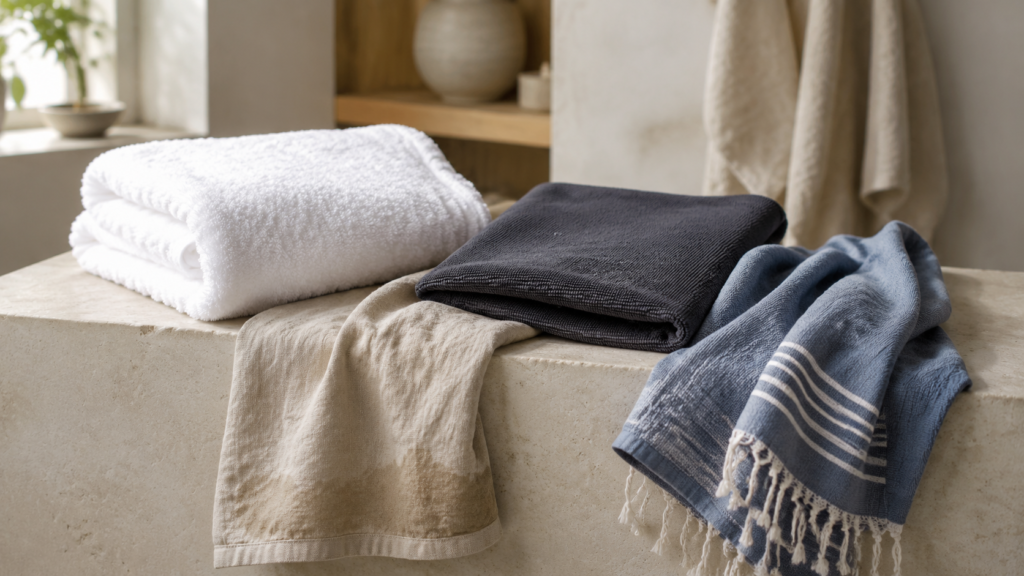
TowelDaily Research Brief
How Do Towel Types Compare?
Absorbency, Softness, Drying Time, and Durability
Towel types differ because fiber content, yarn structure, fabric construction, dimensions, mass, finishing, and laundering work as one system. A geographic cotton name, a twistless yarn, a waffle weave, and a peshtemal describe different layers of that system, so none supplies a complete performance ranking by itself.
This guide separates absorbency speed, holding capacity, fabric hand, drying time, and durability before comparing finished towels. The task is to match a verified construction to a bathroom, travel bag, gym routine, climate, or skin preference without relying on unsupported 1–10 scores or one universal winner.
How Do Towel Types Differ Across Four Performance Metrics?
Which Towel Type Tests Separate Absorbency, Softness, Drying, and Durability?
Towel types need separate measurements because one result never proves all four attributes. AATCC’s 2026 Moisture Management proficiency program lists nine distinct procedures for absorbency, moisture management, vertical or horizontal wicking, drying, and water-vapor transmission; AATCC EP5-2025 separately standardizes the conditions for evaluating fabric hand.
Micro-glossary — performance endpoint: the exact outcome and stopping rule used in a test, such as complete droplet disappearance, retained water mass, or a defined dry state. The unique insight is methodological: “absorbent” and “quick-dry” remain incomplete claims until the endpoint and specimen conditions are named.
How Is Towel Type Absorbency Measured?
AATCC TM79 addresses absorbency, while ASTM D4772-26 addresses rapid surface-water absorption and retention in terry fabric. Wicking speed and total holding capacity require different procedures.
How Is Towel Type Softness Measured?
AATCC EP5 controls subjective hand evaluation. ASTM D1388-23 adds two stiffness procedures—the cantilever and heart-loop methods—without converting softness into a universal product score.
How Is Towel Type Drying Measured?
AATCC distinguishes moisture-analyzer drying, air-flow drying at absorbent capacity, and heated-plate drying. Temperature, humidity, airflow, specimen size, and starting water load belong in every comparison.
How Is Towel Type Durability Measured?
Durability combines strength, abrasion, dimensional change, loop security, colorfastness, and appearance after specified laundering. A wash count alone never states the failure criterion.
Separate endpoints establish the comparison rules. The next section identifies what each familiar towel label actually describes before applying those rules.
How Do Fiber, Yarn, Weave, and Format Define Towel Types?
Which Towel Type Categories Prevent Misleading Comparisons?
Towel types belong to four classification layers: fiber identity or origin, yarn construction, fabric surface or weave, and finished-product format. The U.S. Textile Products Identification Act separately defines fiber, yarn, fabric, and household textile articles, which confirms why “Egyptian cotton,” “twistless,” “waffle,” and “peshtemal” never function as interchangeable material names.
Micro-glossary — classification layer: the level of textile construction described by a label. A towel often combines several layers—for example, cotton fiber, twistless pile yarn, terry fabric, and bath-towel dimensions—so performance comes from the combined specification rather than one term.
What Defines Egyptian Cotton Towel Types?
Egyptian cotton is a claimed fiber origin, not a weave, pile height, GSM, or absorbency result. The Egyptian Cotton Association uses accreditation and genomic testing to verify origin; the finished towel still needs fiber percentage, yarn, construction, dimensions, finish, and performance evidence.
What Defines Turkish Cotton Towel Types?
Turkish cotton is a geographic cotton claim, while “made in Türkiye” identifies processing or manufacturing origin. Neither phrase fixes staple length, loop geometry, fabric mass, finish, or drying time, so the label and finished specification control the comparison.
What Defines Pima and Supima Towel Types?
Pima describes an extra-long-staple cotton class, while Supima is a trademark for American-grown Pima cotton. A 2021 USDA-ARS paper reports Pima fiber lengths of 31.8–50.8 mm versus 22.4–33.3 mm for upland genotypes; those fiber ranges support yarn potential, not a guaranteed finished-towel score.
What Defines Twistless Cotton Towel Types?
Twistless describes a pile-yarn system rather than a cotton species. In Sekerden’s 2015 set of 15 towels, twistless pile produced greater absorptive capacity and lower flexural rigidity but longer absorbency time than twisted pile, which separates capacity from pickup speed.
What Defines Bamboo-Derived Towel Types?
Most soft towels marketed with “bamboo” use rayon, viscose, or lyocell whose cellulose source was bamboo. The Federal Trade Commission states that the generic manufactured-fiber name must appear unless the product contains fiber made directly from bamboo; source plant, process, and finished performance remain separate claims.
What Defines Microfiber Towel Types?
Microfiber describes fine manufactured fibers and never identifies one chemistry or surface construction. A product might use polyester, polyamide, a blend, split filaments, loops, suede-like knit, or waffle texture, so fiber percentages, dimensions, fabric mass, finish, and a drying protocol deserve inspection.
What Defines Linen Towel Types?
Linen identifies fabric made from flax fiber, while the towel surface might be flat-woven, waffle, or blended. Linen’s familiar crisp hand and low-bulk designs differ from plush terry, yet blend percentage, fabric mass, weave openness, and laundering determine the finished result.
What Defines Peshtemal Towel Types?
Peshtemal describes a lightweight, usually flat-woven towel format associated with Turkish bathing traditions. The format targets packability and airflow rather than raised terry pile, but fiber content, weave tightness, dimensions, fringe construction, and retained water load still change drying and durability.
What Defines Waffle-Weave Towel Types?
Waffle describes a cellular fabric structure rather than a fiber. Recessed cells increase textured surface and preserve air spaces, while cotton, linen, regenerated cellulose, synthetic content, GSM, cell size, and finishing determine whether a specific waffle towel feels crisp, soft, light, or slow to dry.
Correct classification prevents category errors. The next section compares each label through the same finished-product questions instead of assigning source-free numerical scores.
How Do Towel Types Compare Under Equal Test Conditions?
Which Towel Type Comparison Matrix Avoids Unsupported Scores?
Towel types compare reliably when every claim stays attached to a construction and test endpoint. Sekerden’s 2015 experiment tested 15 specified cotton towels and found that twistless pile increased capacity and lowered flexural rigidity but lengthened absorbency time relative to twisted pile, proving that one “absorbency” score hides opposing results.
Micro-glossary — evidence boundary: the sample, method, condition, and outcome that limit a finding. The matrix below reports what each label describes, its usual design target, its main uncertainty, and the evidence a shopper needs; it never assigns invented coordinates or universal winners.
| Towel Type Label | What It Describes | Common Design Target | Main Uncertainty | What to Verify |
|---|---|---|---|---|
| Egyptian cotton | Claimed cotton origin | Fine or strong cotton yarn potential | Origin never states pile, GSM, finish, or performance | Accreditation, fiber percentage, construction, named tests |
| Turkish cotton | Geographic cotton claim | Cotton towels across terry and flat-woven formats | No universal staple length, mass, or loop geometry | Fiber label, manufacturing origin, dimensions, construction |
| Pima / Supima | Extra-long-staple cotton class / trademark | Fine, uniform, strong yarn potential | Fiber quality never fixes finished uptake or drying | Trademark status, percentage, pile system, equal-condition tests |
| Twistless cotton | Pile-yarn construction | Low rigidity, bulk, and capacity | Pickup speed and wash durability vary by build | Capacity, absorbency time, shedding, laundering results |
| Rayon / lyocell made from bamboo | Manufactured regenerated cellulosic fiber | Smooth hand and moisture interaction | Process, blend, finish, and wet strength differ | Correct generic name, percentage, process claim, wash test |
| Microfiber | Fine-fiber product description | Low bulk, transport, and packability | Polyester/polyamide blend and surface vary | Fiber percentages, dimensions, fabric mass, drying method |
| Linen | Flax-fiber textile | Crisp hand, low bulk, and open constructions | Blend and weave control softness and capacity | Flax percentage, weave, dimensions, laundering change |
| Peshtemal | Flat-woven towel format | Packability and airflow | Thinness never guarantees equal water capacity | Fiber, weight, dimensions, fringe, drying result |
| Waffle weave | Cellular fabric structure | Texture and preserved air spaces | Fiber, cell depth, and GSM alter every outcome | Fiber, GSM, cell construction, uptake and drying tests |
A bounded matrix supports selection without pretending that every product under one label performs alike. GSM is the next variable to isolate because shoppers often mistake mass for density or quality.
What Does GSM Reveal About Towel Types?
Which Towel Type Conclusions Does GSM Support?
Towel types use GSM to report fabric mass per unit area, not density, quality, softness, uptake speed, capacity, durability, or drying time. ASTM D3776/D3776M-20(2025) defines four approved measurement options—full piece, full-width sample, small swatch, and narrow fabric—so the number remains meaningful only with the applicable sampling method.
Micro-glossary — GSM: grams per square metre of fabric. The unique insight is arithmetic: a 70 × 140 cm rectangle covers 0.98 m², which gives about 392 g at 400 GSM, 588 g at 600 GSM, and 784 g at 800 GSM before product-specific hems, borders, conditioning, and measurement differences.
| GSM Statement | Supported Conclusion | Missing Evidence |
|---|---|---|
| 400 GSM versus 600 GSM | The second fabric has 50% more mass per equal area | Fiber, pile access, softness, capacity, and drying result |
| Same GSM, different dimensions | The larger towel contains more total fabric mass | Equal water load and equal-condition drying performance |
| Same GSM, different constructions | The fabrics share mass per unit area | Loop height, twist, pore access, weave, finish, and hand |
| Higher GSM | More fabric mass occupies each square metre | No automatic “luxury,” absorbency, or durability rank |
GSM narrows weight preferences without choosing the towel. The intended location, water load, available drying time, and tactile preference supply the next decision layer.
How Do Towel Types Match Bathrooms, Travel, Gyms, and Hot Climates?
Which Towel Type Selection Rule Fits Each Use Case?
Towel types fit a use case when the construction meets its water load, storage space, tactile preference, wash routine, and drying environment. AATCC’s 2026 program lists three distinct drying procedures—TM199, TM200, and TM201—which shows why “dries by morning” requires defined temperature, humidity, airflow, starting moisture, specimen size, and endpoint.
Micro-glossary — task match: the alignment between a finished towel’s measured attributes and the conditions of use. The useful question is never “Which fiber wins?” but “Which tested construction handles this water load and reaches the required dry state in this environment?”
Which Towel Types Fit Daily Bathrooms?
Start with the desired fabric hand and water capacity. Terry pile often targets surface pickup and a cushioned feel; ventilation, hanging area, towel dimensions, and the measured drying endpoint determine whether the finished product fits the room.
Which Towel Types Fit Travel and Gyms?
Prioritize folded volume, total product mass, drying conditions, and storage hygiene. Lightweight microfiber, peshtemal, and compact waffle constructions form useful candidates, while equal-size and equal-water-load tests decide among actual products.
Which Towel Types Fit Humid or Hot Climates?
Prioritize lower retained water, open hanging, air movement, and a verified drying result. Lower mass and open construction often reduce the evaporation burden, while a large towel or heavy water load still lengthens the cycle.
Which Towel Types Fit a Low-Friction Preference?
Compare fabric hand, surface roughness, finishing, fragrance, and wash change rather than assuming one fiber is hypoallergenic. AATCC EP5 evaluation and repeated-laundering samples reveal more than an unverified “sensitive skin” label.
A task-matched towel still changes after laundering. Care therefore belongs inside the performance comparison rather than after it.
How Does Care Preserve Different Towel Types?
Which Laundry Habits Protect Towel Type Performance?
Towel types retain their intended hand and water response when laundering follows the product label, detergent directions, load capacity, and material limits. For stiffness linked specifically to powder detergent and hard-water residue, the American Cleaning Institute gives a separate soak of 1 cup (240 mL) white vinegar in 1 gallon (3.8 L) warm water, followed by rinsing.
Micro-glossary — redeposition: loosened soil or laundry residue settling back onto a textile surface. Correct product dose, sufficient movement, complete rinsing, and full drying address redeposition more precisely than a fixed tablespoon dose, automatic extra rinse, universal heat setting, or calendar-based stripping routine.
✓ Towel Types: Care Checklist
- ☐ The product label sets the permitted wash, bleach, and drying conditions.
- ☐ The detergent dose reflects concentration, load size, soil level, and water hardness.
- ☐ Open washer space supports water movement and complete rinsing.
- ☐ A label-permitted drying setting reaches a fully dry state without unnecessary heat.
- ☐ Separate before-and-after tests identify changes in wetting, hand, dimensions, or lint.
- ☐ A diagnosed residue receives a measured, chemically compatible treatment.
✗ Towel Types: Unsupported Shortcuts
- ☐ A first wash never proves that every new towel contains “production oils.”
- ☐ One detergent quantity never fits every formula, machine, load, and water supply.
- ☐ One low-heat instruction never overrides a product-specific care label.
- ☐ A softer hand after conditioner never proves faster wetting or greater capacity.
- ☐ A stripping calendar treats towels without first identifying the residue.
- ☐ Mixing chlorine bleach with vinegar or ammonia releases hazardous gases.
Conventional softener deposition often lowers friction while slowing cotton wetting, but chemistry and dose matter. Igarashi and Nakamura’s 2021 cotton study treated wiping efficacy as a multivariable outcome rather than a universal percentage loss; product-specific evidence remains essential.
Care preserves performance only when the diagnosis and method match. The same requirement for precise labels applies at purchase.
Which Labels Help Verify Different Towel Types?
Which Towel Type Claims Require Extra Proof?
Towel types sold in the United States need labels that identify fiber content, country of origin, and the responsible company name or FTC Registered Identification Number. The Textile Products Identification Act generally requires generic names for fibers present at 5% or more by weight, which makes the sewn-in fiber disclosure more useful than a front-of-package adjective.
Micro-glossary — generic fiber name: the recognized identity used for labeling, such as cotton, rayon, lyocell, polyester, polyamide, or flax. A trademark, geographic adjective, source-plant phrase, weave name, or marketing term never replaces the generic fiber content and percentage.
| Claim | Reliable Evidence | What the Evidence Does Not Prove |
|---|---|---|
| Egyptian cotton | Fiber percentage plus Egyptian Cotton Association accreditation or traceability evidence | Finished softness, absorbency, GSM, or durability |
| Supima | Authorized Supima trademark claim plus stated fiber percentage | Pile design, finish, drying time, or wash life |
| Bamboo | Correct label such as rayon or lyocell made from bamboo | Automatic sustainability, antimicrobial action, or biodegradability |
| Turkish cotton | Fiber-content disclosure and separate country-of-manufacture statement | A universal cotton variety, staple length, or construction |
| Quick-dry / highly absorbent | Named method, specimen dimensions, conditions, endpoint, and comparative result | Performance under a different water load, climate, or towel size |
Verified identity establishes what the towel contains. FAQ answers next convert the identity and testing rules into short shopping decisions.
What Else Must Shoppers Know About Towel Types?
Which Towel Type Questions Need Direct Answers?
Towel types need answers that preserve method scope. ASTM D4772-26 excludes five non-terry categories—huck, waffle weave, crash, flour sack, and nonwoven—from its terry surface-water method, while the FTC’s 5% fiber-label threshold addresses identity rather than performance; one result never transfers automatically across every towel structure.
Micro-glossary — method scope: the materials, apparatus, conditions, and outcomes covered by a test. Scope prevents a terry result from becoming a waffle, peshtemal, linen, or microfiber result without a suitable method and directly comparable specimens.
What is the most absorbent towel material?
No fiber name guarantees the highest absorbency. Finished capacity depends on fiber content, pile mass, yarn twist, loop geometry, finish, dimensions, and the test protocol. Compare equal-size towels with a disclosed capacity method instead of treating Egyptian cotton, lyocell, or microfiber as an automatic winner.
Which type of towel dries fastest?
No towel type owns one universal drying time. Low fabric mass, open construction, small dimensions, strong airflow, low humidity, and a smaller retained water load usually shorten drying. Compare finished towels under equal temperature, humidity, airflow, dimensions, initial water load, and endpoint criteria.
What does GSM mean for towels?
GSM means grams per square metre and reports fabric mass per unit area. It does not directly measure density, softness, absorbency speed, holding capacity, durability, or drying time. Use GSM to estimate fabric mass, then compare construction and named performance tests separately.
Are microfiber towels better than cotton towels?
Neither towel type is universally better. Lightweight microfiber often targets low bulk and moisture transport, while cotton terry often targets a looped hand and higher fabric mass. Compare fiber percentages, dimensions, surface construction, water load, drying conditions, wash durability, and skin feel for the intended task.
Are bamboo towels made from natural bamboo fiber?
Most soft products marketed as bamboo towels use regenerated rayon, viscose, or lyocell whose cellulose source was bamboo. The FTC permits a direct bamboo-fiber claim only for fiber made directly from bamboo; otherwise, the label must state the correct manufactured-fiber name.
The direct answers resolve common comparisons without collapsing separate performance stages. The methodology below lists every authority used for classification, testing, labeling, and care.
Which Sources Support This Guide to Towel Types?
How Was the Towel Type Evidence Checked?
Towel types in this guide were checked against 15 named standards, peer-reviewed papers, government records, identity programs, and care authorities. Every quantitative statement remains attached to its specimen, method, label rule, or safety condition, and neither SVG represents independent TowelDaily laboratory data.
Micro-glossary — source hierarchy: the order used to select evidence for a claim. Standards and regulators define methods and labels; controlled studies test bounded constructions; identity programs verify protected or accredited names; care authorities supply measured troubleshooting and safety instructions.
- ASTM International, D4772-26 — defines rapid surface-water absorption and retention for terry fabric and identifies excluded structures.
- ASTM International, D3776/D3776M-20(2025) — defines fabric mass per unit area and four sampling options.
- ASTM International, D1388-23 — defines cantilever and heart-loop stiffness procedures.
- AATCC EP5-2025 — standardizes fabric-hand evaluation conditions and constituent elements.
- AATCC 2026 Proficiency Testing Program — lists separate absorbency, wicking, drying, moisture-management, and water-vapor procedures.
- Jamshaid et al., Scientific Reports, 2025 — reports linked effects of construction and weft density across four woven cotton-terry samples.
- Sekerden, Journal of Engineered Fibers and Fabrics, 2015 — compares capacity, absorbency time, and flexural rigidity across 15 twisted and twistless towels.
- Igarashi and Nakamura, Journal of Oleo Science, 2021 — analyzes softener-treated cotton, wetting, and wiping efficacy as a multivariable outcome.
- Holladay et al., USDA-ARS/Crop Science, 2021 — reports Pima and upland cotton fiber-length ranges.
- Federal Trade Commission, Textile Products Identification Act — defines textile layers and requires fiber, origin, and responsible-company identification.
- Federal Trade Commission, Bamboo Textiles — distinguishes direct bamboo fiber from rayon, viscose, or lyocell made from bamboo.
- Supima FAQ — identifies Supima as the trademark for American-grown extra-long-staple Pima cotton.
- Egyptian Cotton Association — describes accreditation, traceability, and genomic verification for Egyptian Cotton claims.
- American Cleaning Institute, Laundering Problems & Solutions — gives a measured response for powder-detergent and hard-water residue.
- CDC, Morbidity and Mortality Weekly Report, 2020 — warns against mixing bleach with vinegar or ammonia.
Evidence and source links reviewed August 11, 2026. Both SVG figures are original TowelDaily explanatory assets that summarize the cited taxonomy and decision method.
The evidence supports one final rule: compare identity, construction, and each performance endpoint separately.
How Do You Choose Towel Types With Confidence?
Which Towel Type Decision Rule Works Best?
Towel types deserve separate evidence for identity, fabric hand, surface uptake, holding capacity, drying, and wash durability. The 15-towel Sekerden experiment summarized earlier captures the reason: twistless pile improved capacity and lowered flexural rigidity while producing longer absorbency time within the tested constructions.
Micro-glossary — finished specification: the combined fiber percentages, yarn system, fabric structure, dimensions, GSM, finish, care instructions, and named test results for the product sold. That specification carries more decision value than a geographic name, trademark, weave, or “premium” adjective alone.
Key Takeaways for Towel Types
- ☐ Classify the label as fiber, yarn, fabric structure, or product format.
- ☐ Compare absorbency speed, capacity, hand, drying, and durability as separate endpoints.
- ☐ Read GSM as fabric mass per unit area rather than density or quality.
- ☐ Match equal dimensions, water loads, environments, laundering, and test methods.
- ☐ Verify fiber percentages, identity claims, finish, care instructions, and evidence limits.