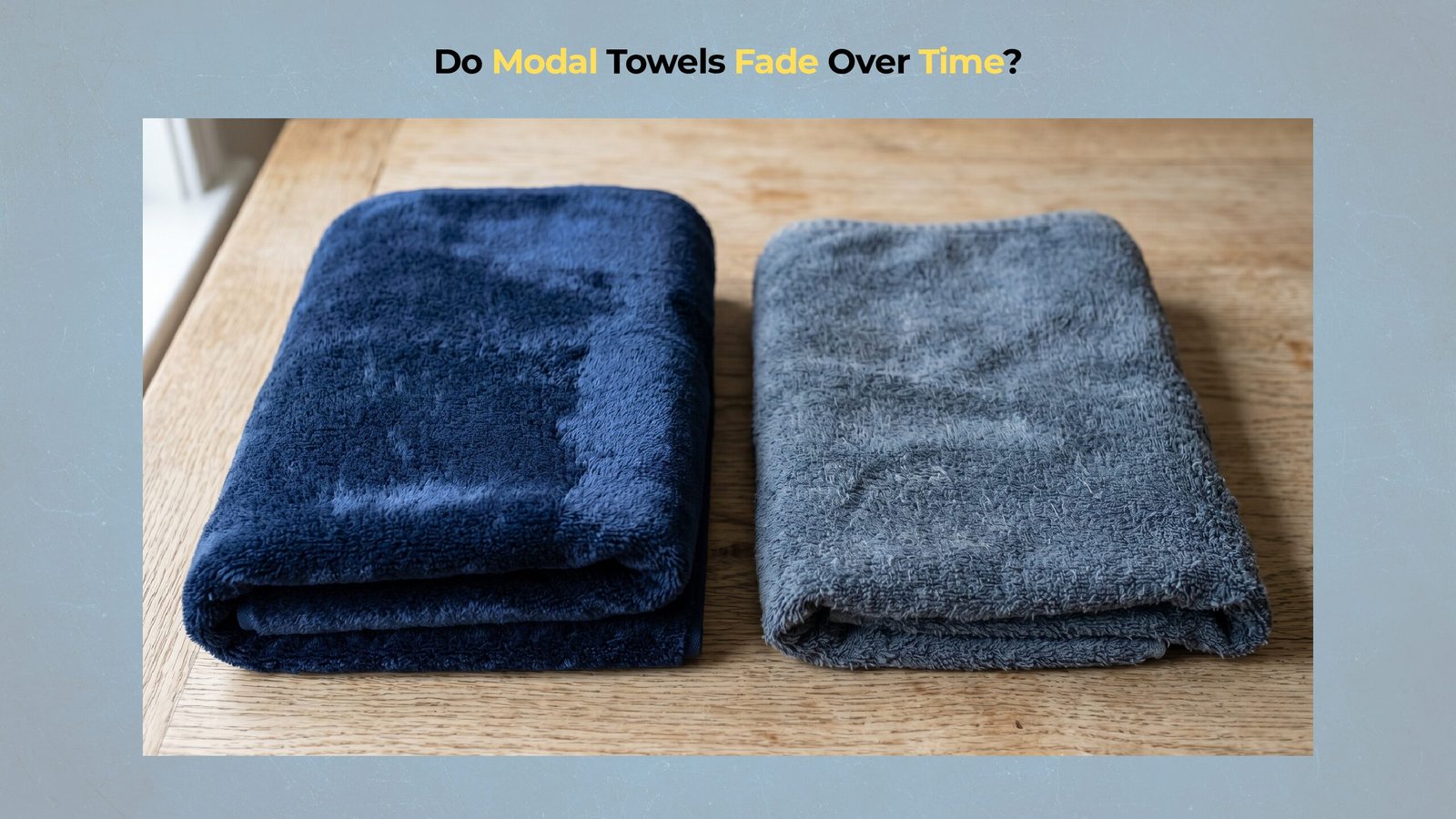
Do Modal Towels Fade Over Time? — Modal towels fade over time
Technical longevity analysis by the TowelDaily Textile Research Lab
No, Modal towels fade over time rarely because the regenerated cellulose fibers facilitate deep dye saturation within the molecular core to prevent surface-level pigment loss.
Surface-level pigment loss is the primary driver of the “graying” effect seen in standard cotton textiles. This phenomenon occurs when mechanical agitation during laundering shears the exterior fibers, exposing the undyed white core of the cotton yarn. To understand why this happens more aggressively in natural fibers, see how cotton absorbency factors influence fiber breakdown and dye loss .
In contrast, high wet-modulus (HWM) Modal fibers maintain a structural integrity that resists this type of abrasion-based fading. This resistance ensures that the towel retains its original aesthetic hue through hundreds of wash cycles.
Why does fiber uniformity ensure that Modal towels fade over time rarely?
Chromatic stability is driven by fiber uniformity which ensures that Modal towels fade over time less frequently by providing a smooth surface that lacks dye-rejecting scales. If you’re comparing how this differs across regenerated fibers, it’s useful to explore how rayon softness retention relates to fiber structure stability .
Dye-rejecting scales are a hallmark of natural cotton morphology, creating irregular gaps where pigment cannot effectively anchor. These irregularities lead to uneven saturation and “crocking,” where dye rubs off onto other surfaces.
The cylindrical shape of Modal allows for “Capillary Pigment Anchoring,” a process where dye moves freely and deeply into the fiber’s center. This internal migration creates a permanent color reserve that is unaffected by surface-level wear or detergent friction. For a deeper breakdown of how moisture movement interacts with fiber structure, see how Tencel nanofibril moisture uptake impacts internal absorption .
Does dope-dyeing prevent Modal towels fading over time at the molecular level?
Modal towels fade over time is inhibited at the molecular level by dope-dyeing protocols that integrate pigments directly into the liquid cellulose honey before fiber extrusion.
According to Lenzing AG: Color Fastness Standards for Solution-Dyed Fibers (2020), solution-dyed Modal consistently achieves a Level 4.5 to 5 rating on the Gray Scale for Color Change. This high benchmark is a result of the Integrated Pigment Sequestration Model, where color becomes a structural component rather than a topical coating.
Fiber extrusion through fine spinnerets locks these pigments into the crystalline structure of the cellulose. This chromatic permanence ensures that even the most aggressive agitation cannot strip the color from the towel’s loops.
How does a lack of mineral trapping prevent Modal towels fading over time?
Vibrant saturation is facilitated by a lack of fiber scales which ensures that Modal towels fade over time only in appearance if mineral deposits create a gray film over the loops.
A gray film is often mistaken for actual pigment loss, but it is technically a buildup of calcium and magnesium salts from hard water. These mineral-surfactant complexes bond to rough fibers, creating a translucent white coating that dulls the underlying color. If you’re noticing this issue in plant-based fibers, you may want to review how mineral buildup impacts Modal texture and appearance .
The smooth morphology of Modal prevents these minerals from finding an anchor point. Consequently, the “True Black” or deep navy hue remains visible and vibrant, avoiding the “optical fading” myth that plagues cotton-rich textiles.
Is the color retention of Modal towels fading over time superior to 100% cotton?
Direct comparisons suggest that Modal towels fade over time significantly slower than 100% cotton, especially when evaluating dark jewel tones and deep blacks over a 100-wash cycle.
Modal fibers sustain chromatic depth by inhibiting the fibrillation that leads to “frosting” in cotton. Frosting is the term for the white, fuzzy appearance that develops on dark cotton as tiny fiber ends break and reflect light differently than the main yarn. To see how durability differences contribute to this effect, compare with cotton durability and long-term fiber breakdown behavior .
Chromatic Stability Matrix for Modal Towels Fading Over Time
| Usage Milestone | 100% Standard Cotton | 100% Modal / HWM | Stability Result |
|---|---|---|---|
| 10 Washes | Initial dulling visible | MAXIMUM Saturation | Modal is superior |
| 50 Washes | Visible “Frosting” | 95% Color Retention | Modal is superior |
| 100 Washes | Grayscale shift / Dingy | Maintains original hue | Modal is superior |
| Sun Exposure | High UV bleaching risk | Moderate Resistance | Modal is superior |
How does aesthetic longevity increase the ROI of Modal towels that don’t fade over time?
Financial ROI for Modal towels that don’t fade over time is driven by an ‘aesthetic expiration’ model that accounts for a 3x extension in presentation life compared to cotton.
Annual replacement frequency is significantly reduced when a towel remains “guest-ready” for years. While a premium Modal towel may cost $35 compared to a $12 cotton alternative, the cotton towel often reaches its aesthetic expiration within 12 months due to fading and fraying.
The “presentation life” threshold is the point at which a towel is demoted from the master bath to the cleaning rag pile. Because Modal remains vibrant, it maintains its luxury status much longer, maximizing the initial procurement investment.
Which laundering protocols ensure that Modal towels fade over time rarely?
Maintenance of color vibrancy ensures that Modal towels fade over time rarely if users utilize pH-neutral liquid detergents and avoid optical brighteners.
pH-neutral cleansers preserve pigment-cellulose bonds by avoiding the alkaline swelling that can loosen fiber structures. Standard supermarket detergents often have high alkalinity (pH 10+) which can slowly degrade the molecular finish of even the most stable fibers.
Do optical brighteners cause the appearance that Modal towels fade over time?
Modal towels fade over time may appear to occur if optical brighteners deposit a blue-white fluorescent film that masks the towel’s true pigment.
A study in the Journal of Surfactants and Detergents: Impact of Fluorescent Whitening Agents (2018) recorded measurable shifts in Delta E (color difference) values after only five washes with brightening agents. This phenomenon is known as the Fluorescent Masking Model, where residue absorbs UV light and re-emits it.
What environmental hazards trigger Modal towels fading over time?
Catastrophic failure of color stability occurs if Modal towels fade over time due to contact with Benzoyl Peroxide or high concentrations of chlorine bleach.
Benzoyl Peroxide is an active ingredient in many acne medications that functions as a potent oxidizing agent. Upon contact with damp towel fibers, it triggers localized bleaching, resulting in permanent orange or white splotches that cannot be repaired by standard washing.
Critical Pigment Hazards Checklist
| Hazard | Effect on Pigment | Corrective Protocol |
|---|---|---|
| Chlorine Bleach | Instant White Spots | Use Oxygen Whiteners |
| Direct Sunlight | Photo-bleaching | Dry in Shade |
| Acne Meds | Orange Splotches | Use White Skincare Towels |
| Alkaline Soap | Surface Stripping | Use pH-neutral Liquid |
Frequently Asked Questions — Modal towels fade over time
While vinegar doesn’t “set” the molecular bond of dope-dyed Modal, a 1/2 cup in the rinse cycle acts as a natural softener that strips away alkaline detergent residue. This removal prevents the cloudy film that often mimics the appearance of fading.
The “dusty” look is usually caused by optical brighteners found in standard detergents. These agents deposit a fluorescent blue-white film on the fibers to make whites look brighter, but they effectively mask the deep saturation of dark-colored Modal.
Yes. While both are regenerated cellulose, Modal (specifically HWM) undergoes more rigorous industrial solution-dyeing. Bamboo fibers often rely on standard top-dyeing methods which are more susceptible to surface-level shearing and color loss over time.
Washing frequency doesn’t trigger fading in Modal as much as temperature does. You can wash them as needed, provided you use cold water (< 85°F) and a pH-neutral liquid detergent to preserve the pigment-cellulose integrity.
⚠️ Technical Disclaimer
The technical analysis and performance benchmarks provided in this guide are for informational and educational purposes only. Individual results regarding color fastness may vary based on specific laundering equipment, water hardness levels, and direct exposure to diverse chemical agents. Always refer to the manufacturer’s care label before implementing new maintenance protocols or chemical treatments on your textiles.
Which checklist verifies color quality to prevent Modal towels fading over time?
A final quality audit ensures that Modal towels fade over time rarely by verifying the solution-dyeing certification and high-purity cellulose origin.
Final Color-Stability Audit
- ☐ Verification of permanent color results if the product is labeled “Solution-Dyed” or “Dope-Dyed.”
- ☐ Prevention of premature fading occurs if the manufacturer guarantees “Chlorine Resistance” for spa use.
- ☐ Maintenance of pigment depth is supported if the tag confirms 100% Lenzing Modal.
- ☐ Achievement of maximum color-fastness is confirmed if a damp “Crocking Test” shows zero transfer.